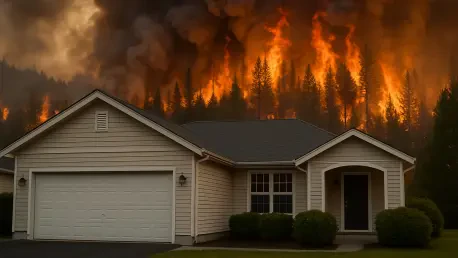

The intensifying frequency of extreme heat waves across the Great Basin has fundamentally altered the risk profile for residential properties that were once considered safe from the reaching flames of wilderness fires. As 2026 progresses, Nevada homeowners are finding themselves at the epicenter of a tightening insurance market where the traditional boundaries of fire danger have dissolved. Major national carriers have increasingly utilized sophisticated predictive algorithms to reassess the vulnerability of the wildland-urban interface, leading to a cascade of non-renewal notices in neighborhoods that previously enjoyed stable premiums. This trend is particularly evident in the outskirts of the Las Vegas Valley and the foothills surrounding Reno, where the proximity of dry brush and invasive cheatgrass has transformed suburban aesthetics into high-stakes liabilities. Consequently, the dream of desert living is now overshadowed by the reality of finding affordable coverage, as the private market retreats from areas deemed too volatile for traditional underwriting models.
Data-Driven Modeling: The Evolution of Risk Assessment
Modern insurance underwriting has transitioned from broad geographical generalizations to highly specific, property-level analysis fueled by high-resolution satellite imagery and advanced LIDAR technology. Insurers now employ artificial intelligence platforms like ZestyAI and Kettle to scrutinize the exact distance between a home’s eaves and the nearest flammable vegetation, effectively turning every residential parcel into a data point for catastrophe modeling. This shift means that a single untrimmed juniper tree or a wooden deck can trigger an automatic denial in a computer-generated risk report, regardless of the homeowner’s long-term claim history. Building on this technological foundation, companies are able to project fire behavior with uncanny accuracy, accounting for wind tunnels and topographical inclines that were ignored in previous decades. The result is a landscape where the algorithm holds more sway than the local insurance agent, leaving many residents in a state of financial uncertainty as their primary asset becomes difficult to insure.
This granular approach to risk has created a stark divide between properties that meet new hardened standards and those that remain stuck in older building paradigms. Transitioning from traditional cedar shingles to ember-resistant roofing materials has become a prerequisite for even obtaining a quote in the current fiscal climate. Moreover, the sheer volume of data processed by these insurance tech firms allows them to simulate thousands of wildfire scenarios per second, identifying vulnerabilities in the urban core that were previously dismissed. This level of scrutiny has forced a rapid evolution in how local municipalities approach urban planning and landscaping requirements. The integration of climate data into real-time insurance pricing has essentially ended the era of static premiums, replacing it with a dynamic system that reacts to seasonal droughts and vegetation density. For the average Nevadan, this means that maintaining a property is no longer just about aesthetics, but about satisfying the rigorous, invisible requirements of a globalized digital risk market.
The situation necessitated a fundamental shift in how residents perceived the relationship between their homes and the surrounding desert environment. Homeowners who proactively invested in ember-resistant vents and replaced flammable landscaping with rock-based xeriscaping successfully maintained their coverage and even secured modest discounts from some carriers. This proactive approach required a significant upfront investment, but it proved to be the most effective way to navigate the volatility of the 2026 insurance market. Furthermore, the collaboration between state regulators and technology providers eventually fostered a more predictable environment for both insurers and the insured. Residents were encouraged to seek professional wildfire risk assessments and to petition their local governments for better vegetation management in public spaces. By taking these concrete steps, Nevadans mitigated the immediate threat of displacement and established a more resilient framework for urban living. The lessons learned provided a clear roadmap for other Western states.