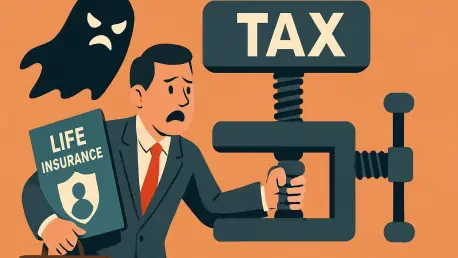

When the total balance of a policy loan equals the accumulated cash value, the contract expires and the resulting debt cancellation is taxed as ordinary income rather than capital gains. This specific accounting mechanism often catches senior citizens off guard, turning what was once a financial cushion into a significant tax liability that consumes liquid savings during retirement. For individuals like Carol, a 71-year-old policyholder, the discovery that a small loan taken decades ago has quietly ballooned into a massive debt is a common yet devastating scenario. As interest accumulates over the years, the gap between the loan balance and the cash value narrows until the policy enters a death spiral. By the time the insurance carrier sends a formal notice, the internal mechanics have often already initiated a collapse that cannot be easily reversed without a cash infusion. Many retirees believe their old whole life insurance policies are safe, dormant assets that provide a permanent safety net without requiring active management.
Compounding Interest: The Engine of Policy Erosion
Whole life insurance policies are designed to accumulate cash value over time, serving as an internal savings component that policyholders can access through loans. These loans are frequently marketed as convenient because they do not require credit checks or a fixed repayment schedule, allowing individuals to navigate temporary financial hardships with ease. However, the flexibility of these loans is often a double-edged sword because the insurance company continues to charge interest on the outstanding balance. If this interest is not paid out of pocket annually, it is added to the principal balance of the loan, leading to a compounding effect that accelerates over several years. In the current economic climate of 2026, the speed at which debt grows can surprise even the most diligent savers. The loan eventually becomes a parasitic force within the contract, slowly draining the very equity that was meant to sustain the policy’s longevity and eventual death benefit.
The Internal Revenue Service does not view the termination of a policy with an outstanding loan as a neutral event; rather, it considers the forgiven debt as a taxable distribution. To calculate the liability, the agency compares the total loan balance being wiped out against the investment in the contract, which represents the total premiums paid minus any previous dividends. If the canceled loan amount is higher than this cost basis, the difference is classified as ordinary income. Unlike capital gains, which are often taxed at lower rates, this phantom income is taxed at the individual’s standard rate, potentially pushing them into a significantly higher tax bracket. This tax treatment has been consistently supported by the U.S. Tax Court, which maintains that the relief of a liability is economically equivalent to receiving cash. Consequently, a retiree could find themselves owing thousands to the government for a policy lapse that provided them with no actual cash flow.
Medicare Surcharges: The Hidden Secondary Costs
The financial repercussions of a lapsed life insurance policy extend far beyond the immediate federal income tax liability, reaching into the realm of government benefit programs and healthcare costs. Because the reported phantom income increases a taxpayer’s Adjusted Gross Income, it can trigger significant adjustments to Medicare premiums. The Social Security Administration uses income data from two years prior to determine whether a beneficiary must pay an Income-Related Monthly Adjustment Amount, or IRMAA, for Medicare Part B and Part D. A sudden spike in income from a policy lapse today will result in higher healthcare premiums years from now, often catching retirees by surprise when their monthly checks suddenly decrease. These surcharges are structured in tiers, and even a small amount of phantom income that pushes a taxpayer over a specific threshold can lead to thousands of dollars in additional costs, transforming a single overlooked policy into a long-term drain.
Navigating these secondary costs requires a deep understanding of how various income sources interact with federal benefit eligibility. When a policy lapses and generates ordinary income, it is not just the base premium that increases; the IRMAA surcharges apply to both medical insurance and prescription drug coverage, creating a compounding expense. For couples filing jointly, the impact is even more pronounced, as the income spike may affect both individuals’ premiums simultaneously. Unlike traditional investment income, which can sometimes be timed or managed for tax efficiency, the income from a policy lapse is often triggered involuntarily by the insurance company’s internal rules. This lack of control makes it nearly impossible to mitigate the IRMAA impact once the lapse has occurred. Seniors must therefore view their life insurance not just as a standalone product, but as a critical component of their broader tax and healthcare strategy to avoid these unforeseen costs.
Proactive Mitigation: Strategies for Policy Survival
Financial planners generally agree that the most effective strategy for avoiding the phantom tax trap is to ensure the policy remains active until the death of the insured. Under current tax laws, life insurance death benefits are typically exempt from federal income tax, regardless of the size of the outstanding loan. When the insured passes away, the carrier simply subtracts the loan balance from the total death benefit, paying out the remainder to the beneficiaries tax-free. To maintain this status, policyholders must be proactive in managing the relationship between their loan balance and the policy’s cash value. Even small annual payments toward the loan interest can be enough to stabilize the contract and prevent the crossover point where a lapse becomes inevitable. In more complex scenarios, a Section 1035 exchange allowed the transfer of value into a newer policy, provided the loan was carried over correctly to maintain the tax-deferred status of the original insurance investment.
Effective long-term management of whole life policies involved reviewing in-force illustrations every two years to account for shifts in dividends or interest rates. If the projection showed a lapse occurring within a decade, the policyholder began making incremental payments or adjusted the death benefit to reduce internal costs before the situation became an emergency. Waiting until a formal lapse notice arrived was often a fatal mistake, as the amount of cash required to rescue a failing policy at that late stage was typically much higher than what was needed earlier. Furthermore, understanding the projected lapse date enabled better coordination with tax professionals and estate planners, ensuring that the strategy remained aligned with long-term goals. By treating the life insurance policy as a dynamic financial instrument, seniors protected themselves from unexpected liabilities and ensured their heirs received the intended legacy. Careful oversight transformed these risks into manageable variables.