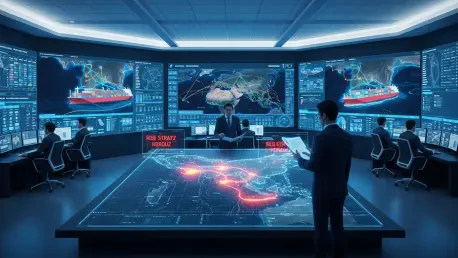

The volatile state of international maritime corridors has reached a critical juncture where the once-predictable rhythm of global trade is being dictated by the rapid escalation of geopolitical friction in the Red Sea and the Strait of Hormuz. These developments have not only disrupted the physical flow of goods but have fundamentally dismantled the traditional frameworks used by marine war risk insurers to quantify and price uncertainty. As the industry moves deeper into 2026, the reliance on historical data is being replaced by sophisticated real-time monitoring systems capable of tracking the minute-by-minute movements of thousands of vessels across contested waters. This transition marks a departure from the static underwriting models of the past century, forcing a more dynamic and aggressive approach to risk management. Consequently, vessel owners and cargo operators are finding themselves in a landscape where standard coverage is no longer a given, and the ability to secure insurance often depends on the granular details of an itinerary.
Navigating Legal Gaps and Operational Realities
Legacy Frameworks: Limitations of Traditional Clauses
Legacy insurance clauses, specifically those governing “blocking and trapping,” were originally designed to address ships stuck in specific ports due to localized conflicts, yet they are increasingly ill-equipped for the regional disruptions currently seen. Under these traditional terms, a ship owner may have the right to declare a total loss after twelve months of continuous detainment, but the same protections rarely extend to the cargo owners whose goods are trapped on board. This creates a significant legal and financial disparity between the interests of the vessel and its freight, as the cargo owner must continue to manage storage costs and depreciation without a clear path to compensation. Furthermore, the modern landscape involves state actors and proxy groups using non-traditional methods to delay transit, often avoiding the literal definitions of “seizure” that trigger standard policy payouts. This lack of alignment between ship and cargo policies has exposed deep structural vulnerabilities that modern shipping enterprises are now scrambling to address through supplemental riders.
Transit Disruptions: The Growing Rerouting Crisis
The mass rerouting of vessels around the Cape of Good Hope serves as a primary example of how operational shifts create new insurance complexities that go beyond physical damage. While avoiding the Red Sea reduces the immediate threat of missile or drone attacks, it introduces the risk of “voyage frustration,” where a journey becomes commercially unviable due to the extreme length and fuel costs of the detour. Standard marine war policies are generally designed to cover physical losses from hostilities rather than the financial fallout of delays or rerouting, leading to significant gaps in coverage for those who do not negotiate specific extensions. To maintain protection during these extended voyages, operators must meticulously adhere to notification requirements and pay the requisite premiums for the new geographic zones they enter. Failure to update an insurer on a change in route can result in the automatic cancellation of coverage, leaving the entire ship and its cargo exposed to both maritime hazards and the ongoing geopolitical threats that forced the reroute in the first place.
The New Mechanics of Risk and Pricing
Market Volatility: Pricing in Trade Arteries
Insurance pricing has evolved into a highly reactive two-tier system where a base annual premium for standard trading is merely the starting point, supplemented by “Additional Premiums” for every transit into a high-risk zone. These designated areas, established by the Joint War Committee, are currently being updated with unprecedented frequency to reflect the shifting borders of conflict in major arteries like the Persian Gulf and the Black Sea. The financial impact of these adjustments is immediate and severe, as a sudden designation of a “listed area” can cause insurance costs to spike by several hundred percent within a single day. This volatility makes it nearly impossible for vessel operators to provide stable shipping quotes to their clients, as the overhead for a single voyage can fluctuate wildly between the time a contract is signed and the vessel actually reaches the contested waters. This environment demands that logistics departments maintain high levels of liquidity to cover these unforeseen premium increases, which have become a fixed cost of modern maritime commerce.
Subjective Profiles: Assessing Geography and Exposure
Beyond the physical location of a vessel, insurers are now prioritizing “touch point” risks which involve a deeper analysis of a vessel’s national affiliations, previous ports of call, and the citizenship of its beneficial owners. In 2026, a ship’s risk profile is no longer determined solely by where it is sailing but by the perceived geopolitical target it represents to various armed groups or state actors. For instance, a vessel with even a minor commercial link to a nation involved in a regional conflict may be targeted more aggressively than its neighboring ships, leading insurers to charge higher premiums or deny coverage altogether for that specific hull. This subjective layer of underwriting creates a hierarchy of risk where “clean” ships with no controversial ties enjoy lower rates, while those with complex international ownership structures are penalized. This trend toward association-based risk assessment has forced shipping companies to undergo extensive due diligence processes to ensure that their corporate structures and previous trade routes do not inadvertently increase their insurance liabilities.
The Future of Underwriting and Resilience
Accumulation Risks: Addressing Harbor Congestion
The concentration of high-value assets in a few “safe” alternative ports has introduced the phenomenon of accumulation risk, where billions of dollars in cargo and hull value are gathered in a single, potentially vulnerable location. As shipping lanes in the Red Sea become more hazardous, the surge of traffic toward hubs like Algeciras or Singapore creates a scenario where a single catastrophic event—be it a cyberattack or a localized conflict—could impact hundreds of vessels simultaneously. Insurers are currently struggling to maintain real-time visibility of this concentration, as traditional reporting methods often lag behind the actual movements of goods. To manage this, the market is beginning to deploy advanced data aggregation tools that synthesize satellite tracking and port manifest data to provide a heat map of financial exposure. By understanding where the highest concentrations of insured value are located at any given moment, underwriters can adjust their capacity and ensure that they do not over-leverage themselves in a single port, maintaining the stability of the sector.
Resilience Strategies: The Shift to Transactional Models
Resilience in the face of these challenges is being driven by a shift toward transactional underwriting, where insurers utilize “notices of cancellation” to reset the terms of a policy in response to real-time events. Rather than ending a long-term relationship with a client, these notices serve as a mechanism to update pricing and coverage limits to reflect the current threat level, ensuring that the insurer remains solvent while the operator remains protected. This data-led approach allows for a more granular assessment of risk, where each voyage is treated as a unique event with its own set of variables and intelligence reports. It encourages a deeper level of communication between the ship owner and the underwriter, as both parties must work together to identify the safest routes and timing for transit. As this trend matures, the industry is moving away from the static, annual renewal cycles of the past and toward a model of continuous risk assessment that provides the flexibility needed to navigate a world where geopolitical conditions can change in an afternoon.
Strategic Responses and Industry Evolution
Technological Integration: Predictive Risk Mitigation
The integration of artificial intelligence and predictive modeling has become the primary defense mechanism for insurers looking to mitigate the impact of sudden geopolitical shifts between 2026 and 2028. These technologies analyze vast amounts of metadata, including social media sentiment, military movement patterns, and historical attack data, to forecast potential flashpoints before they materialize into full-scale disruptions. By providing this intelligence to vessel operators, insurers are no longer just passive payers of claims but have become active partners in risk avoidance. This proactive stance includes the development of secure digital corridors where real-time data sharing between naval forces and commercial fleets allows for the optimization of convoy movements and route adjustments. The implementation of these advanced tracking systems ensures that deviations from a planned course are detected immediately, allowing for rapid insurance adjustments and security responses. This level of technical synergy has proven essential for maintaining the flow of essential commodities.
Actionable Frameworks: Enhancing Global Supply Chains
In response to these escalating complexities, the industry moved toward a more integrated model of risk sharing and transparency that prioritized immediate data over historical precedent. Shipping companies successfully mitigated their financial exposure by adopting a dual-strategy approach that combined specialized cargo riders with real-time AIS monitoring. This transition required a fundamental shift in how maritime operations were managed, as fleets prioritized the transparency of their ownership structures to avoid being categorized under high-risk touch-point classifications. Furthermore, the market began to demand that all participants invest in robust cybersecurity measures to prevent the spoofing of vessel locations, which had previously led to numerous insurance disputes. By standardizing the notification process and ensuring that all rerouting decisions were backed by verified intelligence, operators were able to secure more favorable premium rates and ensure continuous coverage. These steps collectively ensured that the global supply chain remained functional and the insurance sector stayed resilient.