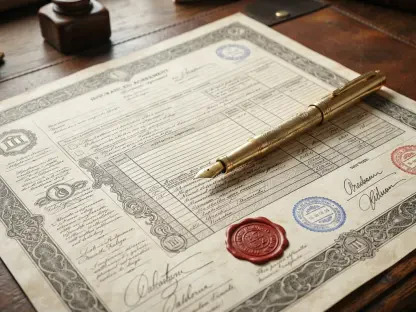

The sudden emergence of a century-old document from the depths of maritime history offers a chillingly precise financial record of the world’s most infamous nautical catastrophe. This original insurance policy, drafted for the RMS Titanic just two weeks before its ill-fated departure from Southampton, provides more than just a glimpse into the logistical preparations of the White Star Line; it serves as a stark testament to the cold calculations of early twentieth-century commerce. While much of the ship’s story is told through rusted artifacts, this paper trail highlights the immense scale of the financial risk managed by the Oceanic Steam Navigation Limited. The document’s recent surfacing has reignited discussions, as it represents the only surviving evidence of the “total loss” coverage that would be triggered within thirty days of the vessel’s sinking. This artifact bridges the gap between the ship’s engineering brilliance and the economic reality that followed its demise.
Financial Logistics: The Burden of Risk
Distribution of Coverage: The Seventy-Seven Insurers
Managing the insurance for a vessel as massive as the Titanic required a complex web of financial agreements that involved no fewer than seventy-seven different underwriting entities. The policy provided five million dollars in coverage, a figure that translates to approximately one hundred and seventy-three million dollars in the contemporary economy. By spreading this risk across a wide array of insurers, the parent company ensured that no single institution would be bankrupted by a potential disaster, demonstrating a sophisticated understanding of risk management. One of the primary contributors to this pool was Atlantic Mutual, which ultimately paid out one hundred thousand dollars following the disaster. When adjusted for inflation in 2026, that single payout represents a loss of roughly three and a half million dollars. This fragmented approach to insurance was necessary because the sheer value of the Olympic-class liners exceeded the capacity of any single insurance provider of the era.
Auction Details: Preserving History in Devizes
The scheduled auction in Devizes, England, on November 21, 2026, represents a landmark event for maritime heritage, with the insurance policy expected to fetch nearly seventy thousand dollars. This sale is not limited to the financial documents but also includes original shipbuilding plans drafted by the legendary Harland and Wolff firm in Belfast. Together, these items provide a comprehensive look at the ship’s life cycle, from its architectural conception to its final financial liquidation. The inclusion of the construction diagrams allows for a direct comparison between the physical reality of the “unsinkable” ship and the legal precautions taken in case of its failure. Potential buyers are bidding on the tangible proof of a turning point in history where technology, hubris, and finance collided. The auction has drawn international interest, highlighting an enduring fascination with how such an enormous investment could vanish into the Atlantic in a single night of tragedy.
Corporate Priority: A Study in Compensation
Rapid Settlement: The Total Loss Clause
One of the most striking revelations within the timeline of the insurance claim is the incredible speed with which the ship’s owners were compensated for their lost asset. Within just thirty days of the Titanic hitting the iceberg and slipping beneath the waves, the seventy-seven insurers had already processed the paperwork and paid out the full five million dollars. This rapid financial resolution occurred while official inquiries in both London and Washington were just beginning to gather testimony from survivors. The efficiency of the insurance market in 1912 meant that the corporate entities were made whole almost immediately, while the wreckage was still settling on the ocean floor. This underscores a prioritization of capital that characterizes the Gilded Age’s legal landscape, where the mechanisms of finance moved with a speed and certainty that the mechanisms of justice for individuals could not match. The “total loss” clause, signed so close to the voyage, proved to be an effective tool.
Human Liability: The Final Legal Outcome
The discrepancy between corporate recovery and human restitution suggested a necessary overhaul of international maritime laws to better protect passengers. While the company received its millions almost instantly, the families of the victims were forced into a four-year legal battle that yielded only six hundred and sixty-three thousand dollars for all claimants combined. This historical outcome drove maritime authorities to establish stricter liability standards that prioritized human life over hull insurance in subsequent decades. Experts who studied the document concluded that the event served as a catalyst for modern safety regulations, ensuring that such a financial imbalance could never be repeated in the industry. The legacy of the policy eventually mandated that carriers maintain specific insurance tiers dedicated solely to survivor support. These steps transformed the industry into one that accounted for the human element of risk. By auctioning these papers, historians preserved a vital lesson about the ethics of global commerce.