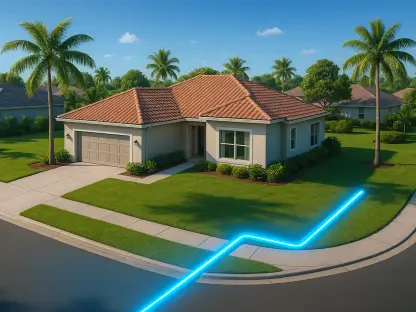

The traditional promise of residential security is undergoing a fundamental transformation as private insurance providers begin to abandon high-risk geographic regions with unprecedented speed and precision. This shift marks the end of an era where risk was shared broadly across diverse populations, moving instead toward a model characterized by selective exclusion and hyper-local risk assessment. As global temperatures rise and geological stability becomes more unpredictable, insurers have refined their predictive modeling to identify properties that are no longer profitable to cover. This strategic retreat creates a significant vacuum in the housing market, where the financial safety net that once supported homeownership is rapidly fraying. The socio-economic consequences are profound, as homes in vulnerable areas transition from being stable investments to potentially stranded assets. Homeowners who once viewed insurance as a routine administrative task now find themselves at the mercy of complex algorithms that can render their property uninsurable overnight.
Regional Market Shocks: The Postcode Syndrome
In New Zealand, the emergence of what experts call postcode insurance syndrome has fundamentally altered the relationship between homeowners and financial institutions. This phenomenon occurs when insurance companies apply blanket exclusions to entire geographical areas based on digital mapping data rather than conducting individual property assessments. Consequently, even a well-maintained home on a raised foundation may find itself uninsurable simply because it shares a zip code with a property located on a vulnerable floodplain. This shift has created a dual crisis of affordability and availability that is currently rippling through the residential real estate market. Existing homeowners are facing skyrocketing premiums that often exceed their annual property tax obligations, while prospective buyers find it nearly impossible to secure the new coverage required by mortgage lenders. This systemic change is turning insurance from a standard formality into a significant barrier to entry for the middle class.
The coastal town of Westport serves as a primary example of how the relationship between a community and the insurance industry can deteriorate under environmental pressure. Following the major floods that occurred several years ago and left many residential properties uninhabitable, insurers began to distance themselves from the region entirely. By the start of the current cycle, major providers like AA Insurance suspended new policies for homes and businesses in key postcodes across the district. While some corporate spokespeople frame these moves as temporary pauses intended to allow for risk reassessment, the broader market signal remains clear: certain regions are becoming effectively uninsurable. Local headlines have increasingly labeled these areas as unsellable, reflecting the grim reality that a home without insurance cannot be financed or sold on the open market. This retreat represents a permanent shift in how capital perceives geographic risk in coastal settings.
This retreat creates a lock-in effect that traps current homeowners in properties they cannot easily offload or improve due to a lack of financial backing. While some owners may be able to renew existing policies for the time being, the inability of a potential buyer to secure new insurance prevents the successful transfer of the asset. This stagnation leads to a sharp decline in regional property values and forces a growing reliance on specialist brokers who operate outside the mainstream market. These non-traditional coverage options often come with extremely restrictive terms, high deductibles, and much higher costs, further straining the financial security of residents in weather-exposed communities. As the mainstream market shrinks, the gap between those who can afford protection and those who cannot continues to widen, creating a new class of real estate that exists outside the traditional financial system and leaving families with no clear path to exit.
Expanding Hazards: International Risk Trends
The insurance retreat is not limited to climate-related weather events; it also encompasses geological risks such as seismic activity and land instability. In the Canterbury region, communities like Woodend and Rolleston have faced sudden pauses on new insurance policies due to newly established seismic risk limits. This occurs when an insurance company reaches the maximum financial exposure it is willing to accept in a specific earthquake-prone zone, regardless of the individual building’s quality. This multi-hazard phenomenon demonstrates that the retreat is a broad strategic shift affecting any area where the concentration of risk exceeds corporate comfort levels. For residents in these zones, the sudden loss of insurance access feels arbitrary, yet for the insurers, it is a necessary step to maintain solvency in an era of catastrophic claims. The intersection of seismic and climatic threats means that few regions remain entirely immune to these market fluctuations.
These developments align with global trends observed in Australia and the United States, where insurers are increasingly abandoning low-lying coastal zones and floodplains. Experts suggest that the historical model of socialized risk—where the many pay for the losses of the few—is being replaced by risk-based pricing that isolates and penalizes high-risk geographies. This is increasingly viewed not as a temporary fluctuation in the market, but as a permanent adjustment to a world where natural hazards are becoming more frequent and more expensive to cover. As private capital exits these markets, the burden of protection shifts to the individual or the state, neither of which may be equipped to handle the scale of the financial requirements. The transition from a collective safety net to an individualized risk model is dismantling the traditional concept of homeownership as a safe investment, forcing a re-evaluation of where and how modern societies choose to build.
Policy Interventions: Strategic Political Responses
To address the growing gap in protection, several policy interventions are being debated among regulators, including the expansion of state-backed coverage models. One potential framework is the Sustainable Insurance Strategy currently being refined in California, which mandates that private insurers cover a certain percentage of policyholders in high-risk areas to spread the financial burden across a larger population. Other suggestions include increasing the scope of national hazard commissions to cover higher property values, effectively using public funds to shore up the gaps left by the private sector’s withdrawal. These strategies aim to prevent a total market collapse by forcing a level of participation from private companies that would otherwise choose to exit. However, the implementation of such mandates requires a delicate balance between consumer protection and the economic reality that insurance companies must remain profitable to stay in the market.
However, these proposed solutions introduce significant conflicts regarding individual responsibility and the future of urban development. If the government socializes the risk of living in dangerous areas through subsidized premiums, it may inadvertently reduce the incentive for residents to relocate or for local councils to stop approving developments in floodplains. There is a growing concern that subsidizing insurance in high-risk zones creates a moral hazard, where the general public bears the cost of private decisions to build in areas that nature has repeatedly reclaimed. This tension creates a political stalemate where officials must choose between the immediate financial relief of their constituents and the long-term necessity of moving populations away from harm. The result is a patchwork of temporary fixes that delay the inevitable conversation about managed retreat and the physical limitations of protecting property in an increasingly hostile environment.
The insurance crisis has consequently moved into the political arena, creating an ideological divide between stakeholders that defines the current era. Political figures argue that insurance companies should contribute to the funding of flood defenses and resilient infrastructure since they benefit from the reduced risk such projects provide. Conversely, the insurance industry maintains that its primary role is to quantify and price risk rather than to fund public works or social programs. This standoff over who should pay for climate adaptation and infrastructure remains a major obstacle to a coordinated national response, leaving many homeowners in a state of financial limbo. Without a clear agreement on the division of costs, the insurance retreat will likely continue, further destabilizing the real estate market and forcing communities to face the reality that some locations may simply no longer be viable for permanent human settlement.
Adaptive Solutions: Implementing Future Resilience
As 2026 progressed, the insurance landscape fundamentally shifted from a model of reactive payouts to one of proactive risk mitigation. The industry recognized that the old ways of socialized hazard coverage were no longer viable in a volatile environment, leading to the widespread adoption of parametric insurance and community-based resilience bonds. Homeowners who moved toward sustainability succeeded by investing in structural reinforcements and flood-proofing technologies that directly lowered their risk profiles in the eyes of automated underwriting systems. These practical steps became the only way to secure coverage in areas previously deemed uninsurable. The integration of high-resolution satellite data allowed for more granular pricing, which rewarded individuals who took responsibility for their property’s physical integrity. This transition favored those who prioritized long-term resilience over short-term savings, setting a new standard for property management.
Local governments and urban planners eventually realized that the era of building on vulnerable floodplains had reached its logical conclusion. By shifting focus toward managed retreat and the creation of natural buffer zones, cities reduced their overall exposure and stabilized the local insurance markets. New developments were required to meet rigorous climate-ready standards before being granted the permits necessary for financial backing. This move toward smarter urban planning provided a clear path forward for maintaining property values in a changing world. Communities that embraced these changes saw a return of private capital, as insurers were more willing to provide coverage for assets protected by modern infrastructure. The lesson learned from this global retreat was that while the terms of insurance had changed forever, the ability to protect a home remained possible for those who aligned their living conditions with the realities of the natural environment.