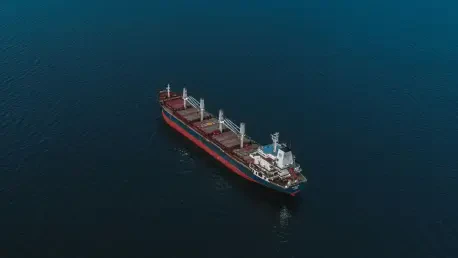

The sheer silence currently echoing through the Strait of Hormuz, where once a vessel passed every few minutes, represents a staggering shift in the global economic order that few underwriters could have predicted just years ago. As tensions across the Middle East reach a critical boiling point, the maritime industry finds itself at the center of a high-stakes recalibration of risk and liability. Shipowners and insurers are no longer dealing with simple logistical delays; they are confronting a fundamental rewrite of the rules of international trade. This analysis explores how recent regulatory shifts, such as the implementation of specific model clauses, are forcing a total restructuring of the insurance landscape, ultimately signaling a new era of maritime security and financial accountability.
Navigating the Turbulent Waters of Modern Marine Underwriting
The global maritime industry is currently facing a transformative shift in risk management as tensions in the Middle East reach a fever pitch. At the center of this disruption is the Strait of Hormuz, a narrow waterway that serves as a vital artery for international trade but has recently become a flashpoint for geopolitical conflict. As shipowners and insurers navigate this high-stakes environment, the traditional rules of maritime coverage are being rewritten. This environment requires a level of agility that was previously unnecessary in the relatively stable world of marine underwriting.
Industry leaders recognize that the current scenario is not merely a temporary bottleneck but a catalyst for a new era of maritime security and financial accountability. The introduction of specific model clauses by the Lloyd’s Market Association is forcing a total recalibration of liability. We see an emergence of government-backed insurance alternatives and a dual-front naval conflict affecting both the Gulf and the Red Sea. Consequently, the industry must adapt to a reality where the cost of passage is dictated by political volatility as much as by physical safety or cargo value.
The Historical Significance of the World’s Most Vital Waterway
To understand the gravity of the current situation, one must consider the historical dominance of the Strait of Hormuz as the primary artery for global energy. This narrow passage has long served as the conduit for approximately twenty percent of the world’s seaborne petroleum, making its stability synonymous with global economic health. For decades, the London insurance market provided the confidence necessary for ships to traverse these waters, offering a predictable framework for war risk coverage even during periods of localized friction. This stability allowed for the expansion of global supply chains that relied on the just-in-time delivery of raw materials.
However, the transition from manageable regional tension to state-sponsored disruption has fundamentally altered this relationship. Past adjustments to maritime premiums were typically reactive and incremental, but the current volatility is different. The escalation of sanctions and the direct targeting of commercial tankers have moved the goalposts for global underwriters. These historical precedents demonstrate that while the industry is inherently built on managing risk, the current level of legal complexity and geopolitical interference is largely without parallel in the modern history of merchant shipping.
A New Reality: Sanctions, Volatility, and the Dual-Front Conflict
The Legal Trap: Model Clauses and the Iranian Toll Dilemma
A pivotal development in this ongoing crisis is the introduction of a new model clause by the Lloyd’s Market Association, designed to shield insurers from the legal consequences of Iranian-imposed transit fees. Reports have indicated that regional authorities have sought to collect tolls from passing ships, creating a profound legal dilemma for operators. If a shipowner pays these fees to ensure safe passage, they may inadvertently violate international sanctions by funding proscribed organizations. The new clause allows insurers to terminate coverage immediately if such payments are made, placing shipowners in an impossible position where they must choose between the risk of seizure or the loss of all financial protection.
The Pincer Effect: Simultaneous Crises in Hormuz and the Red Sea
The complexity of the situation is compounded by the fact that the industry is now fighting a conflict on two distinct naval fronts. While traffic in the Strait of Hormuz has slowed to a trickle, a second crisis has re-emerged in the Red Sea, where Houthi forces have intensified their attacks on commercial vessels. This simultaneous disruption creates a pincer effect that leaves global shipping routes under constant threat on both sides of the Arabian Peninsula. Underwriters are forced to account for two active war zones at once, which has rendered traditional actuarial models obsolete and forced a complete rethink of how regional risk is quantified across the entire Middle Eastern corridor.
The Financial Toll: Skyrocketing Premiums and Market Volatility
The financial consequences of these overlapping crises are nothing short of transformative for the industry bottom line. War risk premiums, once a minor consideration in the total cost of a voyage, have surged to become a dominant expense. Rates that previously hovered around 0.1 percent of a vessel’s value have spiked as high as 10 percent during periods of peak tension. For a modern tanker valued at $150 million, a single passage can now result in an insurance bill exceeding $7 million. Such volatility makes long-term financial planning nearly impossible, as the cost of transit now fluctuates based on the daily news cycle rather than stable market data.
The Rise of Sovereign Backstops and Geopolitical Rivalries
As the private market in London struggles to absorb these extreme risks, a significant shift toward government-backed insurance alternatives has begun to emerge. The United States government, through the International Development Finance Corporation, has reportedly established a massive reinsurance backstop to stabilize trade in the Gulf. This facility, supported by several major American insurance carriers, represents a direct challenge to the traditional dominance of the London market. It suggests a future where maritime security and insurance are increasingly tied to sovereign power rather than purely private capital.
Furthermore, this transition is being accelerated by the adoption of sophisticated tracking technologies that allow for real-time risk assessment. Insurers are now using satellite data and artificial intelligence to monitor vessel movements with surgical precision, allowing them to adjust coverage on a per-mile basis. These technological and regulatory advancements are not merely temporary fixes; they are setting the stage for a permanent reorganization of the competitive landscape between traditional European hubs and emerging American and Asian insurance centers. The result is a more fragmented but technologically advanced market.
Strategic Decision-Making in an Era of High-Risk Transit
The current environment forces maritime stakeholders to navigate a trilemma of options, each carrying significant financial and operational burdens. For logistics professionals and shipowners, the following strategies have become essential for maintaining operations in high-risk zones:
- Route Diversion: Many companies are opting to bypass the region entirely by sailing around the Cape of Good Hope. While this avoids the immediate threat of seizure, it adds considerable time to delivery schedules and increases both fuel consumption and environmental impact.
- Compliance Rigor: Implementing exhaustive legal checks has become a survival requirement. Vessel operators must ensure that no payments are made to sanctioned entities, as the loss of insurance coverage can lead to catastrophic financial ruin and potential legal prosecution.
- Market Diversification: Relying on a single insurance provider is no longer a viable strategy. Stakeholders are increasingly looking toward diverse insurance pools and public-backed facilities to mitigate the risk of sudden market exits by private underwriters.
Resilience in the Face of a Global Maritime Paradigm Shift
The Hormuz crisis fundamentally redefined the relationship between maritime logistics and financial security. By forcing a total recalibration of risk, the industry transitioned away from outdated actuarial models that failed to account for simultaneous geopolitical disruptions. Stakeholders implemented more robust compliance protocols and diversified their insurance portfolios to survive the unprecedented volatility. This era of high-cost uncertainty ultimately mandated the adoption of sovereign-backed reinsurance and advanced surveillance technologies to maintain even a fraction of normal trade flows.
Shipping firms that successfully integrated these new tools established a more resilient foundation for their long-term operations. The shift toward government intervention and real-time data monitoring provided a necessary blueprint for managing geopolitical instability in other vital waterways around the globe. Ultimately, the crisis demonstrated that the era of predictable, low-cost maritime transit had concluded, necessitating a new focus on legal transparency and shared risk. Moving forward, the industry prioritized the development of multi-jurisdictional alliances to protect the supply chains that remain the lifeblood of the global economy.