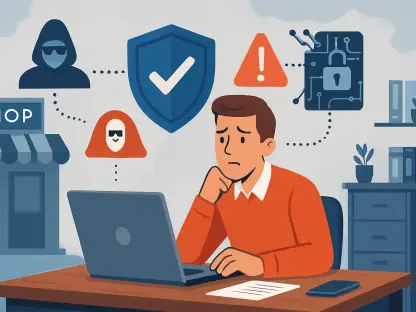

A significant gap exists between owner perception and reality, as only 27% of small business leaders rank cyberattacks among their primary operational concerns. This statistic, derived from the ERGO NEXT survey of over five hundred small business owners in 2026, highlights a dangerous level of complacency in an era where digital threats have become localized and persistent. While many proprietors view cybersecurity as a concern reserved for multinational corporations or high-tech startups, the localized data landscape suggests otherwise. A report published by KESQ on October 31, 2026, emphasized that the necessity for cyber liability insurance has transitioned from a luxury add-on to a foundational requirement for any firm handling customer data or digital payments. The reality is that the modern economy runs on a web of interconnected digital transactions, and small businesses are often the most vulnerable nodes in this network. Ignoring these risks does not mitigate them; instead, it leaves a company exposed to financial shocks that can be impossible to absorb without a dedicated insurance safety net.
The transition toward digital-first operations has accelerated the frequency of intrusions, yet the psychological preparedness of business owners has not kept pace. Many entrepreneurs still rely on outdated security models, believing that their small scale makes them invisible to global threat actors. However, automated scanning tools and artificial intelligence now allow attackers to cast a wide net, identifying vulnerabilities in small retail shops or local consultancy firms with the same efficiency used against larger targets. The October 31 report serves as a timely reminder that digital exposure is cumulative. Every credit card swiped, every email sent, and every cloud-based file stored adds to the potential attack surface. As the fiscal year 2026 progresses, the demand for specialized cyber liability policies is expected to rise as more vendors and partners require proof of coverage before signing contracts. This shift is turning cyber insurance into a prerequisite for doing business, forcing owners to reconcile their perceived safety with the measurable hazards of the current digital environment.
1. The Disconnect Between Threat Perception and Reality
The statistical evidence regarding small business vulnerability is both clear and concerning, yet it continues to be overlooked by a majority of leadership teams. According to the Identity Theft Resource Center’s 2025 Business Impact Report, a staggering 81% of small businesses reported experiencing a security breach, a data breach, or both within the preceding twelve-month period. This high frequency of incidents stands in stark contrast to the small minority of owners who actively worry about such events. This awareness gap suggests that many firms are operating under a false sense of security, perhaps relying on basic antivirus software or the assumption that they lack data worth stealing. In truth, even the most basic customer list or payroll record holds significant value on the dark web, and the operational disruption caused by a breach can be far more damaging than the actual theft of information. The discrepancy between the 81% breach rate and the 27% concern rate points to a critical need for education and a reassessment of risk priorities across all sectors.
Building on this data, the financial consequences of such oversights are frequently devastating for organizations with limited cash reserves. Among the small businesses that suffered a breach, approximately 63% reported losses exceeding $250,000, a figure that includes both direct theft and the subsequent costs of remediation. For a company with fewer than fifty employees, an unexpected quarter-million-dollar expense is rarely a survivable event without external support. These costs are not merely theoretical; they represent real-world invoices for forensic investigators, legal counsel, and the specialized notification services required by state and federal privacy laws. Furthermore, the loss of customer trust can lead to a long-term decline in revenue that far outlasts the immediate technical crisis. By failing to recognize cyber threats as a primary operational risk, owners are effectively gambling the future of their companies on the hope that they will remain part of the lucky 19% who avoid an incident. The current market conditions in 2026 indicate that such luck is an increasingly rare commodity.
2. Why Small Enterprises Remain Primary Targets
Hackers and cybercriminal syndicates frequently view small firms as the most attractive targets due to a combination of weak defenses and valuable entry points. Unlike large enterprises that can afford a full-time Chief Information Security Officer and a dedicated security operations center, small businesses often distribute IT responsibilities among staff members who have other primary roles. An office manager or an owner might be responsible for patching software or managing firewall settings, tasks that often fall to the bottom of a busy to-do list. This lack of dedicated expertise creates “low-hanging fruit” for attackers who use automated scripts to find unpatched servers or accounts lacking multi-factor authentication. In 2026, the sophistication of these automated attacks has reached a level where even a single missed update can provide an entry point for a global ransomware group. The cost of entry for a criminal is low, while the potential for a quick payout from a desperate business owner is high.
Beyond their own internal data, small businesses are increasingly targeted because they serve as gateways into much larger, more lucrative corporate networks. Supply chain attacks have become a dominant trend, as attackers realize that a small vendor often has a trusted connection to a massive client’s infrastructure. Whether it is a software developer with access to a client’s source code or a small accounting firm with administrative rights to a corporate payroll system, these small entities are the “weak links” that provide a path for lateral movement. The KESQ report highlighted that large organizations are now reacting to this threat by mandating that all their small-business partners carry significant cyber liability limits. This defensive posture by major corporations means that a small firm’s failure to secure its own systems could lead to the immediate termination of its most valuable contracts. In this context, cyber insurance acts as a form of “digital bonding,” providing financial assurance to partners that the small firm can handle the repercussions of a security failure without collapsing.
3. Industry-Specific Vulnerabilities and High-Risk Sectors
While no business is immune to digital threats, certain industries face higher levels of exposure due to the sensitivity of the information they process. Professional services, such as accounting, legal consulting, and insurance agencies, sit at the top of the risk hierarchy because their entire business model is built on the management of sensitive client identifiers. An accountant’s server contains everything needed for full-scale identity theft, including Social Security numbers, bank account details, and historical tax records. Similarly, software developers often hold the “keys to the kingdom” for their clients, managing credentials and source code that could compromise thousands of end-users if leaked. For these professionals, a data breach is not just a technical failure but a total breach of trust that can lead to professional liability claims and regulatory investigations. The need for comprehensive coverage in these sectors is driven by the high cost of notifying every affected party and the potential for long-term litigation.
The retail and hospitality sectors face a different but equally potent set of risks centered on the high volume of digital payment transactions. Every point-of-sale terminal and online checkout page represents a potential point of compromise for “skimming” scripts or malware designed to intercept credit card data. For a local restaurant or an e-commerce boutique, a compromise in the payment chain can lead to significant fines from card networks and the immediate suspension of their ability to process transactions. Real estate is another sector under heavy fire, particularly from wire fraud and business email compromise schemes. The FBI’s Internet Crime Report, as cited by KESQ, noted that real estate fraud complaints exceeded 12,000 in 2025, with losses reaching hundreds of millions of dollars. Because real estate transactions involve large, one-time wire transfers, attackers spend weeks monitoring email threads to intercept the exact moment of closing. Without social engineering coverage, an agency might find itself responsible for a client’s lost down payment, a scenario that often leads to total bankruptcy.
4. Understanding First-Party and Third-Party Coverage
A standard cyber liability policy is generally structured into two distinct parts to address different types of financial loss, and understanding the difference is crucial for any owner. First-party coverage is designed to address the immediate, out-of-pocket costs that the business incurs during the first few days and weeks following an incident. This includes the fees for forensic experts who must determine how the breach occurred and whether any data was actually exfiltrated. It also covers the cost of notifying customers, which is a legal requirement in almost every American jurisdiction, as well as providing credit monitoring services to those affected. Perhaps most importantly for small firms, first-party coverage often includes business interruption insurance, which replaces lost revenue if the company is unable to operate due to a ransomware lockout or a server failure. This immediate liquidity is what allows a business to stay afloat while its technical systems are being rebuilt.
Third-party coverage, on the other hand, protects the business against the long-term legal and regulatory fallout that follows a data breach. When a company loses client data, it is often sued by the affected individuals or by partners who suffered financial harm as a result of the leak. Third-party insurance covers the legal defense fees, settlements, and any judgments that may be handed down by a court. It also addresses the increasingly common problem of regulatory fines. In 2026, state attorneys general and federal agencies like the FTC have become much more aggressive in penalizing firms that fail to implement “reasonable” security measures. Without this coverage, a business owner might be forced to defend themselves against a multi-year legal battle while simultaneously trying to rebuild their company’s reputation. By balancing both first-party and third-party protections, a cyber policy creates a comprehensive buffer that addresses both the technical emergency and the subsequent legal aftermath.
5. The Financial Impact of Modern Extortion Methods
Ransomware has evolved from a sporadic nuisance into a highly organized criminal industry that targets small businesses with frightening regularity. According to Verizon’s 2026 Data Breach Investigations Report, approximately 48% of all recorded breaches now involve some form of ransomware or extortion. This represents a steady increase from previous years, reflecting the high success rate of these attacks. Modern ransomware groups do not just encrypt data; they often engage in “double extortion,” where they steal sensitive files before locking the system and then threaten to publish them online unless a second ransom is paid. This puts the business owner in an impossible position: even if they have backups to restore their systems, they may still be forced to pay to prevent a catastrophic leak of customer data. Cyber insurance policies are now being written with specific ransomware sublimits, and insurers often provide access to professional negotiators who can help lower the ransom demand or determine if the attacker is likely to follow through on their promises.
While ransomware captures the headlines, Business Email Compromise and social engineering continue to drive massive financial losses through deception rather than encryption. In 2025, the FBI recorded $3 billion in losses attributed to BEC, where attackers impersonate a trusted vendor or a company executive to redirect legitimate payments to fraudulent accounts. These attacks are particularly effective against small businesses because they rely on human psychology rather than technical flaws. An employee might receive an email that appears to be from a long-term supplier requesting a change in wire instructions for an upcoming invoice. If the employee complies without verification, the money is often gone forever within minutes. Many basic cyber insurance policies exclude these “voluntary” transfers of funds unless the owner has specifically added social engineering or funds transfer fraud coverage. As we navigate the remainder of 2026, ensuring that these “human-centric” threats are covered is just as important as protecting the network from technical intrusion.
6. Implementation Strategy: A Practical Guide for Owners
For a small business owner looking to secure their digital perimeter in the current fiscal quarter, the first phase of the action plan involves a thorough audit of assets and obligations. Every organization should begin by identifying and cataloging every system that stores or processes sensitive client information, payment details, or company funds. This inventory serves as the map for determining how much insurance is actually required. Simultaneously, it is necessary to review existing agreements with clients and vendors to see if they mandate specific levels of cyber insurance. Many modern contracts require at least one million dollars in coverage as a condition of service. Owners should also evaluate their current general business policy to see if a small “cyber endorsement” is already attached. Often, these endorsements have very low limits, such as $25,000, which would be insufficient for anything beyond a very minor incident. Gathering multiple estimates for standalone policies allows for a side-by-side comparison of exclusions and the “waiting periods” that apply before business interruption payments begin.
The second phase of the implementation strategy focuses on the technical hygiene that insurers now demand as a prerequisite for coverage. Before applying for a policy in 2026, a business must verify that multi-factor authentication is active on all email and administrative accounts, as many carriers will simply decline any applicant who lacks this basic control. Data recoverability is the next priority; the team should perform a test restoration of their backups to ensure that the data is not only being saved but is actually usable in an emergency. It is highly recommended to follow the 3-2-1 backup rule, ensuring one copy is kept completely offline or “immutable” to prevent ransomware from deleting the safety net. Finally, the organization must organize its emergency response by keeping the insurance company’s breach hotline number in a physical and digital location accessible to the entire team. Having a pre-planned response avoids the panic that often leads to costly mistakes in the first few hours of a cyber crisis.
7. Clarifying Common Questions Regarding Cyber Policies
As the market for cyber insurance matures, several common questions frequently arise among business owners regarding the scope and cost of these products. A primary point of confusion involves the difference between general liability and cyber liability; many owners believe their existing policies cover digital theft, only to find that general liability is strictly limited to physical injury or property damage. Another frequent question concerns wire fraud and whether it is covered by default. As previously noted, “social engineering” is often a separate add-on, and owners must explicitly ask for this coverage to protect against the $3 billion threat of email-based payment redirection. Furthermore, many are surprised by the rigorous requirements set by insurers. Modern carriers are not just passive payers of claims; they act as active risk managers, often requiring proof of regular employee training and a documented incident response plan before they will issue a quote. These requirements, while demanding, often serve to make the business more secure in the long run.
The final consideration for most owners is the cost of coverage and how it is determined in a fluctuating 2026 market. Premiums are not fixed; they vary significantly based on the industry, the annual revenue of the firm, the volume of sensitive data handled, and the quality of the security habits in place. A business with a clean record and strong technical controls like MFA and encrypted backups will always pay less than a firm with a history of incidents or lax protocols. While the KESQ report did not provide a universal price list, the consensus among brokers is that the cost of the premium is almost always a fraction of the $250,000 average loss seen by breached firms. Investing in a policy is a strategic move that transforms an unpredictable, potentially business-ending catastrophe into a predictable monthly or annual expense. As the digital landscape continues to evolve toward 2027, the role of insurance will only grow as a cornerstone of small business resilience and long-term viability.
The strategic landscape for small businesses in 2026 required a fundamental shift in how digital risk was managed and financed. It was clear that the high frequency of breaches, coupled with the rising costs of legal and technical remediation, made self-insurance a non-viable strategy for the vast majority of firms. Business owners realized that while technical defenses were their first line of protection, cyber insurance provided the essential financial backstop that ensured survival when those defenses were eventually breached. The decision to invest in comprehensive coverage moved beyond a mere line-item expense and became a signal of operational maturity to clients, partners, and regulators alike. As organizations prepared for the fiscal challenges of the coming years, those that integrated robust insurance with disciplined security hygiene were the ones that maintained the highest levels of trust and stability. The era of treating cyber threats as an optional concern effectively ended, replaced by a more pragmatic and resilient approach to the digital economy.