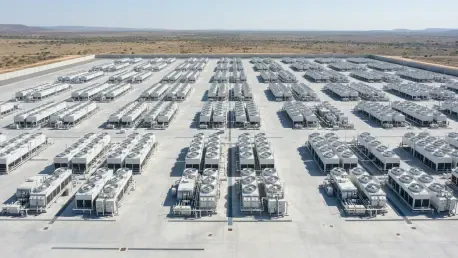

Aon is establishing specialized multi-billion dollar facilities for data centers and energy projects to aggregate the underwriting capacity needed for massive infrastructure investments. This strategic move addresses a pivotal moment where the global appetite for artificial intelligence computing power is colliding with the hard realities of physical risk and financial exposure. As technology giants and developers accelerate their construction schedules for massive data centers, they are encountering a significant hurdle: the insurance industry’s current inability to absorb the concentrated risks these facilities represent. CEO Greg Case has identified this imbalance as a critical bottleneck for the industry, noting that the sheer density of high-value hardware and energy-intensive infrastructure creates a vulnerability that traditional underwriting models were never designed to handle. This creates a systemic challenge where the velocity of innovation outstrips the rate at which financial protection can be manufactured for the market.
The Financial Impact of Data Center Vulnerabilities
The shift from legacy data storage to high-frequency artificial intelligence processing has fundamentally altered the financial consequences of operational failure. In the current landscape, business interruption is no longer viewed through the lens of daily or hourly inconvenience; instead, downtime for these critical facilities is now calculated in millions of dollars per minute. This extreme sensitivity to disruption necessitates a transition from reactive insurance procurement to a model of proactive risk engineering. By involving insurers and risk advisors during the initial stages of facility design and site selection, developers can identify potential hazards before they become embedded in the physical structure. This collaborative approach allows for the optimization of power redundancy and the implementation of geographic diversification strategies that satisfy the rigorous demands of global lenders. Consequently, the physical resilience of the infrastructure becomes a foundational element of its financial viability.
Furthermore, the concentration of massive computing power within a limited number of geographic hubs has introduced a level of risk aggregation that is historically unprecedented. When billions of dollars in specialized GPU hardware and cooling systems are housed under a single roof, a single localized disaster—be it a flood, fire, or catastrophic power grid failure—could result in an insurance claim that dwarfs typical industrial losses. This reality is forcing a reorganization of how these projects are funded, as the lack of comprehensive insurance coverage can effectively lock developers out of the primary debt markets. To maintain the flow of capital, builders are now required to demonstrate advanced risk mitigation protocols that go far beyond standard building codes. This includes the integration of secondary and tertiary power sources, as well as the use of AI-driven monitoring systems that can predict and isolate hardware failures before they escalate into facility-wide outages.
Strategic Expansion into the Middle Market Sector
Aon is aggressively repositioning its service offerings to address these systemic complexities through significant strategic investments, most notably the multi-billion-dollar acquisition of USI Insurance Services. This transaction, alongside the 2024 purchase of NFP, is specifically designed to extend sophisticated risk management capabilities to the middle-market sector. These companies, which are often the backbone of regional economies, now face the same complex artificial intelligence and cybersecurity threats that were once the exclusive concern of multinational conglomerates. By integrating human expertise with proprietary analytical tools, the firm provides these mid-sized enterprises with the level of data-driven insight required to navigate a volatile digital landscape. This expansion ensures that as AI tools become ubiquitous, the protection mechanisms needed to safeguard them are not restricted solely to the world’s largest corporations but are accessible to the broader business ecosystem.
The rationale behind this massive scale-up is rooted in the observation that technological risks are becoming increasingly democratized and interconnected. Small and medium-sized firms are now integral parts of the global supply chain, often providing critical components or data services to larger entities. If a middle-market firm suffers a catastrophic cyber breach or an AI-related operational failure, the ripple effects can destabilize entire networks. The integration of these new business units is expected to generate nearly $400 million in annual earnings benefits, driven by significant cost savings and revenue synergies. More importantly, it creates a more resilient overall market by ensuring that a wider range of businesses has the financial backing and technical advice necessary to adopt emerging technologies safely. By closing the gap in risk awareness and insurance access, the firm helps prevent the middle market from becoming the weakest link in the global technological infrastructure.
Bridging the Global Capital Gap through Institutional Investment
One of the most significant challenges facing the industry is the massive shortfall in global insurance capital, which currently stands at approximately $4.5 trillion. However, as the demand for protection against AI infrastructure failures and cyber threats continues to climb, industry experts estimate that this pool must grow to at least $15 trillion to remain effective. Because traditional reinsurers and commercial carriers cannot bridge this multi-trillion-dollar gap alone, there is an urgent need to treat insurance risk as a distinct and attractive asset class for institutional investors. By tapping into the $250 trillion pool of capital managed by pension funds, sovereign wealth funds, and high-net-worth individuals, the industry can create the underwriting capacity required to support the next generation of technological growth. This shift transforms the role of insurance brokers from mere intermediaries into sophisticated market-makers who facilitate the flow of global capital.
Successfully attracting these non-traditional investors depends entirely on the precision of risk measurement and the transparency of available data. To convince a pension fund or an institutional investor to assume the risks associated with a massive AI data center, the industry must provide granular evidence regarding the probability and severity of potential losses. This is why the development of specialized facilities is so critical; they provide a structured framework for aggregating capital and distributing it across high-stakes projects with clearly defined risk parameters. These facilities allow investors to access uncorrelated returns—performance that is not tied to the volatility of the stock or bond markets—while providing the technology sector with the essential financial foundation it needs to scale. As these investment vehicles mature, they create a more stable and predictable environment for both the insurers who provide the coverage and the developers who rely on it.
The Dual Threat of Artificial Intelligence in Cybersecurity
The relationship between artificial intelligence and organizational risk is a complex, double-edged sword, as the technology simultaneously empowers security researchers and malicious actors. While AI-driven tools are being used to identify and patch system vulnerabilities at an accelerated pace, they are also allowing cybercriminals to scale their operations with unprecedented speed and sophistication. Recent threats to global programming languages highlight how a single technological weakness can be exploited to create widespread exposure for businesses and their insurers. This rapid acceleration of the threat landscape reinforces the necessity for alternative capital sources, as a single systemic cyber event could trigger correlated losses across thousands of organizations simultaneously. The ability of AI to automate the discovery of exploits means that traditional, static security measures are no longer sufficient to protect the digital assets that underpin the modern economy.
In response to these evolving threats, the commercial insurance market is witnessing a unique trend where some pricing structures are actually beginning to soften despite the increasing complexity of the risk environment. However, sophisticated corporate clients are not simply treating these lower premiums as a way to reduce their overhead; instead, they are leveraging the savings to significantly increase their overall coverage limits. As data analytics provide a clearer and more terrifying picture of the potential for systemic failures, businesses are moving toward more robust and layered protection strategies. This shift indicates a growing recognition that sufficient coverage from the past is likely inadequate for the challenges of the present. By restructuring their insurance programs to include higher levels of protection, organizations are preparing themselves for the unpredictable nature of AI-assisted attacks and the long-term volatility of the digital age.
Future Directions for Technological and Financial Stability
The global financial system recognized that the evolution of AI infrastructure required a paradigm shift in how risk was quantified and managed. Stakeholders across the technology and insurance sectors took decisive action to integrate risk mitigation into the very blueprints of data centers, ensuring that physical resilience kept pace with computational power. Developers and investors collaborated to establish new standards for redundancy and geographic distribution, effectively de-risking the massive capital outlays required for the AI revolution. Furthermore, the successful mobilization of institutional capital as a secondary insurance layer provided the necessary financial cushion to absorb the systemic shocks of the digital era. These combined efforts transformed the insurance industry from a potential bottleneck into a proactive catalyst for innovation. Moving forward, the focus shifted toward continuous, real-time monitoring and the dynamic adjustment of coverage to reflect the ever-changing nature of technological threats.