
The expansion of digital tools on the job site has pushed the construction industry’s attack surface far beyond the back office and into physical equipment controls. This shift represents a seismic change in how safety professionals and project managers interpret the daily chaos of a build site. Where risk management was once a manual discipline defined by heavy binders of protocols tucked under a superintendent’s arm, it has become a living, breathing ecosystem of sensors and autonomous algorithms. In the current landscape, the industry is shedding its reputation for being a technological laggard, opting instead for a future where predictive intelligence is the baseline for operational success. By moving away from a purely reactive stance—where lessons were often learned at the high cost of injury or significant financial loss—firms are now leveraging Artificial Intelligence and unmanned aerial vehicles to anticipate problems before they manifest. This proactive paradigm is not merely about adding a layer of software; it is a fundamental restructuring of operational philosophy that prioritizes real-time visibility and data-driven foresight across every phase of a project’s lifecycle, from the first shovel in the ground to the final handover to the owner.
Revolutionizing Site Safety and Field Oversight
Utilizing Computer Vision: Real-Time Hazard Recognition
AI-enabled computer vision is currently at the forefront of this technological shift, offering a sophisticated method for autonomous hazard recognition that operates without fatigue. Unlike human inspectors who are limited by physical presence and the need for rest, these advanced vision systems can continuously scan a job site to detect high-risk conditions such as fall exposures or unauthorized site access. By analyzing live video feeds from fixed cameras, the software can instantly identify when a worker is operating too close to the edge of an unprotected floor or when heavy machinery is moving into a crowded pedestrian zone.
This real-time capability extends to behavioral monitoring, where algorithms track the proximity between moving equipment and ground personnel to prevent devastating “struck-by” accidents. Furthermore, these systems automate the tedious process of compliance checking by identifying the absence of personal protective equipment, such as hard hats or high-visibility vests. By offloading these routine monitoring tasks to a digital supervisor, safety managers can redirect their focus toward high-priority interventions and strategic safety planning, ultimately scaling the effectiveness of their safety programs across multiple complex projects simultaneously.
Deploying Unmanned Aerial Vehicles: Advanced Site Monitoring
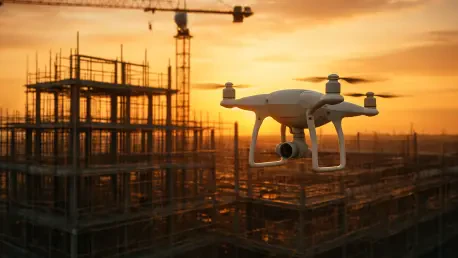
Beyond ground-based monitoring, the deployment of drones has become an essential component of modern risk assessment and progress tracking. These aerial vehicles eliminate the necessity for workers to enter high-risk or inaccessible areas, such as unstable roof structures, high-altitude facades, or restricted zones containing hazardous materials. By performing remote inspections, drones significantly reduce the frequency of high-elevation work, which remains one of the leading causes of workplace injuries in the sector. The high-resolution imagery captured during these flights provides a level of detail that manual walkthroughs cannot achieve, ensuring that no structural anomaly goes unnoticed.
The data collected by these devices is not just for immediate review; it is increasingly converted into detailed digital models and orthomosaic maps that provide project owners with a comprehensive historical record of the build. This aerial data helps in verifying that construction is proceeding according to the engineered plans, which mitigates the risk of rework and structural failure. However, the use of such hardware requires a structured governance program to ensure compliance with strict aviation regulations. Organizations are now implementing rigorous pilot training and data management protocols to address potential privacy concerns regarding the surrounding community while protecting the proprietary nature of the site data.
Leveraging Data Ecosystems for Predictive Insights
Breaking Down Silos: Integrated Analytics and Pattern Recognition
The movement toward shared data ecosystems is successfully breaking down the traditional information silos that once hindered comprehensive risk management. Historically, project schedules, incident reports, and local weather data were stored in separate, disconnected systems, making it nearly impossible to identify the underlying causes of site-wide issues. Modern analytics platforms now connect these disparate data points to reveal critical correlations that were previously hidden. For example, analytics can now demonstrate how persistent project delays or excessive overtime hours correlate directly with a spike in injury rates or a decrease in quality control standards.
This predictive capability enables general contractors to move beyond intuition, allowing them to identify which specific projects or trade partners are trending toward a higher risk profile. By analyzing historical performance data alongside real-time project metrics, safety directors can allocate resources and oversight to the areas where they are most needed. This targeted approach ensures that the most dangerous phases of a project receive the highest level of professional scrutiny, thereby preventing accidents before they occur. The ability to forecast potential failures based on subtle shifts in site behavior represents a massive leap forward in preserving both human life and project profitability.
Creating Digital Twins: Long-Term Quality Control and Defect Prevention
Data analytics also plays a vital role in long-term quality control and the prevention of construction defects that often surface years after a project is completed. By creating a “digital twin” of a project—a virtual representation that matches the physical structure—firms can identify deviations from architectural specifications early in the building lifecycle. These tools allow for the comparison of as-built conditions against the original Building Information Model, flagging discrepancies in material thickness, structural alignment, or utility placement. Rectifying these errors during the active construction phase is significantly less expensive than attempting repairs once the building is occupied.
Furthermore, this digital record-keeping provides a level of transparency that manual logs simply cannot match, reducing the likelihood of costly litigation regarding latent defects. By maintaining a verifiable “golden thread” of information from design to completion, firms can prove that specific quality standards were met at every stage of the process. This proactive approach to defect prevention not only protects the structural integrity of the asset but also safeguards the firm’s reputation and financial bottom line from the long-tail risks associated with construction claims. The integration of predictive data into the quality assurance process has redefined the standards of craftsmanship for the modern era.
Transforming the Claims Process Through Technology
Optimizing Resolution: Early Severity Models and Administrative Efficiency
The digital revolution extends deep into the post-loss phase, where technology is fundamentally streamlining how claims are reported, evaluated, and resolved. Early severity models now use sophisticated historical data sets to flag specific claims that may involve high-cost litigation or medical complexity as soon as they are entered into the system. By identifying these “red flag” cases immediately, senior adjusters can intervene within hours rather than weeks, ensuring that the injured party receives the necessary care and that legal strategies are implemented before costs spiral out of control.
In addition to severity modeling, AI tools are significantly improving administrative efficiency by organizing massive volumes of legal documents, medical records, and demand packages. These systems can ingest thousands of pages of unstructured text, extracting key facts and dates to create a concise summary for the claims handler. This automation allows professionals to focus on the strategic evaluation of a case rather than being bogged down by tedious data entry. The result is a much faster resolution cycle, which reduces the overall financial impact of a claim and allows the construction firm to move forward without the weight of unresolved legal liabilities hanging over the project.
Preserving Factual Baselines: Digital Documentation and Site Cameras
Digital tools provide an indisputable factual baseline for claims, significantly reducing disputes over liability and the specific circumstances surrounding an incident. The proliferation of job site cameras, wearable devices, and digital logs ensures that evidence is preserved in its original state, providing a clear and objective documentation of whether proper safety controls were in place at the time of an incident. This transparency is beneficial to all parties involved, as it eliminates the reliance on conflicting testimonies or the fading memories of witnesses who may have been under significant stress during the event.
The ability to replay the minutes leading up to an accident allows investigators to understand the root cause with scientific precision. Was it a mechanical failure, a breach of protocol, or an environmental factor? Having the answer to this question available in high-definition video or a digital sensor log speeds up the settlement process and ensures that outcomes are based on reality rather than negotiation tactics. As a result, the integration of these technologies leads to higher-quality claim resolutions and improved financial predictability. Firms that utilize these tools find themselves better equipped to defend their safety records and manage their insurance premiums effectively over the long term.
Navigating the New Frontier of Digital Vulnerabilities
Securing the Attack Surface: Cybersecurity and Operational Risk
As construction sites become increasingly tech-dependent, the industry faces an expanding “attack surface” for cyber threats that goes far beyond the theft of corporate emails or financial records. An operational cyberattack on a Building Information Model or connected machinery can lead to immediate physical safety hazards and catastrophic project delays. For instance, if a hacker gains access to the controls of a connected crane or a site’s automated access control system, the potential for physical harm is immense. Firms must now view cybersecurity as a fundamental component of site safety, treating digital firewalls with the same level of scrutiny as physical perimeter fencing.
This environment requires a holistic approach to resilience where Information Technology departments work in tandem with risk management and field operations teams to protect the integrity of the project. Organizations are beginning to implement “cyber-safety” audits, checking that IoT devices on the site are properly encrypted and that subcontractors are following strict digital hygiene protocols. A vulnerability in a single subcontractor’s tablet could potentially provide a gateway into the entire project’s data network, compromising sensitive blueprints or scheduling software. Protecting this digital infrastructure has become a non-negotiable aspect of delivering a project safely and on time in an interconnected world.
Maintaining Ethical Integrity: Privacy and the Human-in-the-Loop Requirement
The use of AI and wearable sensors introduces complex ethical and legal challenges regarding data privacy and the potential for algorithmic bias. Collecting sensitive information about a worker’s heart rate, location, and productivity requires rigorous protocols to ensure that data is stored securely and used only for its intended safety purposes. There is a growing concern that if this data is used for punitive measures or performance rankings, it could damage the trust between management and the workforce. Clear communication and transparent data governance policies are essential to ensure that workers feel protected by the technology rather than monitored by it.
Additionally, it is critical to maintain a “human in the loop” to ensure that AI serves as a decision-support tool rather than an autonomous decision-maker. There is a inherent risk that AI models trained on flawed or incomplete historical data could produce biased outputs, particularly in areas like subcontractor selection or performance evaluations. To mitigate these risks, all AI-generated recommendations must be validated by qualified safety professionals and engineers who can provide the necessary context that an algorithm might lack. By combining the scalability of machine intelligence with the nuanced judgment of human experts, the industry can avoid the pitfalls of automated error and ensure that safety decisions remain grounded in professional expertise.
Synthesizing Innovation into Operational Resilience
The transformation of construction risk management was marked by a decisive shift from historical analysis to real-time, predictive intervention. Industry leaders successfully navigated the complexities of integrating AI, drones, and data analytics into their daily operations, ultimately creating a safer and more efficient environment for all participants. These advancements allowed for the mitigation of physical hazards and the streamlining of legal processes, providing a comprehensive framework for resilience in a digitally-dependent era. The evidence showed that firms embracing these tools experienced fewer catastrophic incidents and maintained more stable insurance costs, proving that the investment in technology was as much a financial strategy as it was a safety initiative.
Moving forward, the most effective strategy for construction firms involves the continuous synthesis of technological innovation with rigorous human oversight. Organizations should prioritize the establishment of unified governance models that treat cybersecurity with the same urgency as structural integrity, ensuring that digital defenses are integrated into the earliest stages of project planning. Furthermore, fostering a culture of transparency regarding data use and privacy will be essential for maintaining trust among the workforce and trade partners. By viewing digital tools as an extension of professional judgment rather than a replacement for it, the industry can build a future that is not only more productive but fundamentally more secure against both physical and virtual threats. Professional development must now include digital literacy for safety officers to ensure they can interpret the complex data streams that now define the modern job site.