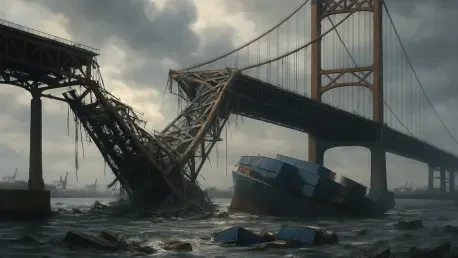

The sheer magnitude of the Francis Scott Key Bridge disaster in Baltimore has fundamentally altered the financial trajectory of the global marine insurance industry by establishing a record-breaking loss benchmark. What began as a complex recovery operation has evolved into a fiscal phenomenon that surpasses previous maritime catastrophes in both scale and complexity. Recent assessments place the total insured loss at a staggering $2.8 billion, a figure that represents a massive escalation from the initial market projections of approximately $1.5 billion. This development serves as a wake-up call for stakeholders who previously relied on historical data that no longer reflects the reality of modern infrastructure values and liability risks. The surge in these estimates highlights a significant shift in how the industry must account for large-scale bridge failures. While the 2012 grounding of the Costa Concordia was long considered the high-water mark for marine claims, the Baltimore event now stands as the definitive case study for systemic risk in the mid-twenties.
Unpacking the Financial Drivers of Increased Claims
The primary engine behind this $1.3 billion deterioration in loss estimates is the unprecedented cost associated with modern bridge reconstruction and the subsequent logistical challenges. The settlement framework between the State of Maryland and its various insurers reveals that nearly $2.5 billion of the total loss is dedicated specifically to the physical replacement of the infrastructure itself. Beyond the steel and concrete, the claim is weighed down by a labyrinth of secondary liabilities, including massive pollution mitigation efforts, extensive wreck removal, and the persistent drain of business interruption. Furthermore, the loss of toll revenues adds a layer of economic impact that complicates the final payout structure. These factors combined have created a perfect storm of financial liability that tests the limits of traditional maritime policy wording. As the industry moves through 2026 and toward 2028, these figures will likely dictate the foundational pricing models for all major transit-related infrastructure coverage.
This concentrated financial burden does not fall upon a single entity but is instead distributed through a sophisticated network of global players. The International Group of P&I Clubs manages such astronomical claims via a specialized pooling mechanism designed to absorb shocks that would otherwise bankrupt a standard insurer. This process involves an extensive excess-of-loss reinsurance program where the heaviest weight of the $2.8 billion loss is transferred to the global reinsurance and retrocession markets. For several prominent firms, this single maritime event constitutes a significant erosion of their overall capital base, forcing a recalibration of their risk appetites. The interconnected nature of these markets means that a tremor in the Baltimore shipping lane is felt in the boardrooms of London, Zurich, and Bermuda. This distribution model ensures market stability, yet it simultaneously creates a ripple effect that influences the cost of doing business for maritime operators across the globe.
Market Resilience and the Paradox of Capital
From a broader market perspective, the Baltimore bridge loss is sending a series of conflicting signals to investors and underwriters alike. On one hand, the cumulative strain of this disaster, coupled with lingering aviation leasing claims and ongoing geopolitical instability, is placing measurable pressure on corporate balance sheets. Underwriters are increasingly cautious, and industry analysts suggest that marine liability rates will inevitably see a correction to account for this new level of severity. There is a palpable sense that the era of bargain-rate coverage for high-value infrastructure is ending as the true cost of catastrophe becomes impossible to ignore. However, this pressure exists alongside a counterintuitive trend of capital abundance. Despite the record-breaking losses, fresh investments continue to flow into the reinsurance sector, attracted by the higher yields and the structural reforms that have bolstered industry-wide resilience during recent years.
The paradox of the current market lies in the fact that even a multi-billion-dollar marine loss has not yet triggered a broad hard market across all sectors. Broad reinsurance remains characterized by significant capacity, which has maintained a competitive environment and even led to price softening in unrelated lines during the most recent renewal cycles. This surplus of capital acts as a buffer, preventing the Baltimore incident from causing a total market freeze. The challenge for reinsurers is maintaining pricing discipline when the immediate need for rate hikes is offset by a supply of capital that empowers buyers to negotiate more favorable terms. This dynamic creates a complex landscape where marine liability is becoming more expensive, while the overall reinsurance market remains relatively accessible. Stakeholders must now navigate this bifurcated environment, balancing the specific demands of the marine sector against the broader trends of the global financial markets.
Strategic Adaptations for the Evolving Risk Environment
The Baltimore bridge event served as a critical stress test for the pricing discipline and risk assessment protocols that the insurance industry relied upon during the mid-twenties. While the $2.8 billion total was indeed material for the marine class, it was effectively managed alongside much larger potential exposures, such as the catastrophic $100 billion natural disaster scenarios that regularly haunt the industry. This perspective allowed major players to absorb the shock without compromising their long-term solvency or operational integrity. Experts noted that while the loss shifted long-term thinking regarding infrastructure vulnerability, the current surplus of market capacity ensured that negotiating power remained largely in the hands of the buyers. The event proved that the global reinsurance system was robust enough to handle record-breaking specialized losses without collapsing into a state of panic or liquidity shortage.
In the aftermath of the crisis, leading organizations moved away from reactive strategies and began focusing on proactive portfolio positioning. The lessons from Baltimore encouraged a more rigorous analysis of “tail risks” that were previously dismissed as statistical outliers or improbable occurrences. Risk managers sought to anticipate future market turns by integrating advanced predictive modeling and real-time logistics data into their underwriting processes. This transition allowed clients to better align their coverage with the actual replacement costs of modern infrastructure rather than relying on outdated historical benchmarks. The industry ultimately recognized that while capital remained abundant, the cost of systemic failure was rising at a rate that required a fundamental redesign of liability frameworks. These strategic adjustments ensured that the market remained functional and prepared for the next era of global maritime and logistical challenges through 2028.