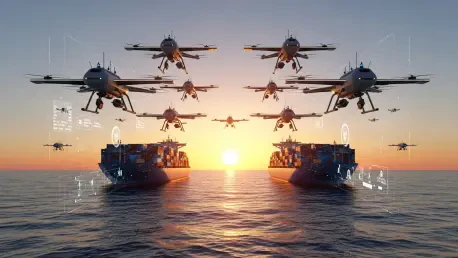

The maritime arteries of the global economy are currently pulsing with an unprecedented level of military friction as direct kinetic engagements between American and Iranian forces redefine the security landscape of the Strait of Hormuz. What began as localized friction has evolved into a high-stakes confrontation that threatens to sever the world’s most critical energy artery. This situation has reached a fever pitch in May 2026, marking a significant transition in how tactical military shifts impact global trade and international diplomacy. By analyzing the shift from defensive posturing to active kinetic exchanges, the depth of a conflict that has moved beyond mere rhetoric into a sustained campaign with profound global economic consequences becomes apparent.
The intensification of these hostilities is not merely a regional concern but a systemic shock to the international order. As American naval assets and Iranian forces engage in multi-domain warfare involving sophisticated drones and cruise missiles, the traditional rules of maritime engagement are being rewritten in real-time. This environment necessitates a rigorous examination of the strategic motivations driving both nations, as the current escalation represents a fundamental break from the status quo. The volatility of the situation suggests that the international community is witnessing the birth of a more aggressive era in maritime security where the threshold for direct military action has been significantly lowered.
A Legacy of Tension: From Blockades to Modern Warfare
The current crisis is deeply rooted in a historical cycle of brinkmanship and the strategic importance of the Strait, which facilitates the passage of approximately 20% of the world’s petroleum and liquefied natural gas. Hostilities that erupted earlier this year are the culmination of years of failed diplomatic initiatives and an intensifying sanctions regime that has pushed regional tensions to a breaking point. While the “Tanker War” of the 1980s set a precedent for maritime interference, the modern landscape is far more complex, characterized by the proliferation of drone technology and sophisticated electronic warfare capabilities that extend the reach of combatants far beyond traditional naval silhouettes.
Understanding this background is essential, as it illustrates why neither side is currently willing to retreat from the precipice. For Iran, maintaining a credible threat to the Strait is viewed as a primary lever of national survival and a tool to exert pressure against international economic isolation. Conversely, for the United States, ensuring the “freedom of navigation” remains a cornerstone of its global security architecture and a non-negotiable requirement for global energy stability. The historical weight of these competing interests ensures that any minor tactical miscalculation in the narrow waterway can rapidly spiral into a broader regional conflagration with no easy diplomatic exit.
The Mechanics of Confrontation and Tactical Shifts
Project Freedom and the Strategy of Layered Defense
Central to the American military response is “Project Freedom,” an initiative designed to carve out a secure maritime corridor for merchant vessels that have been effectively trapped within the Persian Gulf. Unlike traditional ship-by-ship escorts, the navy has implemented a “layered defense” strategy to maximize coverage across the expansive waterway. This approach utilizes airborne early warning systems, advanced electronic jamming, and rapid-response helicopter units—such as Apache and SH-60 Seahawks—to create a defensive bubble around high-value targets. While this allows for more flexible deployments, it has also created a psychological gap for commercial operators who feel inherently exposed without a direct destroyer escort in their immediate vicinity.
The effectiveness of this tactical agility was highlighted by the recent neutralization of several Iranian fast boats by airborne units, yet the persistence of drone strikes suggests that a “one-way lane” remains more of an aspiration than a secured reality. The shift toward a distributed defense model reflects the reality of modern asymmetric threats, where a single large vessel is often less effective than a network of smaller, highly integrated platforms. However, the success of this model is predicated on near-perfect intelligence and rapid communication, both of which are constantly under assault by Iranian electronic warfare units attempting to blind or deceive regional sensor networks.
The Expansion of the Conflict to Vital Infrastructure
The geography of the conflict has expanded dangerously beyond the immediate confines of the Strait, signaling a shift in Iranian targeting priorities. A landmark moment in this escalation was the drone strike on the VTTI oil storage terminal in Fujairah, a primary bunkering hub for the UAE located just outside the chokepoint. For years, Fujairah was considered a safe haven, allowing tankers to stage and refuel without entering the high-risk zones of the inner Gulf. By targeting this facility, Iranian forces have effectively signaled that no regional infrastructure is off-limits, regardless of its distance from the physical narrows of the Strait.
This expansion forces commercial vessels to contend with a much larger “danger zone,” complicating logistics for tankers that previously used the Gulf of Oman as a buffer. The strike on Fujairah not only caused physical damage and injured port workers but also shattered the assumption that regional neutrality would be respected. Consequently, logistics providers must now account for a broader theater of operations, leading to increased fuel consumption as ships take longer, more circuitous routes to avoid the expanding reach of Iranian drone swarms and missile batteries.
The Insurance Dilemma and Maritime Legalities
The military kinetic exchange has paralyzed the marine insurance market, creating a unique crisis for the global shipping industry. Following the designation of the Arabian Gulf as a high-risk conflict zone, war-risk premiums have surged fivefold, making many transits economically unviable for smaller operators. A significant point of contention is the “war exclusion” clause within maritime contracts, which has become a focal point for legal disputes. Because the U.S. and Iran are engaged in “hostilities” rather than a formally declared war, underwriters find themselves in a complex legal gray area regarding the activation of certain policy triggers.
Shipowners are currently facing a precarious situation where they must weigh the promises of military protection against the very real possibility that insurance providers will deny claims based on the technical definition of the conflict. This uncertainty has led to a stagnation in vessel movements, with many crews refusing to enter the region until clearer legal protections are established. The standoff illustrates how the financial architecture of global trade is often as vulnerable to disruption as the physical shipping lanes themselves, as the absence of affordable insurance acts as a secondary blockade that is just as effective as a naval minefield.
Emerging Trends in Modern Maritime Warfare
As the conflict persists, several innovations in warfare are shaping the future of maritime security in ways that will likely endure long after the current crisis. The widespread use of “radar-silence” tactics and autonomous drone swarms by the Iranian Revolutionary Guard Corps represents a shift toward asymmetric naval combat that directly challenges the dominance of traditional carrier strike groups. These technologies allow a less technologically advanced force to project power and create significant risk for multi-billion-dollar assets at a fraction of the cost. This democratization of high-precision lethality means that the oceans are becoming increasingly transparent, and traditional stealth or distance provides less security than in previous decades.
Furthermore, we are seeing the emergence of a “shadow” energy economy, where global powers like China are beginning to ignore U.S.-led sanctions, providing Iran with an economic lifeline that undermines the effectiveness of a naval blockade. This geopolitical shift suggests that future maritime conflicts will be defined as much by technological disruption and sanction-defiance as by conventional firepower. The ability of a state to bypass international financial systems while maintaining a kinetic threat on the water creates a new paradigm of resistance that is difficult for traditional power structures to counter through conventional diplomacy or military force alone.
Strategic Takeaways for Global Stakeholders
The escalation in the Strait of Hormuz offers several critical insights for the international community as it navigates this volatile environment. First, the transition from direct escorts to “layered defense” models requires a new level of coordination between military assets and commercial shipping companies to restore market confidence. Businesses must recognize that the era of passive security is over; active participation in data sharing and threat reporting is now a prerequisite for operating in contested waters. Second, the vulnerability of “safe havens” like Fujairah underscores the need for regional actors to invest more heavily in integrated missile defense systems to protect their economic assets from asymmetric strikes.
For global enterprises, the primary recommendation is to diversify supply chains and prepare for prolonged volatility in energy prices, as the “just-in-time” delivery model is increasingly incompatible with the current risks of the Persian Gulf. Strategies that involve holding larger strategic reserves or securing alternative energy sources are no longer optional but are essential for long-term resilience. Moreover, the insurance crisis highlights the need for a reform of maritime legal frameworks to better address the realities of undeclared asymmetric warfare, ensuring that shipowners and crews are not left financially or physically abandoned during periods of heightened geopolitical tension.
Conclusion: A Fragile Future for the Global Commons
The military clashes in the Strait of Hormuz represent more than just a regional dispute; they are a direct challenge to the stability of the global economic order. As diplomatic efforts remain stalled and military engagements become more frequent, the Strait remains a theater of high-stakes brinkmanship where the margin for error is razor-thin. The significance of this waterway ensures that the eyes of the world remain fixed on its narrow passage, where the balance between regional hegemony and global commerce hangs by a thread. The current trajectory suggests that without a fundamental shift in diplomatic engagement, the risk of a total closure of the Strait remains an ever-present threat to international stability.
Achieving a lasting resolution requires a fundamental shift in the current diplomatic strategies, as the cost of continued escalation is quickly becoming a burden the global economy cannot afford to bear. Stakeholders must prioritize the establishment of a multi-lateral maritime security framework that moves beyond bilateral aggression toward a more sustainable model of collective security. The lessons learned during this period of kinetic exchange emphasize that security in the modern age is not merely about superior firepower but about the resilience of the networks that sustain global trade. Moving forward, the international community must focus on building these resilient systems to ensure that the vital arteries of the world remain open to all, regardless of the shifting tides of regional politics.