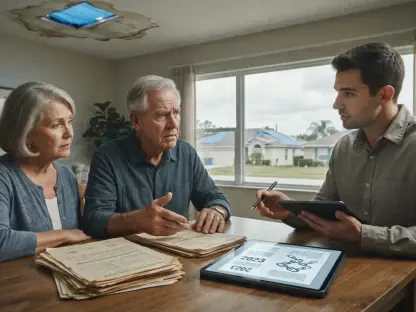

The age of a roof scales the financial disadvantage of an Actual Cash Value policy, making the depreciation deduction more punitive as the asset nears the end of its lifespan. This reality has become a central concern for Florida residents as the state undergoes a significant overhaul of its property insurance regulations. For years, the standard expectation was that a homeowner’s policy would cover the full replacement cost of a damaged roof, ensuring that even an older structure could be restored to a brand-new state after a storm. However, the current landscape has shifted toward a model that prioritizes market stability and affordability over total loss restoration. The transition from Replacement Cost Value to Actual Cash Value represents a fundamental change in how property risk is shared between the insurer and the insured. Homeowners now face an environment where the level of protection they once took for granted is being replaced by policies that account for wear and tear, leaving them with massive bills during a crisis.
The Changing Federal Landscape
New Mortgage Standards: The FHFA Pivot
A major catalyst for this transformation is the recent policy update from the Federal Housing Finance Agency, which has significantly altered the requirements for government-backed mortgages. Historically, entities like Fannie Mae and Freddie Mac maintained strict guidelines that required homeowners to carry full replacement cost coverage for all major home components, including the roof, to protect the underlying asset’s value. As of March 2026, the FHFA has pivoted by allowing these government-sponsored enterprises to accept Actual Cash Value coverage specifically for roofs. This regulatory shift was designed as a strategic response to the escalating insurance crisis in Florida, where soaring premiums have threatened housing affordability and market liquidity. By relaxing these long-standing standards, federal regulators are attempting to provide a safety valve that allows homeowners to secure more affordable, albeit less comprehensive, insurance products that were previously prohibited for properties with active mortgages.
Managing Risk: The Shift in Lender Requirements
While the introduction of these more flexible standards aims to make homeownership more accessible in high-risk zones, it fundamentally changes the nature of the safety net available to Florida residents. By permitting ACV policies, the FHFA is enabling insurance providers to offer budget options that lower the monthly financial burden on the policyholder. This can be particularly beneficial for buyers who are on the edge of qualifying for a loan or for existing homeowners struggling with fixed incomes. However, this flexibility comes with a trade-off that often remains hidden until a catastrophic event occurs. Because the mortgage holder no longer mandates full replacement coverage, the financial responsibility for the gap between a depreciated payout and the actual cost of a new roof shifts entirely to the homeowner. This departure from previous norms reflects a broader trend toward individual risk management, where the consumer must weigh the benefit of lower premiums against the long-term risk of significant out-of-pocket expenses.
The Financial Reality of Depreciated Payouts
Calculating the Cost: The Impact of Roof Aging
The shift toward Actual Cash Value introduces a rigorous accounting methodology known as straight-line depreciation into the claims process, which can drastically reduce the final payout received by a homeowner. Insurers calculate the current worth of a roof by evaluating its material type, installation quality, and expected lifespan against its current age. For instance, consider a roof with a replacement cost of $22,000 and an estimated economic life of 30 years. If that roof is 12 years old at the time of a covered loss, it has effectively lost 40% of its value through wear and tear. Under an ACV policy, the insurance company will automatically subtract this $8,800 in depreciation from the total cost before even considering the policyholder’s deductible. This means the baseline for the claim starts significantly lower than the actual market price of labor and materials, ensuring that the insurer only pays for the remaining life of the asset rather than providing a brand-new replacement as would have occurred under older standards.
Deductible Structures: Navigating Hurricane and Roof Fees
Florida’s insurance framework is further complicated by unique deductible structures that can significantly impact the net payout of any claim, regardless of whether the policy is based on ACV or RCV. Most residents are now accustomed to hurricane deductibles, which operate differently than the flat dollar amounts typical of standard fire or theft claims. Instead of a fixed $1,000 or $2,500 fee, hurricane deductibles are usually calculated as a percentage of the total insured value of the dwelling, often ranging from 2% to 10%. On a home insured for $300,000, a modest 2% deductible means the homeowner must cover the first $6,000 of damage before the insurance company contributes a single dollar. When this high threshold is combined with the depreciation deductions found in ACV policies, the final check from the insurer can be surprisingly small. This layering of financial responsibilities ensures that homeowners maintain significant skin in the game when managing the risks of living in a storm-prone environment.
Strategic Decision-Making for Homeowners
Assessing Risk: Premium Savings versus Out-of-Pocket Costs
Choosing between the lower monthly costs of an ACV policy and the comprehensive protection of RCV is a high-stakes balancing act that depends heavily on a household’s financial liquidity. For residents with significant emergency savings, the new 2026 rules provide a way to reduce fixed monthly overhead by accepting more responsibility for future roof aging. In this context, an ACV policy serves as a financial safety valve that keeps insurance accessible in an increasingly expensive market. However, for many Floridians, a surprise bill exceeding $10,000 would represent a major financial catastrophe. If the ability to pay for a large gap in coverage is not readily available, maintaining a traditional RCV policy is often the more secure path, despite the higher premiums. The primary challenge for homeowners lies in accurately forecasting their ability to cover these costs years into the future, as the potential savings from a cheaper policy are often dwarfed by the massive out-of-pocket requirements that arise when an aging roof finally fails.
Planning Ahead: Asset Management and Mortgage Compliance
Before finalizing any changes to their coverage, homeowners must verify that their specific mortgage provider permits the use of ACV for roof components, as requirements can vary between federal entities and private investors. While Fannie Mae and Freddie Mac have moved toward greater flexibility, some private lenders or smaller banks may still require full replacement cost coverage to protect their security interest in the property. Additionally, the chronological age of the roof must be the primary factor in this decision; the older the asset becomes, the more punitive the depreciation deduction becomes under an ACV framework. Homeowners should also be aware of recoverable depreciation clauses in RCV policies, which require strict documentation and adherence to timelines to receive the full payout. Ultimately, the 2026 regulatory environment offers more consumer choice, but it also places a greater burden of risk management on the individual, making informed decision-making an absolute necessity for ensuring long-term property stability.
Implementing Proactive Risk Mitigation Strategies
The evolution of Florida’s insurance rules throughout 2026 provided a necessary adjustment to a market that had become increasingly unsustainable for both providers and residents. By moving toward a model that incorporates Actual Cash Value for roofs, regulators successfully lowered the barrier to entry for many homeowners, though this came at the cost of reduced protection. To mitigate the risks associated with these changes, residents were encouraged to establish dedicated home maintenance funds to bridge the gap created by depreciation. Many experts advised homeowners to conduct annual roof inspections to document the condition of the asset, which served as a vital defense during the claims process. Additionally, the industry saw a rise in hybrid products that allowed for RCV coverage on newer roofs while transitioning to ACV as the materials reached a certain age. Those who proactively consulted with independent agents to review their mortgage compliance were better positioned to weather the financial impact of subsequent storm seasons.