
Simon Glairy is a seasoned authority in the high-stakes world of maritime risk and insurance technology, a field where legal intricacies often meet the raw power of the ocean. With a career dedicated to deciphering the complexities of risk management, he has become a go-to expert for understanding how geopolitical shifts translate into environmental and financial exposure on the high seas. In this discussion, we explore the unfolding crisis of the tanker rotting off the coast of Oman and the unprecedented involvement of a sanctioned Russian insurer. We delve into the complexities of obtaining legal waivers during environmental emergencies, the structural failures of the “shadow fleet,” and the diverging data that complicates our understanding of one of the largest oil slicks in recent memory.
When a sanctioned insurer like AlfaStrakhovanie is the primary source of funding for an environmental emergency, what specific legal and operational hurdles must be cleared before any work can begin?
The situation with the Suezmax tanker is a legal labyrinth because transacting with a sanctioned entity is strictly prohibited under Western law. AlfaStrakhovanie was designated by the EU in December 2023 for its role in high-risk shipping practices, and the UK followed suit in November 2024, making any financial interaction a potential criminal offense. Before salvors could even deploy their 100 tons of equipment, they had to secure specific licenses or waivers from regulators like the US Treasury’s Office of Foreign Assets Control or the UK’s Office of Financial Sanctions Implementation. This is not a simple rubber-stamping process; it requires proving that the funds are used strictly for humanitarian or environmental protection to prevent a catastrophe. Even with a waiver, the money remains “traceable” to a sanctioned source, which creates a massive compliance headache for Every bank and contractor involved in the chain. It’s a tense, high-stakes waiting game where lawyers have to move as fast as the oil slick to prevent total ecological collapse.
The reports regarding the vessel’s condition and the local weather are harrowing; how do 40-knot winds and massive swells impact the technical reality of a salvage operation on a tanker with already compromised tanks?
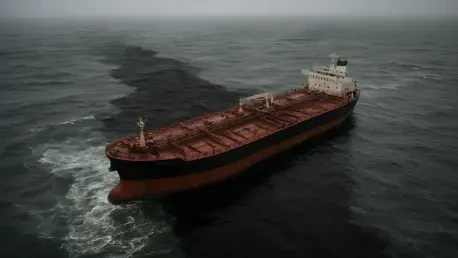
Salvaging a ship like the Caroline Bezengi during the Khareef monsoon is a nightmare scenario for any response team. We are looking at a vessel where seven of the twelve cargo tanks are already leaking, meaning the structural integrity of the hull is rapidly failing as seawater contaminates the remaining cargo. When you add 40-knot winds and four-meter swells into that equation, the physical stress on the weakened steel is immense, threatening to snap the tanker in two at any moment. The “extremely challenging” conditions described by responders include dense fog and lashing rain, which makes aerial surveillance nearly impossible and boat transfers dangerous for the crew. You can almost feel the vibration of the hull as it sits lower in the water, battered by the monsoon, while salvors desperately try to stabilize a stateless vessel that has been essentially disowned by its own flag registry.
There is a staggering gap in the reporting of the spill size, with estimates ranging from 390 to 2,000 square kilometers—what does this lack of consensus tell us about the current state of independent maritime monitoring?
The discrepancy in these numbers is a vivid illustration of how difficult it is to track environmental disasters in remote or politically sensitive waters. When you have Greenpeace Germany estimating 600 square kilometers while others suggest 800 or even 2,000, it highlights the variability in satellite passes and the different analysis methods used by watchdogs. A slick isn’t a static object; it is a shifting sheen that changes shape with every gust of wind and wave, often making it look larger or smaller depending on the sensor’s sensitivity. This confusion is exacerbated by a lack of independent verification on the ground, leaving us to rely on conflicting reports until the oil physically hits the 40 kilometers of Omani coastline. It’s a sobering reminder that our “eye in the sky” technology still struggles to provide a single, unified truth when a crisis is unfolding in real-time.
As Western P&I clubs exit Russian-linked tonnage, what are the long-term implications for the maritime industry when a vessel lacks the traditional $1 billion pollution coverage?
The exit of the International Group of P&I clubs from Russian-linked shipping has created a massive vacuum that is now being filled by domestic insurers with opaque balance sheets. Traditionally, these clubs provide a pooled reinsurance net of up to $1 billion per incident, a gold standard that ensures even the most catastrophic oil spills can be cleaned up. Now, we are seeing a “shadow fleet” that accounts for roughly 17% to 20% of the global oil tanker fleet, many of which carry paperwork that looks like insurance but lacks the actual capital to pay a nine-figure claim. Research shows that insurance data is missing for more than a third of the global tanker fleet, leaving coastal nations like Oman to cross their fingers and hope for the best. When a vessel sits outside the mainstream system, a grounding is no longer just a maritime accident; it becomes a sovereign financial risk for the nearest coastline.
With oil now reaching the Omani mainland and threatening endangered species, how should underwriters and ship owners adjust their risk assessment protocols to account for the “shadow fleet” phenomenon?
Underwriters must move beyond simply checking if a vessel has a piece of paper that says “insurance” and start verifying if that cover is backed by a member of the International Group. The rise of ship-to-ship transfers and murky ownership structures means that every renewal conversation now needs to be a deep dive into the actual claims-paying ability of the insurer of record. If a ship is moving through maritime chokepoints without verifiable cover, it should be treated as a high-risk liability regardless of its age or previous history. We are seeing a live test off the Hallaniyat Islands where a marine reserve, home to one of the world’s most endangered humpback whale populations, is the one paying the ultimate price for these regulatory gaps. For the industry, this is a wake-up call that the “shadow fleet” is no longer a theoretical problem; it is a 2,000-square-kilometer reality that can wash up on your doorstep at any time.
What is your forecast for the future of shadow-fleet regulation following this incident?
The Caroline Bezengi crisis will likely serve as the primary catalyst for the adoption of the Nordic-Baltic proposal for mandatory insurance checks at critical maritime chokepoints. Until now, such measures were seen as too diplomatically sensitive or difficult to enforce, but the image of oil hitting 40 kilometers of Omani coastline despite a sanctioned insurer’s presence will change that math. I expect to see a significant push for “transparency mandates” where tankers must prove their P&I cover is backed by a verifiable $1 billion pool before they are allowed to enter high-traffic international waters. We are moving toward a bifurcated shipping world where the risk of being a “stateless” or “shadow” vessel becomes so operationally expensive—due to delays, detentions, and the inability to secure salvage in a timely manner—that the current model of murky ownership becomes unsustainable for all but the most desperate operators.