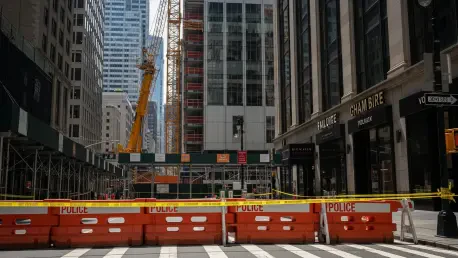

The sudden realization that a skyscraper is structurally compromised can transform a routine afternoon in Midtown Manhattan into a chaotic struggle for safety and financial survival. This became a reality at 235 East 42nd Street when construction teams discovered buckling steel columns on the 21st floor of the former Pfizer headquarters, prompting an immediate city response. The Department of Buildings cordoned off a multi-block radius and ordered the evacuation of nine surrounding buildings to mitigate the risk of a catastrophic collapse. This project, which aimed to convert the massive office structure into 1,600 modern apartments, illustrates the inherent dangers of high-density urban redevelopment. While engineers eventually stabilized the tower, the local business community found itself paralyzed by an external crisis. For restaurants and retail shops within the exclusion zone, the temporary peace of mind regarding structural safety did little to alleviate the mounting debt from lost revenue and operational paralysis during the mandatory closure.
Identifying Potential Insurance Triggers
Common Provisions: For Urban Disruptions
Recovery for these businesses depends heavily on the specific language found in their insurance policies and whether they can prove their situation meets narrow criteria. One of the most relevant triggers for this type of incident is Civil Authority coverage, which applies when a government body prohibits access to a premises because of damage at a nearby location. For this to work, the nearby damage usually must be caused by a risk that is also covered under the claimant’s own policy. This means if the buckled column was deemed a result of a standard construction mishap, businesses must ensure their policies do not have specific exclusions for such occurrences. The complexity increases when the order is issued as a preventative measure rather than a response to an actual collapse. Policyholders must demonstrate that the government action was a direct consequence of the physical threat posed by the adjacent structure, creating a vital link for reimbursement for the period when they were forced to remain closed by the city.
In addition to government orders, businesses may look to Ingress and Egress coverage if the physical path to their storefront was blocked, even without a formal evacuation order from the city. This specific provision is designed for situations where a business remains legally allowed to operate but becomes physically unreachable due to debris, safety tape, or police barricades. For a coffee shop or a boutique in the shadow of the Pfizer building, the inability of customers to walk through the front door constitutes a functional shutdown. Furthermore, specialized provisions like service interruption coverage might apply if the emergency caused a loss of power, water, or gas, provided the utility infrastructure itself was damaged by the structural shifting. The success of these claims often hinges on the distinction between a minor temporary inconvenience and a total blockage of access that prevents the business from functioning. Clear evidence showing that customers and employees were physically barred from the site is essential for any successful recovery of lost business income.
The Hurdle: Direct Physical Loss Requirements
A major obstacle for many claimants is the standard requirement that business interruption must stem from direct physical loss or damage to the insured property itself. In the Midtown incident, most of the affected businesses remained structurally sound, yet they could not open because the surrounding streets were cordoned off for public safety. Insurance companies frequently argue that if the walls, windows, and inventory of the insured business are intact, the policy does not trigger, leaving a significant gap for those suffering purely from the external environment. This interpretation creates a paradox where a business can be perfectly safe but completely insolvent because it is located next to a hazard. Legal precedents have been mixed on this issue, with some courts favoring a broad interpretation that includes the loss of use, while others strictly adhere to the physical damage requirement. This tension forces business owners to scrutinize their policy definitions of property and loss to identify any specific language that might support a claim.
The shift toward office-to-residential conversions in 2026 has introduced new variables into this legal debate, as the aging infrastructure of older towers presents unique risks during renovation. When a structural failure occurs nearby, the resulting economic vacuum can last for weeks, even if no dust ever settles on the claimant’s shelves. Insurers often rely on the argument that the physicality of the loss must be tangible and localized to the policyholder’s address. To counter this, some legal experts suggest that the loss of function should be treated with the same weight as physical destruction, especially when the cause is a structural emergency of this scale. Businesses must be prepared to argue that the physical instability of the neighboring building created a tangible dangerous condition that essentially altered the physical state of their own premises by making it uninhabitable. Navigating this nuance requires a sophisticated understanding of how policy endorsements can modify or expand the definition of physical loss in dense metropolitan areas.
Strategies for Securing a Successful Claim
Building a Narrative: Of Financial Impact
To overcome the skepticism of insurance adjusters, business owners must act as their own historians by creating a comprehensive claim package that details every aspect of the disruption. This involves more than just showing a drop in sales; it requires a narrative that connects the construction emergency directly to the financial loss through a chronological record of events. This documentation should include comparative financial statements from the same period in previous years to establish a baseline for expected revenue. Additionally, logs of canceled reservations, missed appointments, and voided contracts provide granular evidence of the immediate impact. If a catering firm lost several high-value contracts because their kitchen was inside the evacuation zone, those specific losses must be tied to the dates of the city’s closure orders. The goal is to leave no room for the insurer to claim that the dip in revenue was caused by general market trends or seasonal fluctuations rather than the specific structural emergency at the nearby site.
Beyond lost revenue, business owners should meticulously track all extra expenses incurred as a direct result of the emergency, such as payroll for displaced staff or the costs of temporary relocation. Extra expense coverage is a vital component of many commercial policies, but it requires proof that the spending was necessary to minimize the total loss or maintain operations elsewhere. For instance, if a law firm rented temporary office space to meet filing deadlines while their primary office was inaccessible, those rental fees and the cost of moving files should be documented. Even marketing costs aimed at informing customers that the business has reopened can sometimes be recovered under these provisions. By maintaining a dedicated ledger for emergency-related spending, managers can present a clear, professional accounting that demonstrates proactive mitigation of the crisis. This level of detail not only speeds up the adjustment process but also builds credibility with the insurance carrier, making it harder for them to deny legitimate claims.
Accounting for Timelines: Regulatory Investigation
The duration of the payout, known as the period of restoration, is often a point of contention between the insurer and the policyholder during these complex urban recovery efforts. In the case of the Pfizer building, the timeline was not just about how fast the steel could be shored up, but how long city agencies took to complete their safety investigations. Insurers may try to limit payments to the theoretical time it took to stabilize the building’s structure, while businesses argue they should be covered for the entire duration the neighborhood remained closed. This discrepancy can result in weeks of unpaid losses if the city maintains a frozen zone for forensic engineering analysis long after the immediate danger has passed. Business owners must emphasize that their restoration is not complete until the government officially permits them to resume normal operations. Negotiating this period requires a clear understanding of the difference between physical repairs and the regulatory hurdles that prevent a business from reopening its doors.
Businesses that navigated the financial aftermath of the Midtown structural emergency discovered that proactive preparation was the only effective defense against total loss. It was essential for owners to review their insurance policies for specific endorsements like Civil Authority or Extended Business Income before a crisis occurred. Those who maintained digital backups of their financial records and operational logs were able to file claims significantly faster than those who struggled to access physical documents within the evacuated zone. Moving forward, the most successful firms implemented a multi-layered risk strategy that included setting aside emergency cash reserves and establishing secondary locations for critical operations. They also engaged in active communication with local development boards to stay apprised of any potential structural risks in the neighborhood. By treating insurance as a dynamic part of their business strategy rather than a static expense, these organizations ensured they were resilient enough to survive the next inevitable urban disruption.