
As a leading figure in the evolution of Insurtech and risk management, Simon Glairy has spent years navigating the complex intersection of technology and commercial insurance. His expertise is particularly vital in the renewable energy sector, where shifting weather patterns and rapid technological advancements create a volatile risk landscape. In this discussion, we explore the dramatic transformation of the insurance market for wind, solar, and battery storage. We delve into how the industry has moved from a decade of “hard” market conditions—characterized by soaring premiums and restrictive terms—to a period of unprecedented softening that hands significant leverage back to asset owners.
The conversation covers several critical themes, including the surge in insurer appetite driven by massive growth in utility-scale capacity and the nuances of managing natural catastrophe risks like hail. We also examine the strategic shift from merely chasing lower premiums to addressing structural pain points such as high deductibles and limited coverage. Furthermore, we touch upon the emerging cyber threats within SCADA systems and the industry’s pivot toward “repowering” aging assets rather than decommissioning them, painting a picture of a sector that is maturing and finding its footing in a cleaner energy future.
After a decade of rising costs and restrictive terms, the market is finally seeing double-digit rate cuts for renewable energy projects. How would you describe the current atmosphere for asset owners who have spent years paying more for less coverage?
The shift we are seeing right now is nothing short of a total role reversal that has been years in the making. For the better part of a decade, renewable energy owners were essentially at the mercy of a hardening market where insurers were pulling back, raising rates, and tightening terms to the point where many felt they were getting very little value for their premiums. Today, that environment has flipped into a rapidly softening market where the appetite from insurers is stronger than it has been in seven or eight years. We are seeing double-digit rate reductions being offered with surprisingly little resistance, which is a breath of fresh air for developers who have struggled with tight margins. It is a moment of significant leverage for the buyers; they finally have the upper hand in negotiations and can start to reclaim some of the ground they lost during the lean years.
The data suggests a massive influx of new capacity, with solar and battery storage expected to dominate new utility-scale projects in 2025. What is driving this intense insurer interest despite the shifting political and policy landscape?
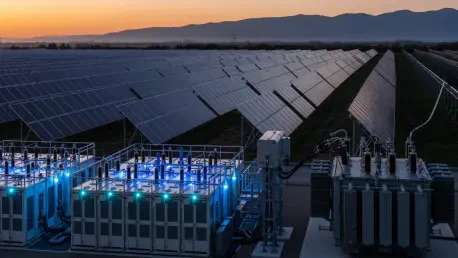
The momentum behind renewables has become largely decoupled from the immediate political rhetoric because the underlying economics are simply too compelling to ignore. According to current projections, solar and battery storage will account for roughly 81% of all new US utility-scale generating capacity in 2025, which translates to about 32.5 GW of solar and at least 18 GW of battery storage hitting the grid. This scale is staggering, and insurers are eager to get a piece of that action because these assets have never been more commercially viable. We’ve seen battery storage capacity grow by about 59% in just the last 12 months leading into late 2025, reaching a record-breaking 57.6 GWh in total additions. From an insurance perspective, these are compact, high-value assets that provide essential grid-balancing services, making them an incredibly attractive risk profile compared to the legacy infrastructure of the past.
Natural catastrophes remain a primary concern for insurers, with hail specifically being a major “silent killer” for solar farms. How are providers managing these risks without completely abandoning regions like Texas that are prone to severe weather?
The industry has moved away from the blunt instrument of geographic exclusion and toward a more sophisticated, structured approach to risk management. Hail is a fascinating peril because, while it only accounts for about 1% of filed claims, an analysis by AXIS Capital found that it represents roughly 55% of the total gross amount of solar natural catastrophe and extreme-weather claims in North America. To put the scale in perspective, US insured losses from severe convective storms have exceeded $50 billion in both 2023 and 2024. Instead of saying “we won’t write solar in Texas,” insurers are now rewarding resilience and technical solutions, such as hail-stow protocols where tracker-mounted panels are tilted to a steep angle to deflect impact as a storm approaches. They are managing their exposure through higher deductibles or specific sublimits rather than walking away, which keeps the market competitive while ensuring they aren’t wiped out by a single storm.
Given that the current window of aggressive rate cuts and high insurer appetite might not stay open forever, what strategic advice do you have for brokers and clients to maximize this cycle?
My strongest advice is to resist the temptation to focus solely on the lowest possible premium and instead look at the structural integrity of your coverage. During the hard market, deductibles for solar farms often skyrocketed from a manageable $25,000 to as much as $250,000, leaving owners with significant “skin in the game” that they might not actually want. This is a rare opportunity for clients to identify their most painful operational gaps—whether that is lowering those massive retentions, expanding the wording of their policies, or securing higher limits for business interruption. Because competition is so high right now, you can negotiate for broader terms and conditions that will protect you long after this soft cycle inevitably begins to tighten again. It’s about building a fortress around your assets while the materials to do so are affordable and readily available.
As the scale of renewable portfolios grows, there is increasing talk about cyber risks and the vulnerability of SCADA systems. How significant is the threat of a “single point of failure” in this distributed energy model?
While we haven’t seen a wave of major client losses tied to cyber events yet, the theoretical risk is something we monitor very closely, particularly regarding the remote monitoring and control systems known as SCADA. The distributed nature of wind and solar actually provides a bit of a natural defense against the kind of massive contagion that keeps traditional utility underwriters up at night. However, the real “nightmare scenario” is a cyber attack targeting a major manufacturer’s fleet rather than an individual site; if a single vulnerability could take down every turbine produced by one of the top three global manufacturers, that becomes a systemic problem. We always recommend that our clients treat cyber coverage as a core necessity, even though the primary focus on the ground remains property damage and weather-related business interruption. It is about understanding that as these systems become more interconnected and digital, the “physical” risk and the “digital” risk are becoming two sides of the same coin.
There has been a lot of discussion regarding the environmental and financial costs of decommissioning older sites. Are we seeing a trend toward abandonment, or is the industry finding a more sustainable path forward?
The reality on the ground is actually far more optimistic than the “graveyard of turbines” narrative suggests; we are seeing a massive trend toward “repowering” rather than decommissioning. Most developers realize that there is immense value in the existing site permits, grid connections, and land rights, so instead of walking away, they are upgrading older wind farms with newer, more efficient equipment. While environmental coverage products exist to manage the risks of dismantling assets, the industry is currently in a healthy place where owners are focused on squeezing more performance out of their aging sites. The infrastructure is being treated as a long-term investment that evolves over time, which reduces the perceived risk of “stranded assets” and proves that the renewable sector is maturing into a truly sustainable part of the global energy mix.
What is your forecast for the renewable energy insurance market over the next three to five years?
I expect that while the current “free-for-all” of double-digit rate cuts will eventually stabilize, we are entering a period of long-term maturity where the focus shifts from price to precision. The massive expansion of battery storage—with that 59% growth rate we’ve seen recently—will force insurers to become experts in chemical and thermal risks, moving away from simple property underwriting. We will likely see a more bifurcated market where “resilient” projects that use smart technology like hail-stow protocols or advanced SCADA monitoring get significantly better terms than those that don’t. Ultimately, as the sector becomes the dominant force in the power grid, the insurance products will become more integrated and data-driven, using real-time performance metrics to adjust coverage and premiums on the fly, making the old annual renewal cycle feel like a relic of the past.