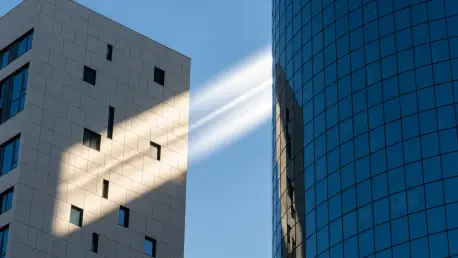

The rise of high-performance architecture has brought with it a series of unintended solar hazards that are beginning to redefine the insurance landscape for commercial properties. As sustainable construction becomes the global norm, the use of energy-efficient glazing has transitioned from a mere thermal barrier into a potential high-intensity magnifying lens. This phenomenon, often referred to as a concentrated solar reflection, occurs when sunlight hits modern glass surfaces and is redirected with such intensity that it can cause significant property damage or physical harm. Stakeholders across the spectrum, including architectural firms, glass manufacturers, and commercial property insurers, are now forced to reckon with a risk that was once dismissed as a freak architectural anomaly.
The role of high-emissivity glass in modern construction is central to this emerging hazard, as these materials are specifically designed to reflect heat away from buildings to reduce cooling costs. While this is highly effective for improving a building’s carbon footprint, the concentrated energy from these reflections creates hot spots in the surrounding urban environment. When a facade covers thousands of square feet, even a minor deviation in the glass surface can concentrate sunlight onto a single point on a neighboring sidewalk or building. Consequently, the very technology used to save energy is now identified as a source of thermal destruction, necessitating a more rigorous approach to urban planning and risk assessment.
The Intersection of High-Performance Architecture and Unintended Solar Hazards
Analyzing the rise of green building materials reveals a direct correlation between advanced thermal coatings and the emergence of the concentrated solar reflection phenomenon. As architects prioritize net-zero energy targets, the reliance on reflective surfaces has increased, often without a complete understanding of how these surfaces interact with their immediate surroundings. This lack of foresight has led to documented cases where the exterior of a building becomes a functional parabolic mirror, focusing heat onto the street level or adjacent residential properties.
Identifying key stakeholders is essential for addressing the liability associated with these solar hazards, as the responsibility often spans multiple disciplines. Architectural firms must now consider the geometric consequences of their designs, while glass manufacturers are under pressure to produce panes that maintain efficiency without creating hazardous glare. Commercial property insurers are also at the forefront of this issue, as they must determine how to price coverage for a peril that is both highly localized and potentially devastating in its impact.
Emerging Architectural Trends and the Quantifiable Impact of Solar Convergence
Technological Evolution and the Shift Toward Reflective Energy Efficiency
The market-wide transition to low-E glass is now a standard requirement for meeting environmental regulations and reducing the operational costs of large-scale developments. These glass products feature microscopic metallic layers that selectively filter solar radiation, allowing light to enter while reflecting a significant portion of the heat. However, the mechanics of bowing present a significant problem; when glass panes are installed, changes in barometric pressure or temperature can cause the glass to curve slightly inward. This curvature turns a flat, benign surface into a focusing lens that concentrates sunlight into a high-intensity beam.
Evolving consumer and developer preferences for glass-heavy facades in dense urban environments further exacerbate the risk of solar convergence. The aesthetic demand for sleek, reflective towers often overrides concerns about the thermal impact on the neighborhood. To combat this, new opportunities for specialized glass coatings and permanent sun-shading solutions have emerged as a way to mitigate thermal focus. These technologies are designed to diffuse light or block specific angles of reflection, providing a proactive way for developers to reduce their liability before a building is even completed.
Mapping the Escalation of Heat-Related Property Damage and Safety Incidents
Reviewing historical data from landmark cases reveals the sheer power of these solar reflections, with London’s Walkie-Talkie building and the Vdara Hotel in Las Vegas serving as primary examples. In London, the concave shape of the building concentrated sunlight to temperatures as high as 117°C, which was sufficient to melt parts of luxury vehicles and ignite carpets in nearby shops. Performance indicators from these events show that reflected temperatures can reach 362°F in residential areas, a level of heat that facilitates spontaneous ignition of common landscaping materials like mulch or cedar shingles.
Projecting the frequency of these hot spot events is a priority as global temperatures rise and urban density continues to increase. The probability of an optical window of opportunity—where the sun reaches the perfect angle to cause damage—is growing as heatwaves become more frequent and severe. This shift has led to a forward-looking growth in forensic engineering demand, as insurance companies and property owners seek experts who can accurately model solar paths and identify glass-induced fire hazards.
Forensic Challenges and the Complexities of Non-Contact Property Damage
Addressing the difficulty of proving proximate cause is a major hurdle in cases involving fires ignited by non-contact thermal radiation. Unlike traditional fires that result from a direct ignition source or electrical failure, solar-induced fires occur because of energy transmitted across a distance. This creates a complex evidentiary chain where forensic investigators must track the sun’s position and the specific angle of a window pane to prove that a building several hundred feet away was responsible for the damage.
The conflict between skeptics who view these incidents as anomalies and forensic experts who identify a systemic risk continues to shape the debate within the insurance industry. Some professionals argue that the number of documented cases is too low to justify widespread changes in building standards, while others point to the increasing sophistication of thermal modeling as proof that the risk is predictable. Strategies for insurance adjusters now include differentiating between common residential fires and window-induced focal point ignitions by looking for specific melt patterns and heat signatures that are characteristic of concentrated solar beams.
Navigating the Regulatory Landscape and the Shift in Building Standards
The impact of state-level building code revisions is becoming evident as regions with documented window fires begin to implement stricter standards. In North Carolina, local authorities have investigated multiple residential fires caused by low-E glass reflections, leading to discussions about mandatory sun-shading or specific installation requirements for high-performance windows. The role of the US Consumer Product Safety Commission has also grown, as the agency now investigates residential glass hazards that were once considered minor nuisances but are now recognized as genuine fire risks.
Compliance requirements for sun-glare assessments are increasingly integrated into the planning stages of new high-rise developments, especially in jurisdictions concerned about public safety. These assessments require architects to use specialized software to predict the movement of solar reflections throughout the year to ensure that no hazardous concentrations occur on public sidewalks or neighboring buildings. Security measures and safety standards are being designed to protect public spaces from high-intensity reflections, reflecting a shift toward more responsible urban design.
The Future of Urban Risk Management in a Warming Climate
The influence of climate change on the frequency of the optical window of opportunity cannot be ignored, as hotter summers and longer periods of direct sunlight increase the duration of solar hazards. As metropolitan areas experience more record-breaking heat events, the thermal energy reflected by glass buildings will have a greater chance of reaching ignition thresholds. This environmental reality is forcing risk managers to look beyond traditional weather-related perils and consider how the built environment itself contributes to localized heat hazards.
Potential market disruptors are appearing in the form of new smart-glass technologies that adapt to sunlight without creating concentrated reflections. These adaptive materials can change their reflectivity or opacity based on the intensity of the sun, effectively neutralizing the risk of a parabolic focus. Anticipating a surge in neighbor-versus-neighbor liability claims and complex subrogation battles is essential for the future of the industry, as property owners seek compensation for damage caused by the buildings next door. Global economic shifts toward net-zero targets will continue to drive the installation of high-performance glazing, but the focus must shift toward mitigating its unintended consequences.
Synthesizing the Impact of Concentrated Solar Energy on Modern Underwriting
The insurance industry recognized that the transition of the skyscraper death ray from a journalistic curiosity to a recognized underwriting peril was an inevitable consequence of architectural progress. Underwriters began to integrate solar-glare analysis into their standard professional indemnity and product liability assessments, ensuring that the risks associated with reflective facades were properly priced. This shift allowed for a more nuanced understanding of how modern building materials interacted with the urban environment and the specific liabilities they created.
Final outlooks on the long-term viability of glass-clad urban design highlighted that the survival of these aesthetic choices depended on the adoption of risk-mitigation technologies. Recommendations for insurers focused on mandating solar-impact studies for all new projects involving large areas of reflective glazing. Strategies for investment in these technologies protected the future of sustainable architecture by ensuring that energy efficiency did not come at the expense of public safety. These steps established a new standard for urban risk management where the physics of solar energy were as central to the underwriting process as traditional fire safety.