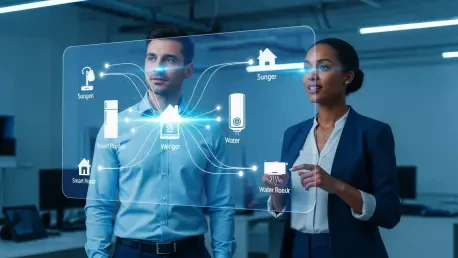

The promise of a truly intelligent home has long been hampered by a fractured technological landscape, leaving consumers to navigate a complex web of incompatible devices and siloed applications. In a decisive move at CES 2026, Samsung articulated a bold new strategy designed to dismantle these digital walls, championing an open and interoperable ecosystem as the essential foundation for the future of home artificial intelligence. The company, supported by a growing coalition of industry partners, is directly challenging the prevailing “walled garden” model, arguing that seamless communication between all smart devices, regardless of brand, is the only sustainable path toward unlocking the full potential of a connected living space and earning the enduring trust of users. This initiative represents more than a technical adjustment; it is a fundamental rethinking of how the industry should approach innovation, prioritizing collaborative progress over proprietary control to finally deliver on the long-awaited vision of a smart home that is truly helpful, intuitive, and unified.
A Paradigm Shift from Competition to Collaboration
The current state of the smart home market is defined by a deep-seated fragmentation that forces consumers to juggle an array of disparate applications and contend with devices that operate in complete isolation from one another. This creates significant friction and frustration, acting as a major barrier to realizing a genuinely intelligent and automated home environment. Samsung’s vision, as articulated by key figures within the Home Connectivity Alliance, calls for a profound paradigm shift away from brand-centric competition and toward a model of consumer-centric collaboration. The central argument is that home AI must be built upon a solid foundation of trust, which can only be achieved through the establishment of universal interoperability. This openness is presented not as a mere convenience but as a fundamental prerequisite for delivering tangible benefits to users, such as enhanced safety, simplified daily routines, and quantifiable financial savings through smarter resource management.
To spearhead this ambitious movement, Samsung is strategically leveraging its considerable market position and the wealth of knowledge gathered from its SmartThings platform. With an established and active user base exceeding 500 million, the company possesses more than a decade of data on consumer behavior and deep insights into the practical pain points associated with connected living. This immense scale lends substantial weight and credibility to its advocacy for an open standard, positioning Samsung not just as a proponent of interoperability but as a leader with the experience and influence required to guide the industry’s evolution. The company’s core understanding is that the ultimate value of a smart home is not derived from its individual components but from its capacity to function as a single, cohesive, and intelligent system—an objective that remains entirely unattainable within the restrictive confines of today’s siloed ecosystems.
From Abstract Concepts to Real World Value
A powerful consensus emerged among the panelists at the CES 2026 Tech Forum, who collectively agreed that interoperability is the critical element needed to transition the smart home from theoretical promises to the delivery of practical, real-world value. Michael Wolf of The Spoon reinforced this viewpoint by identifying the connected kitchen as a potential “killer app” where seamless cross-device coordination could unlock new levels of convenience and proactive maintenance. For instance, a smart refrigerator could communicate with heating and water systems to detect potential issues before they escalate, a level of sophisticated automation impossible when devices are locked into separate, non-communicating platforms. This collective insight signals a significant industry trend: a deliberate move away from speculative features and toward the development of integrated solutions that provide meaningful, everyday benefits to the user.
To substantiate this vision, Samsung highlighted a concrete example of successful cross-industry collaboration through its partnership with insurance company Hartford Steam Boiler. This alliance serves as tangible proof that an open ecosystem can produce measurable and positive consumer outcomes. Jed Usich of Hartford Steam Boiler explained that by responsibly and securely sharing data from smart home sensors, such as a water leak detector, the integrated system can trigger immediate preventative actions that avert thousands of dollars in potential property damage. This proactive capability, in turn, translates directly into a reduction in insurance claims and provides tangible financial savings for the homeowner. This compelling use case transforms the abstract concept of interoperability into a clear and powerful value proposition, demonstrating how shared data, when used transparently and effectively, creates a win-win scenario for both consumers and businesses.
The Future Defined by a Unified Vision
Underpinning this entire initiative is a crucial design philosophy centered on user acceptance and comfort. For home AI to be widely adopted and truly integrated into daily life, it must not feel intrusive, complex, or demanding. The ideal system is described as a “calm, reliable companion” that operates seamlessly and almost invisibly in the background, intelligently orchestrating complex household routines related to cooking, security, and energy management without requiring constant user intervention or oversight. This thoughtful approach prioritizes a user experience that is inherently intuitive, genuinely helpful, and, in its most successful form, completely unobtrusive. The goal is to create a home environment where technology serves the resident, fading into the fabric of daily life while enhancing it in meaningful ways, rather than demanding attention and creating additional cognitive load.
Ultimately, Samsung made a calculated and radical bet that the future of home AI would be defined by open collaboration rather than the entrenched model of closed competition. The company actively challenged the established strategies of other technology giants like Apple, Amazon, and Google, who had historically favored proprietary lock-in as a means to protect and expand their market share. Samsung’s gamble was that the demonstrable benefits of a unified, interoperable system—namely its inherent simplicity, enhanced safety, and potential for significant savings—would ultimately prove more attractive to consumers and, in turn, pull the entire industry toward a more open and collaborative standard. The success of this forward-thinking vision was not guaranteed; it was entirely dependent on whether other major players in the technology industry would choose to participate, setting the stage for a dramatic industry crossroads that would determine whether the smart home became a seamlessly integrated part of our lives or remained a fractured collection of incompatible gadgets.