
The familiar rhythm of rainfall across the British Isles underwent a sinister transformation during the final week of January as a meteorologically standard storm shattered the country’s defensive assumptions. Storm Chandra did not arrive with the record-breaking wind speeds or the unprecedented precipitation volumes typically associated with national disasters. Instead, it exposed a fragile landscape where the margin for environmental error has evaporated, turning a routine seasonal event into a structural crisis that paralyzed major transport corridors and flooded residential hubs.
The Weekend the Traditional Flood Model Collapsed
The paradox of Storm Chandra lies in its deceptive moderation; while the rain gauges recorded significant levels, the meteorological data alone did not suggest a national state of emergency. However, the resulting devastation across England and Wales proved that the old metrics for gauging danger are no longer sufficient. This event marked the moment when the focus of emergency management shifted decisively from the intensity of the storm itself to the underlying vulnerability of the saturated landscape it struck.
The transition from localized disruption to a full-scale national crisis occurred with frightening speed, catching many traditional response frameworks off guard. When drainage systems in towns that had previously remained dry began to fail, it became clear that the United Kingdom had reached a tipping point. The event served as a definitive signal that the structural integrity of national flood defenses is being undermined by a climate that no longer provides the dry intervals necessary for environmental recovery.
The Precedent of Saturated Soils and Compound Risk
The primary catalyst for the chaos was the state of the earth long before the first clouds of Chandra appeared on the horizon. Weeks of persistent, low-level rainfall had already filled the natural “buffer” provided by the soil, leaving the ground in a state of permanent saturation. Because the earth could no longer act as a sponge, every drop of water from the new storm became immediate runoff, flowing directly into overstretched river systems and onto urban streets.
This phenomenon illustrates the emergence of compound risk dynamics, where the cumulative moisture over a period of time outweighs the impact of any single weather peak. The baseline environmental stability of the UK is reaching a state where “normal” rainfall now carries the threat once reserved for once-in-a-generation deluges. This shift suggests that the historical reliance on dry spells to reset the flood risk clock is a luxury that the current climate reality no longer affords.
A Changing Landscape of National Vulnerability
Looking toward the mid-century horizon, the statistical outlook for the country remains sobering, with projections indicating that surface-water flooding will threaten approximately 6.1 million properties. This surge in vulnerability renders traditional emergency planning metrics obsolete, as the thresholds previously used to trigger defensive actions fail to account for the speed of modern flood onset. The sheer scale of the projected impact suggests that the insurance sector and national infrastructure planners must fundamentally recalibrate their understanding of “at-risk” zones.
Managing these events has created a logistical logjam for authorities who must now navigate overlapping cycles of response and recovery. During Storm Chandra, emergency teams were forced to manage active flood zones while simultaneously attempting to clear debris from previous incidents and prepare for subsequent weather fronts. This constant state of operational friction exerts a massive economic toll on road networks and supply chains, proving that the current reactive posture is becoming unsustainable for the national economy.
Insights from the Frontlines of Predictive Intelligence
According to Jonathan Jackson, the CEO of Previsico, the only viable path forward involves a transition from reactive recovery to proactive, data-driven posture. The necessity of this shift was demonstrated during the storm when hyper-local modeling successfully predicted property-level impacts at the Beacon Community Centre in Exeter. While traditional broad-brush warnings provided general awareness, specific intelligence allowed for the deployment of physical barriers exactly where the water was projected to crest.
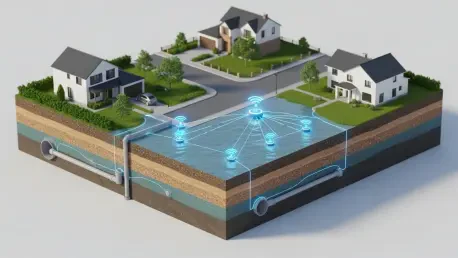
Technological verification has become the cornerstone of modern flood management, utilizing Sentinel-1 SAR satellite imagery and IoT sensors to corroborate ground-level reports in real-time. In locations like Matford and Newry, these digital tools provided a clear picture of rising waters, allowing for more efficient resource allocation than ever before. Furthermore, the identification of risks along the A40 in Abergavenny served as a blueprint for protecting arterial transport routes by pinpointing exactly which segments of the road would become impassable.
Strategies for Building a Flood-Resilient Future
The path toward resilience required the implementation of hyper-local intelligence that moved beyond national-scale forecasts to provide street-level granularity. By adopting real-time modeling that integrated drainage analytics with precise local terrain data, decision-makers gained the ability to visualize how water moved through specific urban environments. This shift allowed for operational decisions that were based on actual physics rather than historical guesswork, ensuring that interventions were both timely and effective.
The integration of extensive IoT sensor networks across England and Wales provided a continuous stream of live environmental data, allowing for the constant monitoring of rising risks. By incorporating saturated ground assessments into standard risk management protocols, the industry successfully adjusted to a reality where the condition of the soil was as important as the forecast itself. Ultimately, the lessons learned from the recent crisis ensured that the nation began to prioritize precision over generalities, fostering a culture of preparedness that better protected both people and property.