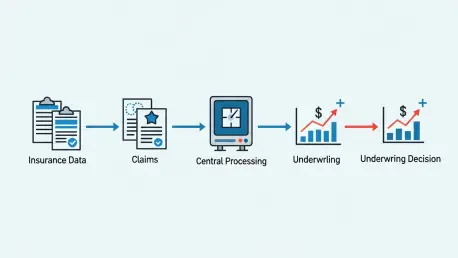

Travelers Companies Inc. has strategically orchestrated a comprehensive, technology-driven overhaul of its core operations, a visionary strategy dubbed “Innovation 2.0” that leverages a decade of technological investment now supercharged by the capabilities of generative AI and advanced machine learning. This initiative represents a systematic deployment of artificial intelligence across the enterprise, aimed at enhancing efficiency, sharpening underwriting precision, and streamlining the entire claims process. The ultimate goal of this ambitious transformation has been to drive significant financial performance and create substantial shareholder value, a feat marked by large-scale employee adoption, key strategic partnerships, and measurable impacts on both operational metrics and the company’s bottom line. The company’s recent performance signals a new era in which deep-seated industry expertise is amplified by cutting-edge technology to create a formidable competitive advantage.
Transforming Operations from the Inside Out
Widespread AI Adoption and Workforce Integration
A central pillar of the company’s strategy revolves around the extensive adoption of AI tools by its workforce, effectively embedding intelligent automation into the fabric of its daily operations. More than 20,000 Travelers professionals are now regular users of AI, a figure poised for significant growth following the recent partnership with Anthropic, announced on January 15, 2026. This landmark collaboration is set to equip nearly 10,000 technical employees, including engineers, data scientists, analysts, and product owners, with personalized Claude AI assistants. These advanced assistants are meticulously designed to integrate seamlessly into Travelers’ unique workflows and proprietary data systems, offering role-specific, real-time support. The explicitly stated goal, as articulated by CEO Alan Schnitzer, is to accelerate and improve the cost-effectiveness of delivering new capabilities across the company, spanning from innovative product development and precise underwriting to more effective new business prospecting. This initiative is a clear statement of intent to empower every level of the organization.
This strategic push for workforce empowerment complements the company’s existing internal generative AI platform, TravAI, which is already utilized by over 30,000 employees on a global scale. The initial results from these integrations have been profoundly positive. Mojgan Lefebvre, the executive vice president and chief technology and operations officer, has noted that preliminary tests of the new AI assistants have already demonstrated “significantly elevated levels of engineering excellence and meaningful improvements in productivity.” This validation underscores the potential of AI not just as a tool for automation but as a catalyst for elevating the quality and speed of work. By embedding these intelligent systems directly into the workflows of its most technical staff, Travelers is not merely optimizing existing processes but is actively fostering a culture of continuous innovation and efficiency, ensuring that its human capital is focused on high-value tasks that require uniquely human expertise and strategic thinking.
Revolutionizing the Claims Experience
The tangible benefits of this AI-driven transformation are arguably most evident in the company’s claims processing division, which has been fundamentally reimagined through intelligent automation. In 2025 alone, Travelers proficiently handled an astounding 1.5 million claims, averaging one every 20 seconds, with total payments to customers exceeding $23 billion. A remarkable testament to the power of automation is that over 50% of these claims are now eligible for straight-through processing, a frictionless system that two-thirds of eligible customers are choosing to use. The operational impact of this efficiency overhaul is further highlighted by a significant restructuring effort: the company has successfully reduced its claims call center staff by one-third while simultaneously consolidating four separate call centers into just two highly efficient hubs. These strategic moves not only streamline operations but also directly contribute to improving the company’s loss adjustment expenses, which positively impacts the overall loss ratio and bottom-line profitability.
Beyond process automation, generative AI is enhancing customer interactions and accelerating resolutions during critical moments. A natural language generative AI voice agent, implemented for the first notice of loss, has seen customer adoption rates that have far surpassed initial expectations, indicating a strong customer preference for fast and efficient digital channels. This advanced tool, when combined with other automation and analytical capabilities, has been a key factor in achieving an impressive 90% closure rate for catastrophe claims within a 30-day window. This rapid resolution not only improves customer satisfaction during stressful times but also mitigates the long-tail costs associated with prolonged claims. The successful integration of these technologies demonstrates a dual victory: a significant reduction in operational overhead coupled with a marked improvement in the speed and quality of customer service, solidifying the company’s reputation for reliability and efficiency.
Enhancing Underwriting Precision Across Divisions
The influence of artificial intelligence extends far beyond claims, fundamentally reshaping Travelers’ underwriting and business insurance operations with unprecedented speed and accuracy. Greg Toczydlowski, president of Travelers Business Insurance, highlighted the transformative use of generative AI agents to meticulously mine vast internal and external data sets. These AI systems can identify complex business classifications and nuanced risk characteristics far more quickly than traditional methods, thereby accelerating the entire underwriting process and enabling the implementation of more sophisticated, highly segmented pricing models. In the personal insurance sector, proprietary AI predictive models are now employed to score property portfolios, providing a more granular understanding of risk exposure. Furthermore, during the renewal process, generative AI is used to summarize complex policy and claims data, a function that has been shown to cut the average handle time by an estimated 30%.
This technological leap allows underwriters to reallocate their time and expertise away from routine data collection and analysis toward high-impact strategic decisions that are most likely to improve long-term profitability. The Bond & Specialty Insurance division, under the leadership of president Jeffrey Klenk, has witnessed a particularly dramatic transformation. AI has been successfully deployed to automate the new business intake process, reducing a workflow that once consumed hours of manual effort to a matter of mere minutes. The resounding success of this initial implementation has spurred the development of dozens of scaled generative AI tools that are now in production across the division. These tools are automating millions of transactions on an annual basis, unlocking significant operational capacity and allowing the team to focus on complex, high-value underwriting challenges and relationship management, which ultimately drives business growth and market leadership.
The Financial Blueprint for AI-Driven Success
The Strategic Investment in Data and Technology
These profound technological advancements did not materialize overnight; they are the direct result of a sustained, long-term investment in technology and a strategic focus on data supremacy. Since 2016, Travelers has committed a total of $13 billion to its technological infrastructure, an investment that has enabled the accumulation of an invaluable corporate asset: 65 billion clean, structured data points. This massive and high-quality data repository serves as the critical foundation for training the precise, sophisticated AI models that now power its operations. What makes this achievement particularly noteworthy is the financial discipline with which it was executed. CEO Alan Schnitzer emphasized that despite the significant increase in technology spending over the years, the company managed to achieve a 300-basis-point, or 10%, improvement in its expense ratio. This key metric, which now stands at an impressive 28.5, demonstrates a remarkable ability to invest heavily in future growth while simultaneously enhancing current operational efficiency.
Translating Innovation into Record-Breaking Profits
The financial results reported for the fourth quarter of 2025 and the full year served as definitive validation of the company’s forward-thinking AI strategy. The company reported a substantial 20% increase in fourth-quarter net income and an even more impressive 26% rise for the full year. After-tax underwriting income surged by a remarkable 40% annually, reaching $3.4 billion, supported by a highly favorable combined ratio of 80.2 for the quarter. The personal lines division was a standout performer, with the full-year auto combined ratio improving by 9.3 points to 85.7 and the homeowners’ ratio falling 6 points to 67.6. This robust financial performance clearly demonstrated the company’s ability to successfully translate technological innovation into concrete, tangible financial gains. The strategy enhanced profitability even while the company continued to make substantial investments in its future capabilities, a balance that has allowed Travelers to return $20 billion to its shareholders since 2016. This created a sustainable competitive advantage as the insurance industry continued its rapid evolution.