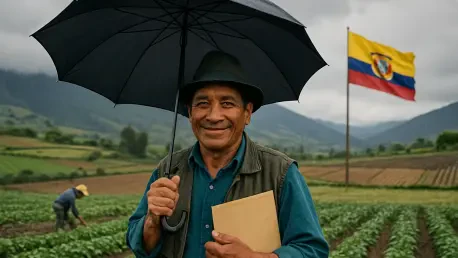

The silent struggle of Ecuadorian smallholders facing the unpredictable wrath of seasonal floods and droughts has finally met a formidable adversary in the form of high-tech financial engineering. Ecuador has officially entered a new era of disaster risk financing with the contracting of its first parametric agricultural insurance policies. This initiative represents a sophisticated evolution in how the nation protects its most vulnerable economic contributors: the smallholder farmers. Historically, agricultural recovery in the face of climate shocks depended on reactive government aid and lengthy, often cumbersome, damage assessment processes. By implementing a parametric model, the state is shifting toward a proactive, data-driven financial architecture. This program specifically targets rice and maize farming households, which are the backbone of the domestic food supply, ensuring that the financial impact of climate change does not result in a permanent cycle of poverty or food insecurity.
The transition to this model reflects a growing global recognition that traditional insurance often fails those who need it most due to administrative overhead and slow payout cycles. By modernizing the safety net, Ecuador is not just providing a financial cushion; it is actively stabilizing the national economy. This strategic shift serves as a template for other nations in the region, illustrating that financial resilience can be built through innovation and international cooperation. The importance of this project cannot be overstated, as it secures the livelihoods of those who provide the majority of the nation’s caloric intake while facing the most direct threats from an increasingly volatile environment.
From Reactive Aid to Proactive Financial Protection: A New Standard
The core of this development is the implementation of parametric insurance, a specialized financial tool that triggers payouts based on objective environmental data rather than subjective loss assessments. Unlike traditional indemnity insurance, which requires an adjuster to visit a farm and verify physical damage—a process that can take months—parametric insurance relies on predefined thresholds of rainfall or drought. When satellite data or meteorological records confirm that these thresholds have been crossed, payments are automatically released to the farmers. This speed is critical for smallholders who need immediate capital to reinvest in the next planting cycle and maintain household stability.
The project initially benefits approximately 10,000 individuals within farming households, focusing on the highly productive but climate-exposed regions of Guayas, Los Ríos, Manabí, and Loja. These provinces are essential to the national agricultural output, yet they are frequently plagued by the erratic patterns of the El Niño-Southern Oscillation. By focusing on these areas, the program addresses the most significant geographic risks within the country. The move from manual inspections to automated satellite monitoring represents a leap in efficiency, reducing the cost of insurance and making it a viable tool for those who were previously considered uninsurable.
Foundationally, the success of this shift relies on the accuracy of the data and the trust of the participants. For years, the lack of reliable weather stations and historical data hindered the development of such products. However, recent advancements in satellite technology and remote sensing have closed this gap. Now, the government can offer a level of protection that is both transparent and nearly instantaneous, fundamentally changing the relationship between the state, the insurance industry, and the agricultural workforce.
The Power of the Tripartite Partnership Model: Collaborative Resilience
Bridging the Gap: International Expertise and Local Needs
A central theme of this initiative is the strength of the Tripartite Agreement, a robust public-private partnership. This model demonstrates that addressing climate resilience requires a multi-layered approach involving international development agencies, foreign governments, and the global insurance industry. The Ecuadorian Ministry of Agriculture, Livestock and Fisheries (MAGP) leads the project, ensuring it aligns with national goals of food sovereignty. Support also comes from the German Federal Ministry for Economic Cooperation and Development (BMZ), which provides essential oversight and strategic direction.
Furthermore, the United Nations Development Programme (UNDP) played a pivotal role, not only in technical support but in regulatory reform. They assisted the government in developing the legal frameworks necessary for parametric products to exist within the domestic insurance market. This type of institutional strengthening is often overlooked but is essential for the longevity of financial products. Without a clear legal definition and regulatory oversight, parametric insurance cannot gain the widespread adoption needed to be effective.
Integrating Innovation: Private Sector Contributions to Public Policy
The private sector’s role is equally vital, with the Insurance Development Forum (IDF) providing the technical underwriting and design. Specifically, global leaders like AXA Climate, Guy Carpenter, and Blue Marble collaborated to design the rainfall and drought risk products. While designed internationally, the policies are implemented on the ground by Hispana de Seguros, a local insurer. This ensures that the program builds domestic insurance capacity rather than relying solely on external actors.
By combining global technical expertise with local execution, the program creates a sustainable ecosystem where high-level data analysis meets the practical needs of the field. This collaboration allows local insurers to gain experience with complex risk modeling, which they can later apply to other sectors of the economy. It is a form of technology transfer that empowers the local financial market, making it more robust and capable of handling future environmental challenges without constant reliance on international grants.
Promoting Social Equity: Economic Inclusion in the Field
The program is meticulously designed to address the specific demographics of the Ecuadorian agrarian landscape, where approximately 75% of the nation’s farmers are smallholders. A significant trend within this initiative is the focus on social equity; of the covered farmers, 44% are women and 15% are young people under the age of 29. By prioritizing these groups, the program addresses long-standing gaps in financial inclusion, recognizing that women and youth are often the most marginalized in rural economies.
Providing these vulnerable groups with a financial safety net is essential for the long-term sustainability of the agricultural sector. It prevents the distress sale of assets—like livestock or tools—during a bad harvest, which is a common cause of long-term poverty. By turning the insurance policy into a tool for social and economic empowerment, the state is ensuring that the next generation of farmers sees agriculture as a viable and secure profession rather than a high-risk gamble.
Emerging Trends: The Future of Disaster Risk Financing
One of the overarching trends identified in this initiative is the necessity of a modernized regulatory infrastructure. The success of this insurance placement was not merely a matter of financial transaction but of institutional preparation involving a wide array of regulators. By creating a regulatory environment conducive to parametric insurance, Ecuador has modernized its financial sector, creating a blueprint that other sectors—such as infrastructure or energy—can follow. This systemic update allows for the introduction of more complex financial derivatives that can protect against a wider range of natural disasters.
Looking ahead, the use of premium financing from the InsuResilience Solutions Fund (ISF) for the initial coverage period acts as a proof of concept. This allows the market to test the efficacy of the payouts before the government or farmers carry the full weight of the premiums. We are seeing a move toward hybrid models where public funds act as a catalyst for private market development. As the data set grows more robust over the next few years, the risk becomes easier to price, which should naturally lead to lower premiums and broader coverage.
Strategic Takeaways: Scaling Climate Resilience and Stability
To ensure the long-term success of this model, stakeholders must focus on moving from subsidized premiums to a self-sustaining market model. The true test lies in the transition following the initial pilot cycles. For businesses and policymakers, the primary recommendation is to invest in high-quality meteorological data and digital infrastructure, as these are the fuel for any parametric system. Without dense networks of sensors and reliable satellite feeds, the “basis risk”—the chance that the insurance does not pay out when damage has actually occurred—becomes too high for the model to be sustainable.
Additionally, fostering public-private dialogue is essential to ensure that insurance products remain relevant to the specific risks faced by different regions. This means constantly refining the “trigger” points based on real-world feedback from the farmers themselves. By leveraging these best practices, other developing nations can replicate Ecuador’s success, turning climate risk management into a cornerstone of national economic strategy. The ultimate goal is to create a market where insurance is not just an emergency measure, but a standard part of the agricultural business plan.
Establishing a New Standard: The Legacy of Agricultural Stability
Ecuador’s first parametric agricultural insurance policies represented a landmark achievement in climate risk financing. By leveraging a complex network of international and local partners, the country moved beyond traditional aid models toward a sophisticated, automated financial defense system. This initiative did more than just insure crops; it protected the livelihood of thousands of families, promoted gender and youth inclusivity, and secured the nation’s food supply against an increasingly volatile climate. The integration of high-level data analysis, regulatory reform, and public-private cooperation provided a cohesive narrative of a nation building a future-ready agricultural sector.
The success of this program established a primary case study for how nations could use insurance as a tool for inclusive, climate-resilient development. Moving forward, the focus should shift toward expanding these products to cover different types of crops and additional environmental risks like volcanic ash or seismic activity. Furthermore, integrating these insurance products with micro-credit facilities could provide a comprehensive financial package that allows smallholders to invest in better seeds and technology with confidence. By continuing to innovate at the intersection of finance and technology, Ecuador has set a high bar for what a modern, resilient agricultural economy can look like in the 21st century.