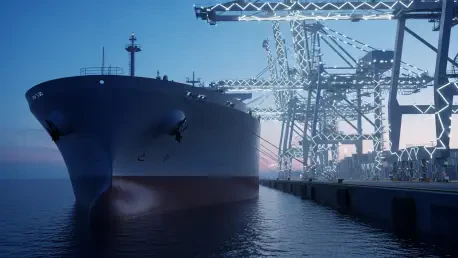

The quiet expanse of the Strait of Hormuz, once a bustling artery of global energy commerce, has been transformed into a silent, steel-strewn graveyard for commercial shipping ambitions despite massive intervention. In early 2026, as the region descended into a theater of high-intensity conflict, the United States government unveiled a massive $40 billion maritime reinsurance facility. It was designed to be the ultimate financial backstop, a “bazooka” aimed at reopening the world’s most vital energy artery by absorbing the risks that private insurers seemingly would not touch. The intent was clear: provide a sovereign guarantee that would bypass the spiraling costs of the private market and keep the tankers moving toward thirsty global ports.
Yet, months after its inception, the facility reports zero uptake—not a single policy has been written. The silence of this multi-billion dollar program raises a haunting question regarding how a plan of this magnitude missed the mark so completely. While the capital exists and the legislative framework is robust, the hulls of the world’s most significant oil tankers remain anchored or diverted. This administrative void highlights a significant disconnect between the halls of power in Washington and the bridge of a vessel facing drone swarms and precision missiles. The “bazooka” failed to fire because the target it was aimed at—financial liquidity—was never the actual problem.
The Anatomy of a Geopolitical Miscalculation: Market Reality vs. Policy
The failure of the Development Finance Corporation (DFC) maritime facility serves as a stark case study in the friction between government policy and market reality. While Washington viewed the cessation of shipping as a “market collapse,” the maritime insurance world saw it as “honest pricing.” Understanding this disconnect is essential for global trade stability, as the ripple effects of this failure now dictate the cost of everything from Australian diesel to global construction materials. The crisis revealed that while you can print money to cover a loss, you cannot mandate the appetite for risk in a combat zone. Capital alone cannot scrub the danger of a ballistic strike from a captain’s log.
Policymakers in the West treated the situation as a liquidity crisis, similar to the banking tremors of previous decades, assuming that if the government provided the floor, the market would resume its ceiling. However, the maritime industry operates on a different logic of physical survival. When the risk of total vessel loss reaches a certain threshold, no amount of indemnity can convince a shipowner to sacrifice an asset that takes years to replace. The failure was not a lack of money, but a lack of understanding that the market was signaling a fundamental physical boundary that insurance, by its very nature, cannot cross.
The Disconnect Between Washington Policy and Actuarial Reality: Signals and Escorts
Policymakers mistakenly assumed that private insurers had abandoned the Strait, when in reality, they had simply adjusted premiums to reflect a 3% risk of total vessel loss. For a Very Large Crude Carrier (VLCC), a $14 million premium per voyage was not a sign of a broken market, but a functional signal that the environment was too lethal for standard commerce. When the DFC attempted to offer cheaper rates, it was essentially trying to subsidize a price that the world’s most sophisticated risk models had deemed necessary for survival. This created a credibility gap; shipowners viewed the low-cost government insurance as a political gimmick rather than a realistic assessment of the dangers they faced.
Structural requirements further hampered the program, specifically through the “Project Freedom” bottleneck. The facility mandated that any insured vessel must travel under United States naval escort—a military commitment that never materialized at the necessary scale. This led to a circular failure of logistics: without the naval escorts, the insurance was inaccessible; without the insurance, the ships would not sail; and without a de-escalated environment, the navy could not guarantee safe passage. The government offered a financial shield but could not provide the physical one required to make the financial one relevant, leaving the $40 billion untouched.
Industry Expert Perspectives on the “Crew Factor” and Risk Models: Human Stakes
Leading brokers from McGill and Partners argue that no payout can compensate for the loss of a crew, highlighting that shipowners prioritize mariner safety over financial indemnity. In the modern maritime era, the “crew factor” has become the ultimate veto in geopolitical shipping. If the sailors refuse to enter the zone, the ship stays in port, regardless of whether the government is backing the hull value. The DFC plan failed to account for the human element, treating vessels as mere balance sheet assets rather than inhabited workplaces where the threat of loss of life is the primary deterrent.
Experts from the Lloyd’s Market Association (LMA) note that even if a ceasefire is reached, the “new baseline” for risk remains elevated because the vulnerability of the chokepoint has been permanently proven. Underwriters are drawing parallels to previous conflicts, suggesting that once a maritime route is compromised, the “risk premium” becomes a permanent fixture of the balance sheet. Organizations like Howden Re have shifted from mere transaction facilitators to strategic advisors, helping shipowners navigate “layered capacity” rather than relying on government gimmicks. These professionals understand that the insurance landscape has shifted from a model of recovery to a model of total avoidance until the physical threat is neutralized.
Frameworks for Navigating the New Era of High-Risk Shipping: Future Resilience
Governments must recognize that capital cannot substitute for the neutralization of physical threats like missile strikes and drone swarms. In the future, any maritime backstop must be integrated directly with a proven, scalable naval protection strategy that functions in real-time rather than as a theoretical prerequisite. Shipowners should work with brokers to piece together coverage from multiple private sources through “layered capacity” strategies rather than waiting for a single state-sponsored solution. This approach allows for more flexibility and a more realistic pricing of risk that reflects the actual conditions on the water.
Businesses dependent on Gulf energy must transition from “just-in-time” to “just-in-case” logistics, accounting for permanently higher freight and insurance rates. Stakeholders are encouraged to view high insurance premiums not as an obstacle to be bypassed, but as a vital data point indicating when a route is truly non-viable. The failure of the $40 billion plan demonstrated that the maritime industry preferred the “honest pricing” of the private market over the subsidized uncertainty of the state. Moving forward, the focus shifted toward physical security and diversified supply chains as the only true insurance against geopolitical volatility.