
Simon Glairy is a distinguished authority in the realms of insurance and Insurtech, specializing in the complex intersection of risk management and AI-driven assessment. As the digital landscape shifts from conventional cloud storage to the power-hungry, high-intensity world of artificial intelligence, Glairy provides the critical insights necessary to navigate this new frontier. In this conversation, we delve into how the next generation of data centers is fundamentally rewriting the rulebook for insurers and lenders alike. From the staggering financial investments projected for the coming years to the physical and geographical vulnerabilities inherent in high-density AI clusters, Glairy explains why traditional resilience models are no longer sufficient. This interview explores the engineering challenges of heat and weight, the evolving global premium landscape, and the urgent need for strategic organizational resilience in an era where downtime is no longer a tolerable option.
The architectural demands of AI hardware are significantly more intensive than those of traditional cloud systems, particularly regarding weight-bearing capacity and cooling. How is this physical evolution changing the way insurers evaluate the structural integrity and operational risks of these facilities?
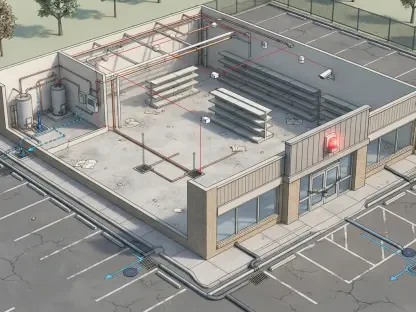
When we look at the legacy cloud environment, we are talking about relatively predictable loads and air-conditioned rooms, but the next generation of AI hardware is a completely different beast that you can feel the moment you walk into the room. We are seeing servers that are substantially heavier, meaning the floor beneath them must be engineered for massive weight-bearing capacity; this isn’t just about racks anymore, it’s about structural integrity on a much larger scale. These machines pull massive amounts of power and generate an intense, dry heat that traditional air cooling simply cannot dissipate, which is why we are seeing a shift toward complex liquid cooling systems that carry their own set of risks. In some locations, this even raises new and urgent questions about local water availability and whether the power grid can handle the sudden, massive draw of a facility running around the clock. From an insurance standpoint, you can’t just treat this as a standard upgrade; it is a major engineering project where every component must be scrutinized for its ability to handle these heightened physical stresses and thermal loads. Insurers are finding that they must look at these facilities on a completely different basis to ensure the physical asset can actually support the technology it houses.
With hyperscaler investment in AI infrastructure reaching astronomical levels, how do you see the insurance market responding to the massive financial requirements and diverse coverage needs of these projects?
The financial scale of this shift is truly unprecedented and is fundamentally changing the risk profile that insurers must manage, with estimates suggesting that hyperscaler capital expenditure on AI infrastructure will reach $750 billion in 2026 alone. This massive influx of capital is creating entirely new pools of risk and a surge in demand for full-value insurance, as lenders often make this a non-negotiable condition for financing these high-stakes, multi-jurisdictional projects. To meet this demand, the industry projects cumulative global data center insurance premiums will reach approximately $90 billion between 2024 and 2030, a figure that reflects the growing complexity of the sector. This total includes a significant $49 billion for property coverage and $18 billion for engineering, while liability is expected to account for $10 billion, credit and surety for $9 billion, and marine for $5 billion. It is no longer just about finding enough capacity in the market; it is about ensuring that the insurance programs are sophisticated enough to reflect the way AI has shifted the exposure itself. We are seeing a market that is still developing the necessary analytical tools to properly place these high-value programs while under immense pressure from the rapid pace of global investment.
In an environment where AI operations often have almost no tolerance for downtime, how should organizations rethink their assumptions about business continuity and strategic resilience?
One of the most dangerous things an organization can do right now is assume that the resilience strategies they used for the traditional cloud will hold up in an AI-driven environment where processing continuity is a matter of survival. These facilities have almost no tolerance for downtime because the processes they support—such as real-time algorithmic trading for major financial institutions—rely on absolute stability and extremely low latency that leaves no room for error. We are seeing some of the largest AI data centers carry total asset values exceeding $20 billion even before the first server is installed, creating a massive concentration of value that demands insurance solutions going far beyond traditional property coverage. Strategic resilience now requires a granular understanding of critical processes and a deep dive into supply chain dependencies to identify which links are most critical to the organization’s long-term health. Interestingly, about one in five conversations with clients still revolves around basic administrative fundamentals like timely paperwork and accurate invoicing, which remains a prerequisite before any sophisticated analysis can begin. Organizations must move past this complacency and realize that a failure in an AI-intensive operation has far-reaching consequences that require a much more robust, proactive approach to business continuity.
There is a growing concern about the concentration of AI infrastructure in specific geographic regions. What are the primary risks associated with this aggregation, particularly when it comes to natural catastrophes?
The geography of risk is becoming a major focal point for the industry because capital continues to flow into specific locations where reliable power, low latency, and cooling capacity converge, creating dense clusters of vulnerability. This concentration of infrastructure means that a single localized event could have a market-changing impact, even though we haven’t seen a massive loss event in this sector just yet. Our data suggests that approximately 40% of U.S. data center capacity is currently situated in zones with significant-to-very-high tornado-day activity, and about a quarter of it is in areas prone to large-hail days. This creates a natural catastrophe accumulation profile that many in the market are only just beginning to accurately price into their risk models, often relying on historical data that doesn’t account for current climate trends. The facilities being financed and built today are larger and more power-intensive than anything insurers have traditionally assessed, making them more vulnerable to environmental stresses like extreme heat or storms. We must acknowledge that things cannot stay resilient forever, and as these facilities become more operationally critical, the potential for a catastrophic aggregation of loss grows significantly.
What is your forecast for the future of AI risk management as these facilities become even more central to the stability of the global economy?
I forecast that we will see a rapid maturation of analytical tools that allow insurers to evolve as quickly as the technology they are protecting, moving away from broad assumptions toward high-precision risk modeling. As we approach that $90 billion premium mark by 2030, the industry will have to move beyond the current state where basic administrative fundamentals still dominate 20% of the dialogue between clients and brokers. We will likely see more bespoke insurance solutions that address the specific engineering needs of AI, moving away from the “picture of cats” cloud model toward high-stakes financial and algorithmic trading risks that require zero latency. The focus will shift from merely insuring a physical building to protecting the strategic resilience of the entire organization, recognizing that the boundary between property insurance and operational risk is blurring. Ultimately, the successful firms will be those that can bridge the gap between traditional insurance practices and the high-speed requirements of the AI era, ensuring that the financial protections in place are as innovative as the technology they serve. This evolution is not just necessary for the insurance market; it is vital for the stability of the global digital economy as a whole.