
In a significant legal escalation with broad implications for the marine insurance market, the prominent maritime services provider Foss Maritime Company has initiated a federal lawsuit against three of its primary insurers. The complaint, filed on December 11, 2025, in the US District Court for the Western District of Washington, alleges that Navigators Insurance Company, Zurich American Insurance Company, and Ascot Insurance Company have breached their contractual and statutory obligations. At the heart of the dispute is the insurers’ protracted failure to address multimillion-dollar claims for catastrophic damage to the propulsion systems of four modern tugboats. Foss contends that after years of paying substantial premiums for what it believed was comprehensive coverage, it has been met with inaction and silence, forcing it to bear the immense cost of repairs and pursue a complex, multi-front legal battle to recover its losses and hold its insurers accountable.
A Cascade of Crippling Failures
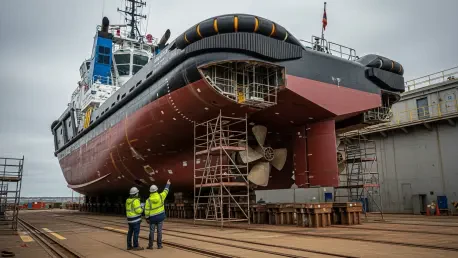
The genesis of this high-stakes legal conflict lies in a series of severe and recurring mechanical failures that plagued four state-of-the-art tugs constructed by Nichols Brothers Boat Builders and delivered to Foss between April 2020 and June 2021. Shortly after these vessels were put into service, their sophisticated azimuth stern drive propulsion units, manufactured by Kongsberg Maritime, began to experience catastrophic breakdowns. According to the court filing, vital internal components such as crucial slewing bearings, slewing rings, and O-rings began to “destroy themselves” under normal operational stress. This internal degradation was compounded by significant fatigue damage to the installation frameworks, specifically at the structural points where the powerful thruster units are integrated into the tugs’ hulls. These systemic issues created a dire situation, compromising the performance, reliability, and safety of the costly new additions to the Foss fleet and necessitating immediate and extensive repair work to prevent further damage and maintain operational readiness.
Foss Maritime’s investigation into the root causes of these widespread failures points to a combination of construction deviations and inherent design flaws. The lawsuit alleges that the shipbuilder, Nichols Brothers, critically deviated from the contractual specifications by installing a single-bearing thruster model instead of the more robust double-bearing thruster that was required. This substitution was allegedly performed without implementing the corresponding and necessary engineering adjustments to the design and construction of the installation framework and the vessel hull. Such a modification would be essential to properly accommodate the different load characteristics and forces exerted by the single-bearing unit. Furthermore, Foss asserts that the Kongsberg-manufactured thrusters were themselves afflicted with latent design defects. This second allegation suggests that even if installed correctly, the units were inherently flawed, predisposing them to the premature and destructive failures that were observed across all four vessels, creating a two-pronged engineering problem that Foss was left to resolve.
A Standoff Over Contractual Duties
The foundation of Foss’s legal action against its insurers is built upon specific provisions within the “Marine Hull / Liability Package” policies it purchased for consecutive one-year terms from 2020 through 2024. The plaintiffs argue that the damage experienced by the tugs falls squarely within the scope of their coverage, citing two key clauses. One, an “Additional Perils” section, provides broad coverage for the cost of repairs or damage to the insured vessels when caused by a wide array of factors, including the “negligence, incompetence or error of judgment . . . of any person whatsoever” and “latent defect.” Another critical provision, the “Liner Negligence Clause,” explicitly covers damage resulting from the “breakage of shafts, or any latent defect in the machinery or hull,” as well as loss or damage caused by “accidents on shipboard or elsewhere.” Foss contends that these clauses were specifically designed to protect against precisely the type of third-party errors and equipment failures that have crippled its tugboats, making the insurers’ refusal to pay a clear violation of their contractual promises.
According to the timeline of events detailed in the lawsuit, Foss has been attempting to resolve the matter with its insurers for several years, only to be met with profound inaction. The company first notified the lead underwriter, Navigators, of the damage to three of the tugs on January 25, 2021, and later reported the damage to the fourth tug on July 28, 2022. Despite these formal notices and the mounting repair bills, Foss alleges that the insurers have fundamentally failed in their duties. The complaint states that as of early 2025, Navigators has neither formally accepted nor rejected the claim, has failed to provide any substantive written explanation for its coverage position, and has not reimbursed Foss for any of the more than $2.5 million in past repair costs. Furthermore, the insurers have allegedly refused to pay for the legal fees and costs associated with the separate arbitration proceedings against the builder and manufacturer and have not committed to indemnifying Foss for necessary future repairs, leaving their policyholder in an untenable financial and legal limbo.
The Escalating Legal Battle
The financial burden on Foss and its affiliate, Northwest Tug Leasing, has been substantial, with the lawsuit citing a specific figure of $2,501,835.60 in expended repair costs to date. In its effort to recover these significant losses from the parties it deems originally responsible, Foss has initiated separate arbitration proceedings against both Nichols Brothers Boat Builders and Kongsberg. The lawsuit strategically highlights that the defendant insurers, through their potential subrogation rights, stand to directly benefit from any financial recovery Foss might secure in these arbitrations. This point underscores Foss’s frustration, as the insurers would ultimately be the beneficiaries of Foss’s own costly legal efforts against the third parties, all while allegedly refusing to provide the very coverage meant to support Foss through such an ordeal. This has created a complex legal landscape where Foss is simultaneously fighting the equipment providers for causation and its own insurers for coverage.
As a result of this prolonged impasse, Foss’s lawsuit levied multiple claims against the insurers. The legal action included a straightforward breach of contract claim, citing the insurers’ failure to properly investigate and indemnify their policyholder. It also brought a claim for breach of the common-law duty of good faith. Seeking to leverage more powerful legal tools, Foss also filed claims under Washington’s Consumer Protection Act and the Insurance Fair Conduct Act. Through these combined claims, the company sought a comprehensive remedy, including actual damages for all repair costs, full reimbursement for attorney fees and litigation expenses, and payment for expert costs. Critically, the claims filed under Washington state statutes opened the door for a request for potential treble damages, which could significantly increase the final award if the court found that the insurers had acted in bad faith, a development that raised the stakes of the legal confrontation considerably.