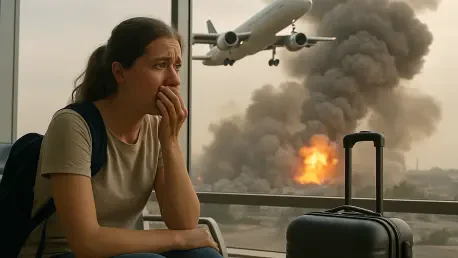

Travelers finding themselves stranded in sprawling airport terminals across Doha and Dubai are currently grappling with the sudden and unprecedented closure of airspace that began following the military escalation involving the United States, Israel, and Iran on February 28, 2026. This geopolitical volatility has transformed routine international transit into a complex logistical puzzle, as nine nations—including Iraq, Jordan, Bahrain, and the United Arab Emirates—have implemented sweeping restrictions on commercial aviation. For the tens of thousands of passengers currently caught in the middle of these rolling shutdowns, the primary concern has shifted from mere delay to the financial viability of their travel insurance. The situation is particularly acute in major Gulf hubs, where cancellation rates have soared past 80 percent during peak disruption periods. As airlines scramble to reroute flights and manage stranded crews, travelers are discovering that the fine print of their insurance policies may hold the key to their recovery.
1. The Rapid Escalation of Middle Eastern Airspace Closures
The military activities that commenced in late February have triggered a cascade of official closure orders that now restrict or prohibit commercial traffic over a massive geographic corridor. Aviation authorities have confirmed that the restricted zone encompasses nine different countries simultaneously, creating a significant chokepoint for any aircraft traveling between the European and Asian continents. This sudden withdrawal of safe passage has forced major international carriers to halt service announcements through mid-April, citing both the legal bans on airspace entry and the prohibitive operational challenges of navigating around the conflict zone. Real-time data shows that the most severe clusters of cancellations occurred between April 2 and April 9, with secondary disruptions continuing to ripple through the global network. Passengers who were scheduled to transit through these regions now find themselves facing multi-day waits for rebooking as airlines struggle to manage the overflow.
The operational impact on the ground at major hubs like Doha and Dubai has been equally staggering, with terminal facilities reaching capacity as flights are grounded or turned back mid-air. These airports, which historically served as the most convenient connection points for global travel, have become tactical bottlenecks where rolling shutdowns are implemented to manage the safety of incoming and outgoing traffic. For the average passenger, this means not only a missed connection but a total breakdown in the travel itinerary that standard insurance was meant to protect. The volatility of the situation is compounded by the fact that many of these closures are announced with little to no lead time, leaving aircraft in the air with nowhere to land except alternative North African or Asian gateways. This level of systemic disruption has exposed structural vulnerabilities in the global aviation network that will take months to fully resolve even after the hostilities eventually subside.
2. Structural Shifts in Global Aviation Routing
As a direct consequence of the widespread airspace closures, airlines have been forced to implement radical rerouting strategies that add significant time and cost to long-haul journeys. Flights that previously crossed through Iranian or Iraqi airspace are now diverted along much longer corridors, frequently adding between two and five hours to total flight durations. These extended routes often require unscheduled technical stops for refueling, further complicating crew schedules and aircraft availability across the entire fleet. The logistical strain is particularly evident for European-to-Asian routes, which are essentially being rewritten on a daily basis to avoid active military zones. For travelers, this translates into missed connections at distant airports and an increased likelihood of being stranded in cities far from their intended destinations. The financial burden of these diversions is immense, as airlines consume significantly more fuel and incur additional landing fees.
The ripple effect of these routing changes extends beyond the immediate flight path, as the entire global schedule of a full-service carrier is interconnected and fragile. When an aircraft is delayed by five hours due to a diversion around the Middle East, its subsequent flights from London or New York are also pushed back, leading to a worldwide wave of delays. Many carriers have proactively suspended several routes through the end of April, acknowledging that the current environment makes consistent service impossible. This overhaul of operations has left many travelers with valid tickets but no actual means of reaching their destinations within a reasonable timeframe. The industry is currently witnessing a historic shift in how global transit is managed, as the focus moves from efficiency to basic safety and risk mitigation. For those with upcoming travel plans, the reality is that a simple direct flight may now involve multiple legs and significantly higher chances of being canceled.
3. Deciphering the War Exclusion Clause in Modern Policies
One of the most significant challenges for travelers seeking reimbursement is the broad “war exclusion” clause found in nearly every standard travel insurance policy issued today. These clauses typically state that the insurance provider is not liable for any claims that arise directly or indirectly from acts of war, military action, invasion, or insurrection. Because the current flight disruptions are the result of government-ordered airspace closures tied to the Iran conflict, insurers are frequently classifying these incidents as war-related risks. This means that trip cancellation, trip interruption, and even emergency accommodation benefits may be entirely voided. Many passengers are discovering this limitation for the first time as they attempt to file claims for thousands of dollars in unrecovered costs. The exclusion applies regardless of whether a formal declaration of war has been made by any of the participating nations or organizations.
Furthermore, the existence of government “do not travel” advisories adds another layer of complexity to the insurance landscape for those currently abroad or planning to depart. If a traveler chooses to proceed with a trip to or through a region that is under a high-level safety warning, many insurance companies will decline all subsequent claims related to that specific environment. Insurers argue that the traveler assumed the risk by entering a known conflict zone, thereby negating the provider’s responsibility to cover the resulting losses. The Federal Aviation Administration and other regional authorities have issued formal guidance that strongly advises against transiting through the affected airspace, which further empowers insurers to deny coverage based on policy exclusions. This gap between traveler expectations and policy reality has left many individuals on the hook for significant financial losses that standard protection simply does not address in the context of military conflict.
4. Distinguishing Operational Failures from Military Risks
While war exclusions are prevalent, there are specific scenarios where coverage may still apply depending on how a claim is categorized and documented. Insurance experts distinguish between a cancellation caused by a government mandate and one caused by an airline’s independent operational decisions. If an airline cancels a flight because of crew unavailability, aircraft being out of position, or a commercial decision that a route is no longer profitable, some policies may treat this as a standard carrier-caused delay. In these instances, travelers might be eligible for reimbursement for prepaid accommodations or additional travel expenses, provided the underlying cause is not officially labeled as a direct result of military action. It is essential for travelers to obtain written confirmation from the airline regarding the exact reason for the cancellation to support any potential insurance claims that fall outside the war exclusion.
Moreover, some premium insurance policies include separate provisions for terrorism or civil unrest that are distinct from the general war exclusion clauses. If a specific incident meets the insurance provider’s definition of terrorism rather than military warfare, there may be a window for coverage that is otherwise unavailable to most passengers. This distinction often hinges on the precise legal language used in the policy and the geographic proximity of the incident to the traveler’s booked destination. Some policies also offer a “cessation of service” benefit, which triggers if a carrier stops all operations to a specific airport for a set period, regardless of the cause. Understanding these nuances requires a meticulous review of the policy documentation and potentially a direct conversation with a claims adjuster. Travelers who are proactive in seeking these distinctions may find paths to compensation that are not immediately obvious when looking at the general terms.
5. Essential Protocols for Travelers Navigating Disruptions
The first and most critical step for any traveler facing conflict-related flight disruptions is to reach out to both the airline and the insurance provider at once to record the current booking status and any coverage limits. By establishing a paper trail early, individuals can ensure that their attempts to mitigate losses are documented and that they are operating with the most current information regarding policy restrictions. It is also vital to review whether the travel destination or any transit point is under government alerts and to check the latest safety notices before attempting to depart. This step helps in understanding whether the travel is even legally or safely possible and whether proceeding will permanently void any remaining insurance coverage. Clear communication with the carrier is equally important, as many airlines have implemented flexible rebooking policies that may provide more immediate relief than a formal insurance claim.
The second part of the response protocol involves meticulous documentation of all personal costs paid out of pocket, such as hotel changes, food, and emergency travel expenses. Travelers must keep a record of these costs and save every receipt, booking confirmation, and message to use as proof for any future compensation requests. Simultaneously, individuals should track live flight updates using digital tracking tools and contact the airline every day to find new flight options or alternative routings. Staying informed through real-time data allows passengers to make quicker decisions when a seat becomes available on a diverted or rescheduled flight. Finally, preserving all correspondence with the airline and the insurance company is essential, as these records serve as the primary evidence if a legal dispute arises over passenger rights. By following these structured steps, travelers can better position themselves to recover costs through airline-provided remedies or international compensation regulations.
6. Critical Statistics and the Geopolitical Landscape
The scale of the current crisis is reflected in the staggering numbers reported by aviation monitoring groups and international transit authorities since the end of February. It is estimated that between 50,000 and 100,000 travelers have been stranded or severely delayed due to the conflict, with restricted airspace now covering nearly the entire heart of the Middle East. Statistical analysis of current travel insurance products reveals that over 95 percent of standard plans explicitly exclude conflict-related claims, leaving a vast majority of the traveling public without a traditional safety net. The financial impact on the aviation industry is also mounting, as rerouted flights consume up to 30 percent more fuel per leg while airlines lose revenue from canceled high-traffic routes. These figures highlight the systemic nature of the disruption, which goes far beyond isolated flight cancellations to affect the core of global logistics and passenger mobility.
Looking ahead at the geopolitical landscape, aviation analysts suggest that the recovery of normal operations is not expected until late April or even May of this year, depending on the stability of the region. Even if the immediate military tensions ease, the process of reopening airspace and recalibrating global flight schedules will take several weeks of coordinated effort between international regulators and carriers. The current situation has served as a wake-up call for the insurance industry, which may see a future shift toward more transparent conflict-related products or higher premiums for travel involving high-risk corridors. For now, the focus remains on the immediate management of the thousands of passengers still caught in the system. The data clearly shows that those who rely solely on standard insurance are at a significant disadvantage compared to those who utilize airline-specific remedies and international passenger rights protections to navigate the fallout of the Iran conflict.
7. Regulatory Protections and Future Travel Resilience
The role of the United States Department of Transportation and equivalent international bodies became central to the resolution process as passengers sought alternatives to traditional insurance. Federal regulations mandated that airlines provided refunds for canceled flights or significant schedule changes, regardless of whether the cause was a military conflict or a weather event. These legal requirements operated independently of private insurance policies, ensuring that travelers were not left entirely without financial recourse when their transportation was eliminated. Passengers utilized these protections to secure direct refunds for the unused portions of their tickets, which they then applied toward alternative travel arrangements on carriers operating outside the affected zones. This regulatory framework provided a critical safety net that bypassed the common war exclusions found in private contracts, highlighting the importance of consumer rights in the modern aviation era.
Travelers moved forward by prioritizing airline-provided remedies such as travel credits and flexible rebooking options over the often-lengthy insurance claims process. By maintaining detailed written documentation of all communications and expenses, individuals successfully navigated the complexities of international compensation regulations. Future travel planning transitioned toward a model of higher resilience, where travelers actively sought out supplemental coverage for civil unrest and verified carrier policies before booking transit through volatile regions. The experience of the 2026 airspace crisis demonstrated that relying on a single layer of protection was insufficient during large-scale geopolitical events. Consumers eventually adapted by diversifying their travel safeguards and maintaining a more informed perspective on the legal obligations of airlines. This proactive approach allowed the global traveling public to better prepare for future disruptions and ensured that the lessons learned from the Iran conflict were integrated into long-term travel strategies.