
In a landmark decision that sent shockwaves through the insurance and legal communities, a Massachusetts judge ordered Liberty Mutual and its affiliates to pay a staggering $91 million judgment, not for the physical injuries a construction worker suffered, but for the company’s deliberate and bad-faith handling of his claim. The case serves as a stark and costly reminder of the severe legal consequences that can arise when an insurer engages in unfair claim settlement practices. This monumental penalty, stemming from a finding that the company willfully and knowingly failed to perform its statutory duties, has ignited intense discussion about industry accountability, the power of consumer protection laws, and whether even a verdict of this magnitude can truly alter the behavior of a multi-billion dollar industry. The ruling meticulously details a pattern of conduct that the court deemed a willful refusal to see the facts, ultimately triggering a mandatory doubling of an already substantial multi-million dollar personal injury award.
The Foundation of a Landmark Verdict
The complex legal battle that culminated in the $91 million judgment began with a catastrophic workplace accident in May 2014. Construction worker John Rooney sustained life-altering injuries after falling through a gap in scaffolding while working on Boston’s historic Longfellow Bridge. After years of litigation, a jury found the contractor, a joint venture, to be 100 percent at fault for the incident. In August 2021, that jury awarded Rooney $26.6 million in damages to compensate for his devastating injuries. With the addition of prejudgment interest and costs, the final judgment in the personal injury lawsuit swelled to over $45 million. This substantial award did more than just provide compensation for Rooney; it established an irrefutable legal and financial baseline for the severity of his harm and the clear liability of the insured contractor. This figure became the central pillar upon which the subsequent bad-faith case would be built, representing the “actual damages” that the insurers had failed to reasonably address.
The conclusion of the personal injury trial, however, was not the end of the legal fight but merely the opening act for a far more consequential showdown. The focus of the litigation pivoted sharply from the contractor’s on-site negligence to the post-accident conduct of its insurers: Liberty Mutual and its affiliates, Peerless Insurance Co. and Ohio Casualty Insurance Co. The $45 million judgment transformed from a compensatory award into the quantifiable harm caused by the insurers’ unfair settlement practices. This set the stage for a new lawsuit under Massachusetts consumer protection laws, which scrutinize whether an insurer has met its statutory duty to investigate claims reasonably and make fair settlement offers when liability is clear. The legal battle that followed would no longer be about the cause of a fall but about the calculated decisions made in corporate offices, decisions that a judge would ultimately find to be a deliberate and willful dereliction of duty.
A Calculated Strategy of Denial
At the core of the bad-faith ruling was Judge Debra A. Squires-Lee’s scathing condemnation of the insurers’ investigation, which she found to be fundamentally flawed and biased from the outset. Rather than conducting an objective assessment of the facts, Liberty Mutual quickly adopted a defensive narrative known as the “single plank theory.” This theory baselessly posited that Rooney himself had caused his own accident by moving a board, despite a mountain of evidence to the contrary. Judge Squires-Lee characterized this entrenched position as “premature, yet somehow cast in concrete,” a theory held onto with stubborn resolve even as contradictory facts emerged. The court’s findings were further bolstered by a critical admission during a deposition, where the company’s own adjuster conceded he possessed no actual evidence to support this self-serving theory. This demonstrated a clear intent to construct a defense rather than uncover the truth.
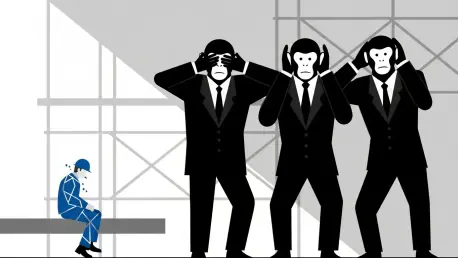
The court employed the powerful analogy of the “three wise monkeys” to describe the insurers’ methodical avoidance of the truth, stating, “It refused to see, hear, or speak the evidence that established that the JV breached its duty of care.” This was not a simple oversight or a mistake in judgment; the judge found it to be a deliberate strategy of willful ignorance. The insurers actively disregarded contemporaneous accident reports and other critical information that pointed squarely to their insured’s liability. This conduct represented a direct violation of Massachusetts General Law Chapter 176D, which explicitly mandates that an insurer must conduct a “reasonable investigation” of a claim. By choosing to ignore clear evidence, Liberty Mutual was not just building a weak defense; it was systematically violating the laws designed to ensure fair treatment for claimants and protect them from such bad-faith tactics.
The High Cost of Unreasonable Negotiations
The insurers’ settlement strategy was identified as another primary and egregious violation of their statutory duties. Despite John Rooney’s medical bills climbing to over $768,000 and the overwhelming evidence pointing to their client’s fault, Liberty’s final settlement offer before trial was a paltry $350,000. Rooney’s attorney, Andrew M. Abraham, described the offer as “laughable” in the face of his client’s catastrophic, life-altering injuries. The inadequacy of this offer was further highlighted when, a week into the personal injury trial and only after their own defense counsel advised them of a 75 percent probability of losing the case, the insurers grudgingly increased the offer to just $700,000. This meager increase was made even more insulting by the fact that Rooney’s legal team had already rejected a “high-low” settlement agreement proposal that would have guaranteed them a minimum of $1 million.
This pattern of conduct was viewed by the court not as a genuine attempt at negotiation but as a cynical strategy of delay and obstruction. The failure to present a fair offer when liability had become “reasonably clear” was a textbook violation of the state’s unfair settlement practices act. Judge Squires-Lee directly confronted and dismissed a common insurer tactic: using the inherent “unpredictability” of jury trials as a justification for making unreasonably low settlement offers. She wrote that if the mere possibility of a defense verdict were enough to avoid making a reasonable offer, “no insurer would settle. Ever.” This powerful judicial commentary established that the legal standard is not the absence of any chance of winning at trial, but rather an objective assessment of whether the insured’s liability is reasonably clear. In this case, the liability was clear, and the insurers’ refusal to acknowledge it constituted what Abraham termed “Liberty playing games,” a game for which they were ultimately “whacked” with a historic penalty.
A Precedent with Lasting Implications
The final ruling stood as a powerful affirmation of the legal mechanisms designed to hold insurance carriers accountable. The judgment demonstrated the critical interplay between state laws governing insurance conduct and broader consumer protection statutes, which together create a formidable deterrent against bad-faith practices. The court’s finding that Liberty Mutual’s actions were “willful or knowing” was the key that unlocked the statute’s punitive power, compelling the doubling of the underlying $45 million award. Judge Squires-Lee’s candid admission that she found the resulting $91 million penalty to be “grossly excessive” yet legally unavoidable highlighted the mandatory and uncompromising nature of the law. This reinforced the principle that judicial discretion is removed once a finding of willfulness has been made, sending a clear message that the financial consequences are absolute. While legal experts remained divided on whether a single, albeit massive, verdict could fundamentally reform an entire industry, the case undoubtedly provided a powerful new weapon for policyholders and their attorneys in the ongoing fight for fair and equitable claims handling across the nation.