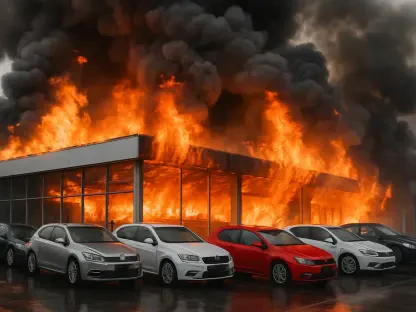

As wildfire seasons grow longer and more destructive, a groundbreaking Nevada law is reshaping the fundamental contract between homeowners and their insurance providers. Taking effect this year, the legislation introduces a four-year pilot program, or “sandbox,” that grants insurance companies the legal authority to exclude wildfire damage from standard homeowners policies. This change, which received strong bipartisan backing, does not force insurers to remove the coverage but provides them with a legal safe harbor if they choose to do so. The goal is to encourage them to remain active in the state by allowing them to offer wildfire protection as a separate, standalone policy. This significant shift attempts to solve a growing crisis for the insurance industry, but in doing so, it places the financial risk of catastrophic fires squarely on the shoulders of individual property owners, creating a high-stakes experiment in a state grappling with escalating climate threats.
The Gamble for a Stable Market
Supporters of the new framework argue that it is a crucial and proactive measure designed to prevent an insurance market collapse similar to what has been witnessed in neighboring states. The primary rationale is to alleviate the immense financial pressure on insurers, who face mounting losses from increasingly frequent and severe wildfires. By allowing them to “unbundle” the high-risk peril of wildfire from a general policy, the law aims to stabilize premiums for the majority of homeowners and, more critically, to stop insurers from issuing mass non-renewals or exiting the state’s market entirely. This concern is particularly acute in Nevada, which, unlike many other states, lacks a “Fair Access to Insurance Requirements” (FAIR) program. Without such a plan to serve as an insurer of last resort, a widespread withdrawal by private companies could leave tens of thousands of homeowners with no viable options for coverage, jeopardizing their properties and financial security. This legislation is therefore positioned as a necessary evil—a compromise to keep insurance available, albeit in a more fragmented and potentially costlier form.
This model of separating specific catastrophic risks from standard insurance policies reflects a broader, evolving strategy in states that are on the front lines of climate change. The practice is not without precedent; for years, California homeowners have had to purchase separate earthquake insurance, while residents in coastal states like Florida and Texas often need standalone policies to cover damage from hurricanes and windstorms. However, applying this unbundling concept to wildfire risk in Nevada introduces a new set of challenges and uncertainties. Because conventional mortgages universally require homeowners insurance, the introduction of a mandatory, yet separate, wildfire policy could erect significant financial barriers to homeownership. Prospective buyers in high-risk areas may face the dual burden of securing a general policy and a potentially exorbitant wildfire policy, complicating loan approvals and making homes less affordable. This raises critical questions about how the real estate market will adapt and whether this legislative solution will inadvertently create new forms of economic inequity.
A Cautionary Tale from California
To understand the potential long-term consequences of insufficient or unaffordable wildfire coverage, one need only look at the recent aftermath of catastrophic fires in Southern California. New data reveals a sobering trend in the hardest-hit communities: nearly 40% of the land where homes once stood is being sold off to real estate investors rather than being rebuilt by the original owners. According to local real estate professionals, this mass sell-off is a direct result of inadequate insurance payouts. Many residents discovered, only after losing everything, that their policies were not enough to cover the staggering cost of demolition, debris removal, and new construction at current prices. Left with no financially viable path to rebuild their lives, selling the empty lot became their only option. This has led to the heartbreaking displacement of entire neighborhoods and serves as a stark warning about the severe social fallout that occurs when an insurance system fails to provide a true safety net for disaster victims. This scenario is precisely what Nevada’s new framework must seek to avoid.
The economic shockwaves from this phenomenon in California extend far beyond individual tragedies, destabilizing the entire regional economy. The flood of vacant lots onto the market has caused land prices to plummet in affected areas, eroding the wealth of those who lost their homes. Simultaneously, the remaining residents have been hit with a dramatic surge in insurance premiums, with some seeing increases of 35% to 50% as insurers re-evaluate the heightened risk. The sheer scale of the financial exposure is staggering; data from Zillow estimated that just two fire zones contained nearly 20,000 homes with a combined value approaching $46 billion. This experience provides a critical lesson: when insurance coverage becomes inadequate or inaccessible, the consequences are not confined to individual homeowners. The fallout can trigger a cascade of negative economic effects, including depressed property values, a strained housing market, and a hollowing out of communities, highlighting the immense stakes of Nevada’s ongoing insurance experiment.
Navigating an Uncharted Landscape
The implementation of Nevada’s wildfire insurance law marked a pivotal moment in the state’s approach to climate risk. The legislation was a calculated gamble, intended to preserve the viability of the insurance market by allowing providers to offload their most unpredictable and costly exposures. In doing so, it fundamentally restructured the financial landscape, shifting the burden of wildfire risk from a broad, pooled system to the individual homeowners residing in the most vulnerable areas. The immediate aftermath of the law’s passage saw the emergence of a new, specialized market for standalone wildfire policies. However, this development also brought the critical issues of affordability and accessibility to the forefront, as residents in high-risk zones grappled with the new reality of securing adequate coverage. The state’s bold experiment ultimately underscored a more profound truth: insurance reform, while a necessary component, was just one piece of the complex puzzle of climate adaptation, which demanded far more comprehensive strategies to ensure the long-term resilience of its communities.