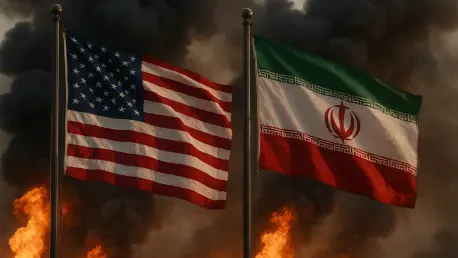

With us today is Simon Glairy, a leading voice in risk management whose work at the intersection of insurance and technology is reshaping how the industry quantifies emerging threats. As the United States amasses its largest military force in the Middle East since 2003, we’ll be exploring how this dramatic escalation is forcing a radical reassessment of risk across the specialty insurance and reinsurance markets, from potential conflict scenarios and their impact on critical infrastructure to the ripple effects on global shipping and trade.
With a major US military force now in the Middle East, reportedly capable of a “sustained campaign,” how are insurers recalibrating their worst-case scenarios? What specific inputs are changing in your models for the frequency and severity of potential political violence claims in the Gulf?
The most significant shift is moving away from modeling a single, surgical strike to modeling a prolonged, sustained campaign. When you see reports of dozens of F-16, F-22, and F-35 fighter jets, multiple aircraft carriers, and the potential for long-range B-2 bombers, the entire nature of the threat changes. Our models are no longer looking at a 72-hour event. Instead, we are stress-testing for a conflict that could last weeks or months. This means we are dramatically increasing the assumed frequency of loss events and the potential for a far greater severity as the conflict grinds on, potentially drawing in regional actors and impacting a much wider geographic footprint. The inputs are changing from a short, sharp shock to a long, attritional burn.
Iran is reportedly hardening key sites, suggesting any conflict could be prolonged. How does this defensive work impact underwriting for energy and infrastructure assets in the region? Please walk me through how you assess the heightened risk of retaliation and adjust coverage terms or premiums.
It’s a complex dynamic. On one hand, the fortification of specific sites, like the reinforced concrete shields over nuclear facilities or the rebuilding of missile bases, makes those individual assets harder to destroy. However, this very action signals an expectation of conflict and an intent to endure it. For underwriters, this is a massive red flag. It tells us that any military action won’t be simple and will likely require a more destructive and prolonged effort to achieve its objectives. This directly heightens the risk of collateral damage and, more importantly, widespread retaliation against softer targets across the Gulf—think commercial property, energy installations, and other critical infrastructure. In response, we are scrutinizing policy wordings, potentially narrowing coverage for certain perils, and certainly repricing the risk with significantly higher premiums to reflect a more volatile and protracted conflict environment.
Given the threat to shipping in the Strait of Hormuz and potential for airspace closures, what practical steps are marine and aviation underwriters taking? Could you detail how you might adjust risk appetite or policy wording for clients operating in, or transiting through, the region?
Practically, we are in a state of high alert. For our marine clients, this means constant communication regarding transit through the Strait of Hormuz. We’re reviewing marine war risk policies on a vessel-by-vessel basis, and premiums for voyages through the region are likely to see sharp increases. Iran’s longstanding threats to disrupt shipping mean we have to plan for a potential full closure, which would be catastrophic for oil flows and trigger enormous business interruption claims. For aviation, the situation is just as tense. We’re advising airlines to have contingency plans for immediate airspace closures and extensive rerouting. The risk of miscalculation is immense; a single stray missile could ground all air traffic over a vast area, leading to huge liability and hull claims. Our risk appetite shrinks in these scenarios, and we may introduce specific clauses or exclusions related to conflict zones to manage our exposure.
A broad conflict could trigger losses across many insurance lines simultaneously. Can you explain the process a reinsurer uses to assess its aggregated exposure across treaty and facultative programs in this scenario? Please provide an example of how you would stress-test your portfolio against this threat.
This is precisely where reinsurance proves its value. Our primary concern is the accumulation of losses. A conflict doesn’t just trigger one type of claim; it triggers a cascade across war, political violence, marine, aviation, and even trade credit policies. We use sophisticated modeling to map our total exposure. For example, we would run a scenario of a two-month conflict that includes missile strikes on key Gulf ports, the closure of the Strait of Hormuz, and widespread civil unrest. We would then aggregate the potential losses from our facultative programs covering specific energy assets, our treaty programs with primary insurers in the region, and our specialty lines like aviation and marine. This stress test reveals our total potential financial hit, allowing us to see if our exposure is too concentrated and whether we need to adjust our underwriting strategy or purchase more retrocession coverage to protect our own balance sheet.
Beyond direct conflict, the situation creates significant uncertainty for businesses. For corporates with exposure to Iran or neighboring markets, what triggers would lead you to act on a trade credit or political risk policy? Please describe the types of claims you anticipate in this environment.
The triggers are often a step removed from the physical conflict itself. A political risk policy might be triggered by government actions like asset freezes, the expropriation of a factory, or the inability to convert local currency and repatriate funds due to new sanctions. For trade credit, a key trigger would be a buyer in a neighboring country defaulting on payment because their business has collapsed due to the regional instability, even if they haven’t been directly hit by a missile. We anticipate a wave of claims related to supply chain and business interruption. A company might have a critical supplier in a country that suddenly becomes inaccessible, or a contract might be canceled by a government entity. The current environment, with the looming threat of new sanctions and widespread instability, means we are bracing for these kinds of complex, politically-driven financial losses.
What is your forecast for the war and political risk insurance market in the Middle East for the next 12 months?
My forecast is for a sustained period of extreme uncertainty and, consequently, a very hard market. With such a substantial US military deployment and Iran’s visible defensive preparations, the perceived risk is at its highest point in over two decades. We will see a sharp increase in demand for war and political risk coverage, but the available capacity will likely shrink as underwriters become more cautious. Premiums will rise significantly, and terms and conditions will become much more restrictive. Insurers will be laser-focused on managing their aggregate exposure, which means clients will face tougher negotiations and higher costs to secure the coverage they need. The market is in a holding pattern, but it’s a deeply uneasy one; any escalation could trigger a rapid and dramatic market reaction.