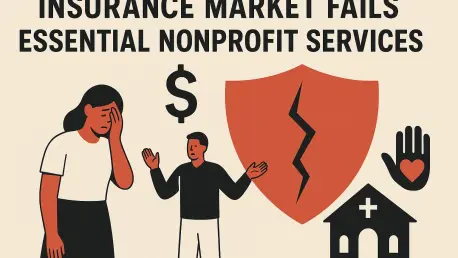

The very framework designed to protect community-serving organizations from catastrophic risk is systematically dismantling their ability to function, creating a paradox where insurers are abandoning the sector they are meant to support. For the nation’s nonprofit organizations, insurance is not a luxury but a fundamental utility, as essential as electricity or water for keeping the doors open. Without it, operations cease, and vital community services disappear. This report analyzes the growing crisis as commercial insurance carriers increasingly withdraw from the nonprofit sector, leaving a void that threatens the stability of the entire social safety net.
A Vital Sector Left Vulnerable: The Nonprofit Insurance Landscape
For any nonprofit, from a local food bank to a national advocacy group, liability insurance is a non-negotiable prerequisite for operation. It provides the financial backstop necessary to manage risk, secure funding, and ultimately deliver on a mission. However, the commercial insurance market has begun to treat this essential service as an optional, low-margin product line. This has led to a widespread and calculated retreat by for-profit carriers, creating an environment of profound instability for organizations that require consistency above all else.
This market withdrawal has drawn a sharp distinction between traditional for-profit insurers and mission-aligned providers like the Nonprofits Insurance Alliance (NIA). While commercial carriers enter and exit the market based on profitability cycles, specialized insurers remain committed to serving the sector through both favorable and challenging economic climates. Their stability is a lifeline for thousands of organizations.
The significance of this reliable coverage cannot be overstated. When a nonprofit can count on its insurance, it can confidently hire staff, launch new programs, and respond to community emergencies. The current market volatility, however, forces these organizations to divert precious resources of time and money toward a desperate search for coverage, undermining their capacity to serve those who rely on them most.
The Widening Chasm: Market Dynamics and Dire Projections
The gap between what nonprofits need and what the insurance market is willing to provide is expanding at an alarming rate. This chasm is not the result of a temporary market fluctuation but a deep, structural disconnect fueled by a profit-first mentality that is fundamentally incompatible with the enduring needs of the social sector. The projections are stark, pointing toward a future where many essential services may become uninsurable.
A Calculated Retreat: Why For-Profit Insurers Are Abandoning Nonprofits
A structural misalignment lies at the heart of the crisis. The for-profit insurance industry operates on a model that seeks to maximize returns, making it inherently cyclical. In contrast, the nonprofit sector’s need for services is constant and often counter-cyclical, growing during economic downturns when community needs are greatest. Commercial carriers view nonprofits as a low-margin segment, making them one of the first to be abandoned when market conditions tighten. This creates a perpetually insecure environment for organizations whose funding is already unpredictable.
The COVID-19 pandemic served as a powerful exposé of this systemic fragility. While many businesses transitioned to remote work, nonprofits providing essential services had to remain on the front lines, facing heightened risks. It was during this period that the market’s failure became undeniable, with insurance brokers making desperate calls, unable to place coverage for long-standing clients like food banks. This experience underscored a crucial reality: the withdrawal of insurance capacity by for-profit carriers is a calculated business decision that ignores the immense social cost.
The Data of Disconnect: Skyrocketing Demands Meet Dwindling Supply
A dangerous trend is accelerating the crisis: public funders are mandating insurance coverage limits that are increasingly difficult, if not impossible, to obtain. Municipalities, counties, and government grantors now frequently require nonprofits to carry liability limits that the commercial market is no longer willing to offer at an affordable price. This leaves organizations in an impossible position, caught between funder mandates and market realities.
This dynamic exposes a glaring hypocrisy within the corporate world. Some of the same insurance companies that publicize minor charitable donations of a few thousand dollars are simultaneously withdrawing millions in insurance capacity from the nonprofit sector. These token gestures of corporate social responsibility do little to address the far more critical and existential threat posed by the lack of stable coverage, a resource that only the insurance industry can provide. The most meaningful contribution is not a small check but a sustained commitment to insuring the sector.
Projections indicate that this disconnect will only worsen. As the civil justice environment continues to drive up claim costs, funder-mandated limits are likely to rise further. At the same time, insurers will become even more risk-averse, pulling back capacity and raising prices. The result will be a growing number of nonprofits unable to secure the coverage required to operate, forcing them to either reduce services or shut down entirely.
Navigating the Obstacle Course: Barriers to Sustainable Coverage
The path to securing stable and affordable insurance has become an obstacle course for nonprofits, one defined by systemic failures rather than temporary market pressures. While alternative solutions are emerging, they are not a universal remedy for a problem so deeply embedded in the structure of the insurance market. The current environment is forcing essential organizations into unsuitable and precarious corners of the industry.
The core challenge is a systemic market failure, not a transient downturn. Unlike a typical hard market cycle, where prices rise but coverage is generally available, the current situation is characterized by a fundamental withdrawal of capacity. Carriers are not just repricing risk; they are eliminating entire classes of nonprofit business from their portfolios, leaving a vacuum that cannot be easily filled. This retreat signals a long-term strategic shift away from the nonprofit sector by major industry players.
In response, many have pointed to alternative risk models, such as risk retention groups (RRGs) and captives, as a potential solution. However, these models are not a panacea. While they can offer stability, they face immense challenges, including the need to raise substantial capital without access to public stock markets. Furthermore, they are not immune to the broader market forces. Even established, specialized insurers struggle to obtain sufficient reinsurance to meet the high-limit demands imposed by funders, demonstrating that these alternatives are still vulnerable to the same systemic pressures.
Consequently, a growing number of nonprofits are being pushed into the surplus lines market. This is a deeply concerning development. The surplus lines market is designed for unique, high-risk, or difficult-to-place exposures, not for the standard operational risks of community-based organizations. Forcing essential service providers into this less-regulated, higher-cost market is a clear admission of failure by the mainstream insurance industry.
The Compounding Pressure: How Judicial and Regulatory Forces Exacerbate the Crisis
Beyond the internal dynamics of the insurance market, external forces from the judicial and regulatory spheres are intensifying the pressure on nonprofits. A deteriorating civil justice environment and uncoordinated mandates from public funders have created a perfect storm, making sustainable insurance coverage an increasingly elusive goal for the organizations that form the backbone of community support systems.
“Judicial Inflation”: The Driving Force Behind Insurer Aversion
A primary driver of the crisis is the phenomenon known as “judicial inflation.” The civil justice environment has become increasingly unpredictable and costly, leading to larger and more frequent jury awards. This trend has a profound and destabilizing effect on the insurance and reinsurance markets, as it makes it nearly impossible for underwriters to accurately price long-term risk.
The direct result of this unpredictability is a sharp increase in insurer aversion to risk. As litigation costs soar, carriers respond by raising premiums to levels that are unaffordable for many nonprofits, tightening underwriting standards, and, in many cases, exiting the market altogether. This defensive posture is a rational response to an irrational legal environment, but it leaves mission-driven organizations bearing the consequences.
This pressure is magnified in the reinsurance market, where insurers go to purchase their own insurance. Reinsurers, reacting to global loss trends and judicial inflation, have significantly increased their prices and reduced the amount of capacity they are willing to provide. This directly impacts the ability of even specialized nonprofit insurers to offer the high liability limits that are now being mandated by funders, creating a bottleneck that affects the entire sector.
Unattainable Mandates: When Funder Requirements Outpace Market Realities
Government grantors and municipalities are increasingly acting as de facto regulators by imposing stringent insurance requirements as a condition of funding. These mandates are often established without any consideration of the insurance market’s ability to meet them. As a result, nonprofits are required to secure coverage that is either unavailable or financially out of reach, creating a compliance trap that jeopardizes their funding and their ability to operate.
For many nonprofits, compliance with these mandates becomes a significant barrier to service delivery. An organization may have the expertise, staff, and community trust to run an effective program, but if it cannot secure an insurance policy with the specific limits and endorsements required by a government contract, it cannot move forward. This effectively sidelines capable organizations and leaves community needs unmet.
The root of this issue is a critical lack of coordination between public funders and the insurance industry. Government entities impose requirements based on their perception of risk, while the insurance industry sets its capacity and pricing based on market realities. Nonprofits are caught in the middle of this disconnect, forced to navigate a system where the demands of one key partner are directly at odds with the offerings of another.
A Glimpse into the Future: The Precarious Path Ahead for Nonprofits
The convergence of these market, judicial, and regulatory pressures paints a grim picture for the future of the nonprofit sector. Without significant intervention, the path ahead is one of increasing instability, forcing essential community pillars to make impossible choices between fulfilling their mission and managing untenable risks. The very fabric of the community safety net is at risk of unraveling.
The most immediate threat is the looming specter of uninsurability for essential services. Organizations that communities depend on in times of crisis—food banks, homeless shelters, and community support centers—may soon find it impossible to secure the liability coverage they need to operate. This is no longer a distant possibility but an approaching reality for a growing number of nonprofits across the country.
Should this trend continue, the result could be a widespread disruption of the social safety net. As organizations are forced to reduce services, turn down government contracts, or shut down altogether due to a lack of insurance, the communities they serve will be left vulnerable. The cumulative effect would be a significant erosion of the support systems that protect the most marginalized populations.
Ultimately, the future outlook for the nonprofit sector depends on a shift toward systemic reform. Temporary, fragmented fixes will not solve a problem this deeply entrenched. A sustainable path forward requires a comprehensive and collaborative effort to address the root causes of the crisis, rather than simply patching the holes in a failing system.
Rebuilding the Safety Net: A Call for Structural Reform and Genuine Partnership
The crisis facing nonprofits is a call to action for the insurance industry, policymakers, and public funders. Addressing this systemic failure requires moving beyond superficial gestures and toward a genuine partnership built on structural reform. The goal must be to rebuild a reliable insurance safety net that enables, rather than hinders, the critical work of community-based organizations.
Beyond Token Gestures: Redefining Corporate Responsibility in Insurance
The current approach to corporate social responsibility within the insurance industry was found to be woefully inadequate. Small charitable donations, while well-intentioned, failed to address the core problem: the withdrawal of the industry’s most critical and unique resource. This highlighted a profound disconnect between public relations efforts and the real-world impact of business decisions.
The dialogue concluded that stable and affordable insurance capacity is the single most important contribution the insurance industry can make to the health and sustainability of the nonprofit sector. This is not charity; it is a fundamental business practice that aligns with the industry’s purpose of enabling societal functions. True corporate responsibility would mean prioritizing this essential service over short-term profit motives.
This led to a recommendation for insurers to develop sustainable, long-term models specifically designed for serving community-based organizations. Such models would need to recognize the unique risk profile and non-cyclical needs of the sector, moving away from the volatile, profit-driven approach that has proven so damaging.
The Urgent Need for a Collaborative Solution
The report’s findings culminated in an urgent call to action. It implored policymakers, regulators, and insurance industry leaders to collaborate on addressing the root causes of the crisis, with a particular focus on the destabilizing effects of judicial inflation. Without tackling this foundational issue, any other solutions would remain superficial.
Ultimately, the analysis showed that without systemic intervention, the organizations communities relied on most would remain dangerously exposed. The failure of the insurance market was not merely a business problem but a societal one, threatening the very infrastructure of community care. A concerted effort to rebuild a stable and accessible insurance market was identified as the only viable path toward securing the future of essential nonprofit services.