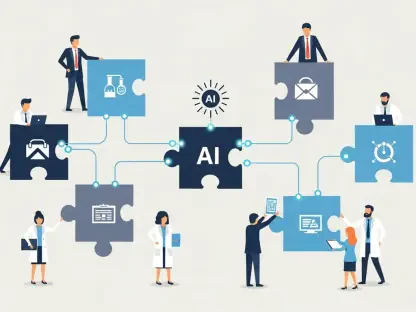

With a deep understanding of risk management and AI-driven solutions, Simon Glairy is at the forefront of modernizing the specialty insurance market. His work focuses on transforming the core operational engines of the business—brokerage and binding authority—by strategically embedding technology to enhance efficiency without sacrificing the crucial human element. In our conversation, we explore how his team is using agentic AI to unravel complex policy dependencies, the calculus behind their “build versus buy” technology decisions, and their innovative approach to driving user adoption through continuous collaboration. Simon also shares how high-level executive vision is translated into practical tools that empower brokers daily, offering a clear-eyed view of a transformation that is both ambitious and deeply pragmatic.
Managing a full tower of coverage, where each excess layer depends on the primary, is extremely time-consuming. How are your agentic AI tools managing these complex dependencies, and what specific efficiencies have you measured in the policy lifecycle as a result?
This is one of the most operationally dense challenges in our world, and it’s a perfect application for targeted AI. When you’re managing a tower with 20 or even 30 policies, the manual follow-up is staggering. Our agentic AI tools function like a highly disciplined project manager. They understand the sequential nature of the tower—that you absolutely cannot secure the excess layer until the primary is fully issued and delivered. The system monitors the status of each layer, automatically triggers follow-ups at the right moments, and escalates exceptions to a human broker. This doesn’t just save time; it enforces a level of sequencing discipline that’s difficult to maintain manually at scale, reducing the risk of errors and downstream delays. We’re seeing a meaningful reduction in the time brokers spend just chasing paper, freeing them up for higher-value work.
Automation often raises concerns about losing the human touch in a relationship-driven industry. Could you share a specific example of how freeing up your team from manual follow-ups has directly enabled them to build stronger client or carrier relationships?
That concern is something we take very seriously, because relationships are our lifeblood. Our goal is never to replace the person but to empower them. A great example comes from a recent complex placement. A broker, who would have normally spent hours each week tracking down policy documents and endorsements for a multi-layered account, was able to delegate that entire follow-up process to one of our new automated systems. With that time back, he was able to proactively fly out to meet with a key carrier partner to discuss an emerging risk class. That face-to-face meeting not only strengthened their rapport but also gave us a competitive edge in understanding the carrier’s appetite, which directly benefited our clients. The technology handled the administrative burden, allowing our broker to do what he does best: build trust and create solutions.
When evaluating technology, you must differentiate between commoditized tools and your firm’s “special sauce.” Can you walk me through the criteria your team uses to make a “build versus buy” decision and provide an example of a recent choice?
The “build versus buy” decision is a constant balancing act. Our primary criterion is whether the solution requires our deep, proprietary insurance expertise to be effective. If it’s a problem that can be solved with excellent technology but minimal specialty insurance context—like a general project management tool—it becomes a strong candidate to buy. These tools are often more commoditized. However, if the solution involves our unique underwriting methodology, our specific workflow logic, or data insights that give us a competitive edge, that’s our “special sauce.” We protect and cultivate that in-house. For instance, we recently decided to build a tool for managing binding authority workflows because it’s deeply tied to our specific operational DNA. Conversely, we chose to purchase a third-party data visualization platform because it allowed us to accelerate delivery without needing to build the complex underlying charting technology from scratch.
Instead of a traditional big-bang launch, your teams engage users throughout development. How does this continuous feedback loop work in practice, and how has it shaped the final design of a recent tool to improve user adoption from day one?
The big-bang launch is dead for us; it just doesn’t work for complex operational change. Our approach is much more like a continuous conversation. From the very early stages of a project, we embed brokers and underwriters from our binding authority teams directly into the development process. In practice, this means we hold bi-weekly demos where we show live, working features—even if they’re imperfect. The users can click around, ask questions, and give immediate, raw feedback. On a recent project, our initial design for a submission intake screen was technically functional, but the team on the ground quickly pointed out that the fields were in an order that didn’t match their natural conversation with a client. It was a simple change for us to make mid-stream, but it made a world of difference. When the tool finally launched, it already felt familiar to them because they helped build it. That’s how you get true adoption.
With transformation being driven from the top, how does your team translate high-level executive vision into tangible, daily operational tools? Could you describe the process of taking a leader’s idea and turning it into a functional solution that brokers will actually use?
It’s a fantastic dynamic. Our leadership provides the strategic “why” and the “what”—they have incredible industry knowledge and are constantly generating ideas about where we can create an advantage or solve a persistent problem. They might say, “We need to be faster and more efficient in our policy follow-up process.” My team’s role is to figure out the “how.” We take that high-level vision and immediately immerse ourselves in the day-to-day reality of the brokers. We sit with them, map out their current workflow, and identify the precise friction points. From there, we prototype a solution, bring it back to both the brokers for usability feedback and to leadership to ensure it aligns with the strategic vision. It’s a constant loop of translating executive insight into a practical, ground-level solution that gets tested and refined by the very people who will use it every day.
What is your forecast for the role of AI in the wholesale brokerage and binding authority space over the next three to five years?
I believe we’re moving from AI as a novelty to AI as a fundamental utility, like email or a spreadsheet. Over the next three to five years, I forecast that AI will become an invisible but indispensable co-pilot for brokers and underwriters. It won’t be about one massive, all-knowing AI; it will be about a suite of specialized, agentic AIs that handle discrete, high-volume tasks with precision—things like checking submissions for completeness, triaging simple queries, and managing the kind of complex policy sequencing we discussed. This will fundamentally shift the broker’s role away from administrative oversight and toward strategic advising, complex negotiation, and relationship management. The most successful firms will be those that seamlessly weave this technology into their workflows, amplifying their human talent rather than trying to replace it.