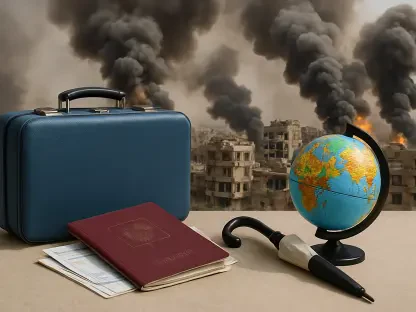

The conventional image of terrorism—a sudden, catastrophic explosion targeting a landmark skyscraper—has been replaced by a much more insidious and pervasive reality where the lines between political activism, state-sponsored sabotage, and criminal violence are almost impossible to draw. As we navigate the complexities of 2026, the global insurance industry finds itself at a crossroads. No longer can underwriters rely on the rigid, binary definitions of the past. Instead, they are forced to confront a landscape where “blurred risks” dominate, requiring a total overhaul of how we quantify threat and provide financial protection.
Historically, terrorism insurance was a relatively straightforward product designed to address “hard targets” and physical property damage. Today, however, the primary concern for many multinational corporations is not the loss of a building, but the total paralysis of operations. This shift toward “soft targets” and operational disruption has fundamentally changed the relationship between insurers, brokers, and the insured. The industry is moving toward a more integrated model that recognizes the deep interconnectedness of human capital, social stability, and corporate assets in a world where a single localized incident can have global repercussions.
Assessing the Transformed Global Terrorism Insurance Market
The current state of the terrorism insurance market is defined by a move away from antiquated, siloed definitions. In the past, a policyholder might have separate coverages for terrorism, sabotage, and civil unrest, often leading to significant legal disputes over which policy triggered during a specific event. This fragmentation is no longer sustainable. Modern insurers are increasingly adopting a holistic approach, recognizing that the intent behind an act of violence is often less important than the resulting disruption.
Brokers are now playing a more critical role as educators rather than just intermediaries. They are tasked with helping clients understand that the traditional “all-risk” property policy may contain significant exclusions for the very types of events that are most likely to occur today. By emphasizing the importance of human capital and the psychological impact of violence on a workforce, the market is beginning to value communal harmony and employee safety as highly as physical infrastructure. This evolution reflects a broader understanding that a company’s resilience depends on its ability to maintain trust and continuity in a volatile social environment.
The Convergence of Geopolitical Instability and Non-Traditional Tactics
Emerging Trends in Political Conflict and Asymmetric Threats
A primary driver of this new risk environment is the dramatic escalation in global geopolitical tensions. Conflicts between major powers and regional actors have effectively doubled over the last two decades, creating a “risk temperature” that can spike without warning. These tensions do not always lead to traditional warfare; instead, they often manifest as asymmetric threats. We are seeing a rise in lone-actor violence and hate crimes targeting communal sites, which serve as proxies for broader political grievances.
Furthermore, the focus has shifted from high-security government installations to “soft targets” like shopping malls, religious centers, and transportation hubs. The goal of these attacks is rarely just physical destruction. Instead, the intent is to cause social paralysis, spreading fear and uncertainty that can ground an entire city’s economy to a halt. This tactical shift requires a different kind of vigilance, as the “battlefield” has moved into the everyday spaces where people live and work, making risk assessment a constant, real-time necessity.
Market Projections for Integrated Political Violence and Terrorism Coverage
In response to these shifting tactics, the demand for integrated Political Violence and Terrorism (PVT) policies has reached an all-time high. These frameworks merge multiple perils, such as strikes, riots, and civil commotion (SRCC), into a single policy. This integration is vital because it eliminates the “grey area” disputes that frequently occur when an event sits on the border between a politically motivated riot and a formal act of terror. When the coverage is unified, the administrative burden on the policyholder is reduced, and the path to recovery is much clearer.
While new capital has entered the market to provide some pricing relief, it has come with a caveat: insurers are simultaneously tightening their exclusionary language. This means that while the headline price might be stable, the actual depth of coverage requires much more scrutiny. Businesses are increasingly adopting “layered” insurance programs, which use a mix of traditional and alternative markets to capture varied forms of disruption. This approach allows for a more flexible response to the rapidly changing nature of global instability.
Overcoming the Complexity of Grey-Area Coverage Gaps
The most daunting challenge facing the industry remains the ambiguity inherent in modern violent disruptions. Many policyholders mistakenly believe their standard terrorism policies provide a catch-all solution for any violent event. However, during the claims process, they often discover that rigid exclusions for “civil commotion” or “labor unrest” can leave them completely exposed. Distinguishing between a spontaneous riot and a coordinated act of terrorism is not just a semantic exercise; it is a financial one that can involve millions of dollars in potential losses.
To bridge these gaps, brokers are prioritizing the mapping of specific operational exposures rather than relying on broad, outdated labels. This involves analyzing supply chain vulnerabilities and the potential for reputational fallout that can persist long after an incident is resolved. The goal is to ensure that policy wording reflects the reality of modern operational paralysis. By focusing on the “why” and “how” of a business’s potential failure, rather than just the “what” of physical damage, the industry can create more robust protections that actually respond when the world turns chaotic.
Navigating the Regulatory Landscape and the Role of Government Backstops
As risks become more systemic, the necessity of public-private partnerships has never been more apparent. Government terrorism pools serve as the essential backstop that prevents the private insurance market from collapsing under the weight of peak losses. These pools, which exist in various forms across the globe, absorb the most catastrophic risks, such as those involving Chemical, Biological, Radiological, and Nuclear (CBRN) threats. Without these state-backed entities, many of the world’s most critical assets would be effectively uninsurable.
Compliance and security measures within these pools are evolving to meet the digital age. Many are now expanding their scope to include cyber-terrorism and state-sponsored cyberattacks that cause physical or operational damage. This evolution ensures that the insurance market remains stable even when faced with threats that transcend physical borders. By providing a floor for losses, government pools allow private insurers to innovate and offer specialized coverages for the more frequent, lower-intensity “blurred risks” that businesses face on a daily basis.
Future Projections: Cyber Paralysis and Data-Driven Risk Assessment
The future of the industry will likely be defined by the rise of cyber-terrorism as a primary tool of political coercion. As global infrastructure becomes increasingly digital, the ability to cause widespread operational paralysis without firing a single shot has become a reality. We are entering an era where a cyberattack on a power grid or a financial system is viewed through the same lens as a physical bombing. This necessitates a shift in risk assessment, where technological vulnerability is weighted as heavily as geographic location.
Innovation in this space is being driven by sophisticated data modeling. Insurers are now utilizing real-time data to quantify the likelihood of civil unrest and state-sponsored digital interference. By analyzing social media trends, economic indicators, and geopolitical shifts, underwriters can more accurately price risk in a world where the “temperature” changes by the hour. This data-driven approach will be the foundation of the next generation of terrorism insurance, providing a level of precision that was previously unimaginable.
Redefining Resilience in an Era of Persistent Uncertainty
The evolution of terrorism insurance underscored the need for a fundamental shift in how organizations perceive and manage threat. Stakeholders recognized that a narrow, property-centric approach was no longer sufficient to protect against the fluid and multifaceted dangers of the mid-2020s. To move forward, businesses should prioritize the integration of political violence, cyber protection, and business interruption coverage into a single, cohesive strategy. This involves not only purchasing insurance but also investing in real-time threat intelligence and robust crisis management protocols that can be activated the moment a “blurred” risk begins to manifest.
Ultimately, the path toward true resilience required a move away from reactive insurance shopping and toward proactive, data-informed risk partnerships. By leveraging government backstops for catastrophic scenarios while utilizing private market innovation for operational disruptions, global enterprises secured their ability to function in an increasingly unpredictable world. The most successful organizations were those that treated insurance not as a static purchase, but as a dynamic component of their broader geopolitical strategy. Moving into the future, the focus shifted toward building organizations that are not just insured against violence, but are structurally designed to withstand and adapt to the systemic shocks of the 21st century.