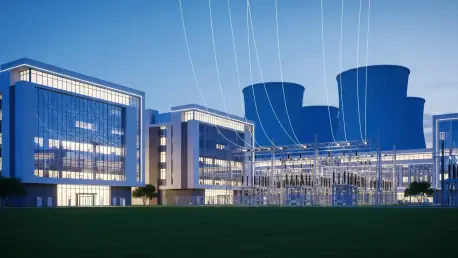

The modern global economy now pulses through a physical labyrinth of server racks and cooling systems that remains invisible to the average consumer, yet this infrastructure is expanding at a relentless pace. With investments currently projected to exceed $1 trillion over the next few years, the data center industry has transitioned from a niche segment of commercial real estate into the central engine of the digital age. As hyperscale providers like Google and Meta funnel hundreds of billions into massive new facilities, a foundational question emerges: is the traditional insurance industry capable of protecting assets that must operate with “five-nines” perfection, where a single minute of downtime constitutes a catastrophic failure?
The High-Stakes Reality of the Trillion-Dollar Digital Buildout
This unprecedented expansion is not merely about square footage; it is about the concentration of immense value into singular, high-density locations. The current decade represents a shift toward massive digital campuses that integrate complex power grids and experimental thermal management systems. Because these facilities underpin everything from global finance to artificial intelligence, the margin for error has effectively vanished. A minor disruption that might be a nuisance in a standard warehouse becomes a systemic crisis when it occurs within a hyperscale data center environment.
The scale of these investments creates a unique pressure on developers and operators to guarantee absolute reliability. In the current market, a data center is only as valuable as its uptime. As the industry moves toward 2030, the sheer density of computing power means that even localized hardware failures can have cascading financial consequences. This high-stakes environment demands a level of protection that goes beyond typical property damage, touching on the very continuity of the global digital supply chain.
Why Traditional Indemnity Is Failing the Hyperscale Era
Traditional insurance models were designed for a world of tangible, slow-moving losses, but data centers operate in a reality of micro-interruptions and extreme sensitivity. The industry standard of “five-nines”—or 99.999% uptime—allows for only a few minutes of cumulative downtime per year. When an insurance policy is built on the premise of physical “bricks and mortar” damage, it often fails to recognize the devastating impact of a flicker in power or a brief spike in ambient temperature that leaves no physical scar but crashes a network.
One of the most significant friction points is the standard waiting period in Business Interruption (BI) insurance, which often requires a 30-day delay before a claim can be triggered. For a data center operator, a month-long outage is an unthinkable scenario that would likely lead to a total breach of contract and the loss of major tenants. Furthermore, data centers defy traditional categorization by blending high-density computing with bespoke power generation. This complexity often leads to an “11th-hour” crisis where risk management is treated as a final administrative hurdle rather than a foundational strategy, leaving projects dangerously underinsured.
Parametric Insurance: A Precision Tool for High-Frequency Risk
Parametric insurance represents a fundamental shift from compensating for “damage” to compensating for “events,” offering a surgical approach to modern resilience. Unlike traditional indemnity, which requires a lengthy adjustment process to prove the exact dollar value of a loss, parametric policies are built around objective, pre-defined triggers. If a sensor records a voltage drop below a certain threshold or a cooling failure for a specific duration, the policy is triggered automatically. This creates a streamlined path to recovery that bypasses the bureaucratic hurdles of conventional claims.
The primary advantage of this model is the delivery of instant liquidity. Rapid funding allows operators to manage immediate Service Level Agreement (SLA) penalties and provide rent credits to tenants without depleting their own cash reserves. Moreover, parametric models are uniquely flexible, allowing for customization around emerging technologies such as liquid cooling or “behind-the-meter” power generation. By bridging the gap between a minor technical glitch and a major financial loss, parametric insurance addresses the specific “micro-risks” that traditional policies simply ignore.
Expert Perspectives on Financial Engineering and Bankability
Industry leaders, including specialists like Paul Brown from The Baldwin Group, emphasize that insurance has evolved into a primary driver of project finance and investor confidence. In the current lending environment, insurance is increasingly used as a credit enhancement tool to attract institutional capital. Lenders are no longer satisfied with basic property coverage; they require sophisticated risk transfer mechanisms that guarantee debt service even in the face of operational hiccups. This shift has made insurance specialists essential members of the development team, often joining the project years before ground is even broken.
Beyond physical risks, these bespoke structures are being used to manage offtaker risk. When a developer signs a lease with a tenant that may not have a perfect credit rating, insurance can bridge the gap by guaranteeing performance or payment obligations. A classic example of this financial engineering in action is the response to a 15-second voltage drop. While a traditional insurer would likely deny the claim due to a lack of physical damage, a parametric policy would provide the necessary cash flow to stabilize the project and satisfy contractual penalties, ensuring the facility remains “bankable” in the eyes of investors.
Strategies for Integrating Advanced Risk Transfer into Development
To secure the long-term viability of digital infrastructure, developers must move risk management “upstream” and treat it as a core engineering discipline. This begins with early-stage risk mapping, where insurance feasibility is incorporated into site selection and proximity to power grids. Choosing a location based solely on land cost or tax incentives can be a fatal mistake if the local utility cannot provide the stability required to trigger favorable insurance rates. Engineering and insurance must work in tandem to create a resilient tech stack.
Designing systems like battery storage and redundant cooling with insurance triggers in mind can significantly lower the total cost of risk. Moving beyond a reactive, administrative checklist allows developers to build a proactive framework that combines traditional property coverage with parametric SLA protection. This holistic approach ensures that every layer of the facility—from the physical shell to the invisible flow of data—is shielded from the volatility of a hyper-connected world. By treating risk transfer as a strategic asset, the industry can maintain its breakneck pace of growth without sacrificing financial stability.
The data center industry matured into a sector where financial and operational risks became inseparable. Developers who integrated parametric triggers into their initial site planning successfully bypassed the liquidity traps that once plagued traditional projects. By shifting the focus toward objective performance metrics and away from subjective loss adjustments, these organizations established a new benchmark for digital resilience. This proactive transition ensured that the capital-intensive buildout of the late decade remained resilient against the increasing volatility of global power grids and climate-driven disruptions.