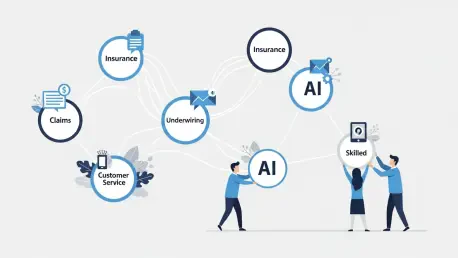

The insurance industry is decisively staking its future on Artificial Intelligence, with executives overwhelmingly committing to increased investment to catalyze a new era of technology-driven growth. This strategic pivot from a traditional focus on cost-cutting to an aggressive pursuit of revenue generation marks a pivotal moment for a sector navigating accelerating technological change. This analysis explores the powerful investment trends, the practical applications of AI at an enterprise scale, the critical talent shortage threatening to derail progress, and the future outlook for the industry.
The Unprecedented Surge in AI Investment and Integration
The financial commitment to artificial intelligence within the insurance sector is not merely a passing trend but a foundational strategic realignment. Executives are demonstrating an extraordinary level of confidence in AI’s capacity to transform their organizations, backing their optimism with significant and sustained capital allocation. This widespread enthusiasm signals that AI is no longer a peripheral experiment but a central pillar of corporate strategy.
A Resounding Vote of Confidence in AI-Driven Growth
A groundswell of executive support is propelling AI investment to new heights. Recent data reveals that 90% of senior insurance leaders plan to increase their AI spending, underscoring a near-universal belief in the technology’s potential. This financial commitment is firmly rooted in a growth-oriented mindset, with a vast majority of executives (85%) identifying AI as a primary catalyst for revenue generation rather than simply a tool for operational efficiency.
This strategic conviction appears remarkably resilient. Nearly half of all leaders (47%) confirmed they would continue to boost their AI investments even if a technology bubble were to burst. Such a stance indicates that AI is viewed not as a speculative play but as a long-term, indispensable component of a competitive business model, essential for navigating an increasingly complex market landscape.
From Pilot Programs to Enterprise-Wide Deployment
The integration of AI is rapidly maturing from isolated pilot programs to comprehensive, enterprise-wide implementation. A significant portion of insurance firms, about one-third (34%), are now deploying AI agents across multiple business functions, moving well beyond the experimental stage. Moreover, 29% of organizations are fundamentally re-engineering end-to-end processes with AI at their core, signaling a deep transformation of foundational operations.
This top-down strategic push is reinforced by personal adoption at the leadership level. The finding that 57% of executives use generative AI tools at least weekly demonstrates a genuine integration of the technology into the organizational culture. When leaders personally engage with the tools they champion, it accelerates understanding and fosters a more agile, tech-forward environment throughout the company.
The Critical Obstacle an Unaddressed Talent Shortage
Despite the industry’s bullish investment and rapid adoption of AI technologies, a formidable challenge threatens to undermine this progress. A quarter of executives identify a shortage of skilled talent as the primary factor limiting their ability to extract value from their substantial AI investments. This concern is not a minor footnote; it is considered equal in magnitude to the difficulty of integrating AI with core business strategy, highlighting its critical nature.
The industry’s response to this looming crisis, however, has been slow and insufficient. Research reveals a significant gap between technological ambition and workforce development. A mere 24% of insurance organizations have implemented continuous AI learning programs to upskill their employees. More alarmingly, only 5% are actively redesigning job roles to support and integrate the new technology, leaving a vast majority of the workforce unprepared for the AI-driven future they are building.
The Future Outlook a High-Stakes Race Between Ambition and Reality
The insurance industry stands at a crossroads where its ambitious investment in AI could either unlock transformative growth or be severely hampered by the lack of a skilled workforce to execute its vision. The primary conflict is the stark disconnect between aggressive capital deployment and inadequate investment in human capital. This gap between technological aspiration and talent reality creates a high-stakes scenario for the entire sector.
Failure to address this skills deficit could have profound consequences. It risks turning multi-billion dollar AI initiatives into wasted resources, leading to failed projects and a loss of competitive advantage for early adopters. The long-term success of AI in insurance will ultimately depend not just on acquiring the best technology but on the ability to synchronize technology and talent strategies into a cohesive, forward-moving plan.
Conclusion Bridging the Talent Gap to Realize AI’s Full Potential
The insurance industry displayed unwavering optimism and a powerful financial commitment to using AI as a primary engine for growth. This forward-looking strategy, however, was critically undermined by a collective oversight in cultivating a workforce capable of leveraging these advanced tools. The promise of AI transformation was not merely about acquiring the right technology but about empowering the right people with the right skills. To close this gap, insurance leaders must shift from a technology-only focus to a holistic strategy that prioritizes robust upskilling, intelligent job redesign, and a culture of continuous learning. Only by aligning human capital with technological investment can the industry ensure its ambitious AI vision translates into tangible and sustainable success.