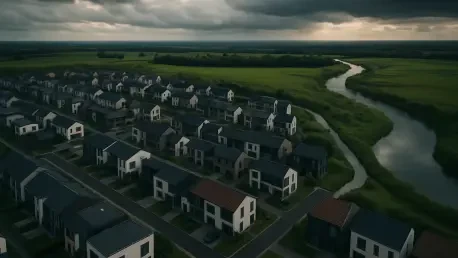

The quiet architectural transformation of the English countryside has reached a precarious tipping point where the dream of homeownership is increasingly colliding with the inescapable reality of rising river levels and saturated floodplains. While the national government accelerates its push to resolve a long-standing housing shortage, a sobering reality is surfacing in planning departments across the country. Approximately one in nine new homes built in England over the last two years is situated in a high-risk flood zone. This shift marks a significant departure from previous decades, suggesting that the drive to meet ambitious delivery targets is increasingly coming at the expense of long-term environmental safety. As homeowners move into these brand-new properties, many remain unaware that they are stepping into a future defined by rising water levels and dwindling financial protection.
This emerging trend represents a fundamental shift in how the nation approaches land use and urban expansion. In the past, developments were largely steered away from vulnerable estuaries and low-lying plains, but the current scarcity of viable land has forced a compromise. The result is a landscape where modern aesthetics often mask a deep-seated vulnerability to the elements. This is not merely a matter of occasional property damage; it is a structural change in the English real estate market that threatens to leave thousands of families stranded in homes that are increasingly difficult to protect or sell.
Why the Intersection: Housing and Climate Matters
The urgency of this issue stems from a direct conflict between national housing quotas and the intensifying reality of climate change. With nearly 44,000 homes recently constructed in medium-to-high danger areas, the traditional “sequential approach” to planning—which prioritizes safe land over floodplains—appears to be buckling under immense political and economic pressure. This trend is not just an environmental concern; it is a systemic threat to economic stability. These developments often alter local drainage patterns, placing not only the new residents but also established nearby communities at a significantly greater risk of devastating property damage as natural runoff paths are paved over.
Furthermore, the acceleration of these projects suggests a disconnect between short-term political wins and long-term sustainability. The pressure to provide affordable housing for a growing population often outweighs the cautionary advice of environmental agencies. However, the true cost of these homes is not reflected in the initial purchase price. Instead, it is deferred to the future, where the burden will fall on individual homeowners and the taxpayer to fund emergency responses and coastal defenses. This creates a cycle of vulnerability that is difficult to break once the concrete has been poured and the keys have been handed over.
Deconstructing the Scale: The Impact of the Flood Crisis
Analysis of nearly 400,000 new properties reveals that 11% of homes built between 2022 and 2024 are in flood-prone areas, a sharp rise from the 8% recorded in the previous decade. When looking at the broader picture, over a quarter of all recent builds possess some inherent level of flood risk. The geographic concentration of these homes is heavily skewed toward specific regions, with Greater London and Essex accounting for nearly a third of the most vulnerable constituencies. Other areas, including Lincolnshire and the North West, show similar trends, indicating that local authorities are granting permissions in floodplains to satisfy central government housing mandates despite the obvious geographic hazards.
A critical financial trap awaits buyers of these properties: homes built after January 1, 2009, are ineligible for Flood Re, the national scheme designed to keep flood insurance affordable. This exclusion leaves thousands of owners facing the prospect of uninsurable properties or exorbitant premiums, as weather-related claims in the region are projected to hit £1.6 billion annually by the end of this decade. By 2050, it is estimated that one in seven homes currently under construction will face significant flood risks. Research shows that residents of homes built within the last five years are already twice as likely to have experienced flooding compared to the general population, proving that the crisis is a present reality rather than a distant forecast.
Expert Perspectives: Sustainability and Risk
Industry leaders argue that while the insurance industry supports housing growth, the current trajectory remains fundamentally unsustainable. There is a dangerous disconnect between construction volume and climate preparedness, with many warning that England is inadvertently creating a generation of financially unviable homes. Data from global financial firms reinforces this concern, showing that the cost of weather-related property damage has more than doubled since 2017. This surge places immense strain on the nation’s economic resilience, as the insurance market struggles to price risk in areas that were once considered safe but are now regularly inundated by seasonal storms.
Experts highlight that the reliance on engineering solutions, such as levees and pumps, often provides a false sense of security. While these defenses are effective to a point, they can fail during extreme weather events, which are becoming more frequent and severe. The consensus among environmental strategists is that the focus must shift from “defending against” water to “building with” water. This requires a radical rethinking of urban design, moving away from high-density developments in low-lying areas and toward more adaptive architectural practices that prioritize natural flood management and permeable landscapes.
Strategies for Resilience: A More Sustainable Housing Market
The path toward a more secure housing market required a fundamental shift in both policy and public awareness. It was eventually determined that a “presumption against” development in high-risk zones had to be the baseline for all future planning decisions. Stricter enforcement of the sequential approach became necessary to ensure that floodplains remained functional for natural drainage rather than being converted into residential neighborhoods. Policymakers realized that protecting the natural capacity of the land to absorb water was the most cost-effective way to safeguard the nation’s housing stock from the long-term effects of climate change.
Moreover, the integration of mandatory resilience measures became a cornerstone of modern building codes. Features such as water-resistant materials, raised electrical sockets, and specialized flood doors were recognized as essential components for any essential developments in at-risk areas. It was also understood that data transparency was vital for the protection of consumers. The decision to provide granular, official information regarding flood zones allowed prospective buyers to make informed financial choices. Ultimately, the transition to a more resilient market was achieved by acknowledging that the true value of a home depended not just on its location, but on its ability to withstand the environmental challenges of the coming century.