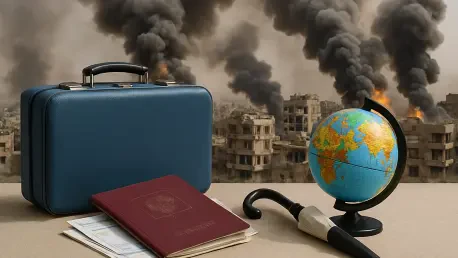

The sudden escalation of military operations and regional instability across the Middle East has sent shockwaves through the international travel sector, forcing thousands of passengers to confront the stark reality of their insurance limitations. As major transit corridors face unprecedented closures and flight schedules are scrapped overnight, a significant number of Singaporean travelers have discovered that the safety net they believed was in place is riddled with holes when it comes to geopolitical conflict. This widespread disruption serves as a critical turning point for the aviation and insurance industries, highlighting a systemic vulnerability in standard policy agreements that often leave individuals stranded during periods of armed hostility. While travelers typically expect coverage for cancellations or delays, the complex legal language surrounding acts of war has created a barrier to financial recovery that few were prepared to navigate. This evolving situation demands a deeper investigation into the mechanisms of risk, the logical framework of policy exclusions, and the proactive measures required to safeguard travel in an increasingly unpredictable world.
Aviation Disruptions: The Reality of Financial Losses
The geopolitical crisis has caused widespread chaos across global aviation networks, specifically impacting routes that rely on Middle Eastern hubs such as Dubai, Doha, and Abu Dhabi. When these central transit points face disruptions, travelers often find themselves stranded in foreign cities with mounting bills for non-refundable tickets, emergency hotel stays, and expensive alternative transport arrangements. Because most standard personal and business policies contain explicit exclusions for losses related directly or indirectly to acts of war, the financial burden of these cancellations typically falls directly on the individual traveler. The realization that thousands of dollars in expenses may never be recouped has left many questioning the utility of traditional insurance in the modern age. Beyond the immediate financial sting, the emotional toll of being stuck in a high-tension zone without guaranteed institutional support has highlighted a significant gap in the duty of care expected by modern global citizens.
Furthermore, the complexity of modern air travel means that a single disruption in a transit hub can trigger a cascade of failures across a traveler’s entire itinerary. For a passenger flying from Singapore to London via a Middle Eastern connection, a closed airspace does not just mean a delayed flight; it often results in missed connecting trains, forfeited prepaid accommodation, and the loss of expensive tour bookings. Standard insurance products are designed to handle localized issues like mechanical failures or inclement weather, but they are fundamentally ill-equipped to manage the systemic collapse of an entire regional aviation sector. As airlines struggle to reroute thousands of passengers, the lack of insurance reimbursement for secondary costs creates a situation where the traveler is effectively self-insuring against the largest risks they face. This reality has forced a necessary, albeit painful, conversation about how travelers must now account for geopolitical volatility as a primary factor in their budget and contingency planning.
Risk Logic: The Mechanics of Industry Exclusions
The exclusion of war-related risks is a fundamental practice within the global insurance industry, driven by the unpredictable and systemic nature of armed conflict which makes it impossible to model accurately. According to the General Insurance Association of Singapore, these events are nearly impossible to price because they can trigger a massive volume of simultaneous claims that could theoretically bankrupt a firm. Unlike a single car accident or a localized medical emergency, a regional conflict affects thousands of policyholders at once, creating a catastrophic accumulation of risk. If insurers were to provide standard coverage for such events, the premiums would need to be astronomically high to cover the potential for billion-dollar payouts. By excluding these high-magnitude events, insurance providers aim to keep their products affordable for the more common risks that travelers face daily, such as lost baggage, minor medical treatments, or cancellations due to personal illness.
Moreover, the behavior of primary insurers in Singapore is heavily influenced by the global reinsurance market, where the world’s largest financial entities provide a secondary layer of protection to local companies. Since most global reinsurers exclude war from their standard portfolios to protect their own solvency, local insurance companies would be forced to bear the entire financial risk of a conflict on their own balance sheets—a move that few are willing or able to make. This structural reality means that even if a local firm wanted to offer comprehensive war coverage, they would struggle to find the backing necessary to make it a sustainable business model. Consequently, the industry relies on a rigid framework of exclusions that protects the financial stability of the insurer but leaves the consumer vulnerable to the very events that cause the most significant disruptions. This highlights a clear divergence between the consumer’s desire for total protection and the industry’s need for mathematical and financial predictability.
Strategic Shifts: Navigating the Known Event Doctrine
A major hurdle for any traveler seeking coverage during times of unrest is the “known event” principle, which dictates that insurance is only valid for risks that are truly unforeseen at the time of purchase. Once a conflict is widely reported in the news or a government issues a formal travel advisory, it is classified as a “known event,” and any policy purchased after that point will typically exclude all related claims. This underscores the absolute necessity of purchasing insurance immediately after booking a trip, rather than waiting until the departure date nears. Travelers who delayed their insurance purchases until the tensions in the Middle East became front-page news found themselves unable to secure protection for the very disruptions they feared most. This principle serves as a reminder that insurance is a proactive tool for managing future uncertainty, not a reactive solution for ongoing crises that have already begun to manifest in the public eye.
In response to these challenges, some insurers have begun to experiment with rare exceptions, such as the temporary coverage extensions seen with Income Insurance for travelers in specific Middle Eastern zones. However, these departures from industry norms are often highly conditional, requiring passengers to first exhaust all refund options from airlines and hotels before the policy pays out. For the corporate sector, the response involved a greater interest in “war buyback” or “passive war” clauses, which offer limited medical protection for employees caught in the crossfire. While these specialized additions provide a layer of security, they come at a significantly higher cost and do not typically cover the logistical expenses of flight cancellations. Ultimately, the industry moved toward a model where the traveler must become an active participant in risk management, monitoring government advisories and understanding the fine print of their policies with a level of detail that was previously reserved for legal professionals.
Future Considerations: Building a Resilient Travel Strategy
The recent disruptions in the Middle East served as a definitive lesson in the limitations of traditional financial protection and the necessity of a more comprehensive approach to travel security. It was observed that travelers who succeeded in minimizing their losses were those who adopted an exclusion-first mindset, meticulously reviewing their policies to identify where the safety net ended before they ever reached the airport. Organizations and individuals alike shifted their focus toward building flexible itineraries that allowed for rapid changes without catastrophic financial penalties. This transition involved prioritizing refundable bookings and maintaining a liquid emergency fund specifically dedicated to geopolitical contingencies. By treating insurance as one part of a broader safety strategy rather than a total solution, travelers were better able to navigate the complexities of a world where airspaces can be closed in an instant and transit hubs can become inaccessible overnight.
In the aftermath of these events, the relationship between travelers and their insurance providers evolved into a more transparent and cautious partnership. The industry prioritized clearer communication regarding what constitutes an act of war, and consumers became more adept at identifying “passive war” extensions that offered at least some protection for medical emergencies. This era of heightened awareness resulted in a travel culture that was more resilient and better prepared for the realities of modern global movement. Companies audited their existing employee benefits and international medical insurance to ensure that staff on overseas assignments were not left entirely unprotected during regional shifts. By taking these actionable steps, the global travel community worked to close the gap between the risks they faced and the protection they held. The focus moved toward early policy acquisition and a constant monitoring of government travel advisories, ensuring that future journeys were grounded in a realistic understanding of global volatility and financial responsibility.