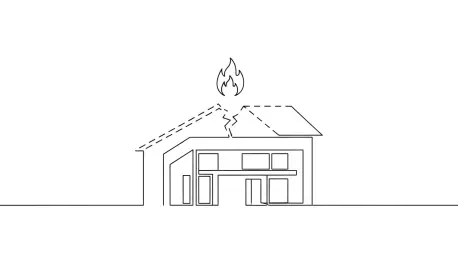

As climate change intensifies and wildfires grow more frequent and destructive, homeowners in vulnerable regions are finding themselves in an increasingly precarious position, with insurance becoming prohibitively expensive or, in some cases, completely unavailable. In response to this escalating crisis, Nevada has enacted a groundbreaking law, set to take effect on January 1, 2026, that fundamentally alters the relationship between insurers and policyholders. This legislation grants insurance companies the explicit authority to “unbundle” wildfire coverage from standard homeowners policies, allowing them to sell a base policy that excludes fire damage while offering a separate, standalone policy for that specific peril. This strategic pivot toward risk segmentation is designed to provide insurers with greater flexibility to manage their exposure to catastrophic events. However, it also raises urgent questions about affordability, consumer protection, and market stability, positioning Nevada as a crucial test case for the future of property insurance in a world of escalating climate risk.
This legislative maneuver in Nevada is not an isolated event but rather a formalization of a broader, well-established trend within the property insurance industry: the systematic separation of high-cost, high-severity catastrophe risks from standard all-peril homeowners policies. This model is already the established norm in several other high-risk markets across the country. In California, for example, earthquake coverage has long been sold as a separate policy, often through the state-created California Earthquake Authority. Similarly, in coastal regions of Texas and Florida that are frequently battered by hurricanes, windstorm coverage is commonly excluded from standard policies and offered separately, sometimes through mechanisms like the Texas Windstorm Insurance Association. By passing this law, Nevada is effectively adding wildfire to this growing list of perils deemed too volatile and costly to be automatically included in a standard insurance package. This underscores a consensus view among insurers that specialized, highly concentrated risks require a distinct underwriting and pricing structure to maintain market solvency and ensure their continued participation in high-risk areas.
A Tale of Two States: Legislative vs. Market-Driven Change
Nevada’s Proactive Legislative Path
The state of Nevada was uniquely positioned to enact such a decisive law primarily because it does not have a “standard fire policy” statute on its books. This absence of a legally mandated minimum for fire coverage gave its legislature the freedom to provide insurers with explicit statutory protection to exclude wildfire perils from standard homeowners policies, a move that would be legally impossible in many other states. The primary motivation behind this legislation appears to be market preservation. In the face of increasing wildfire risk, insurers operating in high-risk Nevada communities, such as those around Lake Tahoe like Incline Village and Stateline, had already begun to severely restrict their underwriting by non-renewing existing policies or refusing to write new ones. This new law provides these insurers with a crucial middle-ground option. Instead of exiting the market entirely, they can continue to offer homeowners insurance by offloading their most significant and unpredictable risk—wildfire—into a separate, specialized product with its own pricing and underwriting criteria.
However, this proactive approach creates a significant new challenge for the state’s residents. A critical difference between Nevada’s model and those in other states with similar risk-segmentation systems is the current lack of a residual market mechanism, such as a Fair Access to Insurance Requirements (FAIR) Plan. These plans typically function as an insurer of last resort, offering essential coverage to consumers who are unable to secure it in the private market. Without such a safety net for this newly separated wildfire peril, homeowners who are non-renewed or denied a standalone wildfire policy by private insurers may be left with no options at all. This creates the potential for a substantial coverage gap, where homeowners can secure a standard policy for risks like theft and water damage but remain completely uninsured for their single greatest threat, leaving them financially exposed to total loss in the event of a major wildfire. The success of Nevada’s new system will heavily depend on the private market’s willingness and ability to provide accessible and affordable standalone wildfire policies across all risk tiers.
California’s De Facto Unbundling
In stark contrast to Nevada’s direct legislative action, California’s insurance market has evolved into a functional equivalent through intense market pressure, despite laws designed to prevent it. California has a long-standing “standard fire policy” statute, which legally prohibits insurers from selectively excluding wildfire coverage from a homeowners policy. This legal barrier should, in theory, guarantee that every standard policy includes fire protection. However, as insurers have faced staggering wildfire losses over the past decade, they have increasingly withdrawn from high-risk areas, forcing the market to adapt in other ways. The result has been the transformation of the California FAIR Plan, a state-created but privately operated entity, from an insurer of last resort into one of the state’s largest property insurers. The FAIR Plan offers a bare-bones policy that typically covers only fire, lightning, and internal explosions, leaving homeowners to find other coverage elsewhere.
This market dynamic has created a complex and often more expensive two-policy system that has become increasingly common for residents in wildfire-prone regions. To obtain comprehensive protection equivalent to a standard homeowners policy, a consumer must first purchase the basic fire coverage from the FAIR Plan and then seek out a separate “difference in conditions” (DIC) policy from a private insurer. This second policy is necessary to cover essential protections not included in the FAIR Plan, such as liability, theft, and water damage. This two-policy structure is not only cumbersome for consumers to navigate but is also frequently more costly than a traditional, bundled policy. As of 2023, over 207,000 California households already relied on this arrangement, with major carriers like State Farm now actively directing some customers toward this model. This situation demonstrates how powerful market forces can effectively circumvent legislative intent, achieving the same risk segmentation seen in Nevada’s new law but through a more fragmented and less consumer-friendly process.
Navigating the New Landscape: Unanswered Questions and Future Hurdles
The Mortgage Lender Wildcard
A significant uncertainty hanging over Nevada’s new insurance landscape is how mortgage lenders will respond to the unbundling of wildfire coverage. The actions of these financial institutions will play a pivotal role in determining the consumer uptake of these new standalone policies. Lenders routinely and consistently require borrowers to purchase separate flood insurance for properties located in federally designated flood zones, making it a non-negotiable condition for securing a mortgage. Their approach to other perils, however, is far less consistent. For instance, despite the extremely high seismic risk in many parts of California, earthquake insurance is generally not required by lenders. Whether lenders will treat wildfire risk more like flood risk—a mandatory coverage in high-risk areas—or more like earthquake risk—an optional add-on left to the homeowner’s discretion—remains a pivotal open question. Their decision will heavily influence whether these new standalone wildfire policies become a standard part of real estate transactions or a niche product purchased only by the most risk-averse.
The path lenders choose will have profound consequences for both the insurance and real estate markets. If they decide to mandate separate wildfire policies for homes in high-risk areas, it will ensure broad consumer adoption and prevent the creation of large pockets of uninsured properties. However, this could also create significant affordability challenges, as the added cost of a standalone wildfire policy might push the total cost of homeownership beyond the reach of many buyers, potentially depressing property values in those areas. Conversely, if lenders do not mandate the coverage, it could lead to widespread underinsurance. Many homeowners, especially those on tight budgets, might opt to forgo the additional policy, creating a scenario where a single catastrophic wildfire could lead to mass mortgage defaults and devastating losses for the lenders whose collateral—the homes themselves—would be destroyed without any insurance proceeds to cover the outstanding loan balances.
Consumer Protection Gaps and Affordability
The shift toward unbundling insurance coverage, while offering a lifeline to insurers, introduces a significant risk for homeowners, a concern voiced by consumer advocates like Amy Bach of United Policyholders. The core issue is the potential for the creation of substantial “protection gaps,” leaving many households underinsured or completely uninsured for their most significant threat. As insurance premiums continue to rise, financially strained policyholders may be forced to make a difficult choice. Faced with the immediate pressure of a high premium for an optional wildfire policy, many may choose to forgo the coverage, gambling that a disaster is unlikely to strike them personally. This decision is often rooted in a common human tendency to underestimate low-probability, high-impact events, especially when weighed against more immediate and certain financial burdens. This could lead to devastating financial consequences for families and communities in the event of a major wildfire.
These individual decisions could aggregate into a widespread societal problem. When a large number of properties in a community are uninsured against wildfire, the consequences of a disaster extend far beyond individual financial ruin. The inability of uninsured homeowners to rebuild can lead to a cascade of negative economic effects, including a long-term decline in property values, an erosion of the local tax base that funds essential public services, and a slower, more painful recovery for the entire community. Furthermore, it shifts the immense financial burden of recovery away from the private insurance industry, which is designed to pool and manage such risks, and onto public resources, such as government disaster relief programs and taxpayer-funded aid. This effectively transforms what was once a matter of private risk management into a significant public policy challenge, threatening the economic resilience and social fabric of entire regions.
Balancing Market Stability and Coverage Adequacy
The new Nevada law is permissive, meaning it allows, but does not require, insurers to exclude wildfire coverage. However, experts anticipate that insurance companies with significant exposure in high-risk zones will likely take advantage of this option to de-risk their portfolios, mirroring the market reaction seen in California’s earthquake insurance sector following the destructive 1994 Northridge earthquake. The central challenge moving forward, for both state regulators and the insurance industry, is to strike a delicate balance between two competing goals: keeping private insurers solvent and actively participating in the market, while also ensuring that consumers have meaningful access to adequate and understandable coverage. The goal of insurer solvency is critical, as a widespread market exit could trigger a crisis in the real estate and mortgage sectors. Yet, this cannot come at the cost of leaving a large portion of the population unprotected from a growing threat.
The increasing unpredictability and ferocity of modern wildfires further complicated this balancing act. Climate change has challenged the very historical models that insurers use to define risk zones, calculate probabilities, and structure their products, making it more difficult to price risk accurately. For insurance professionals and regulators, this new reality, crystalized by Nevada’s legislation, demanded careful attention to several fronts. They recognized the need to monitor market participation closely, develop robust consumer education programs to help homeowners navigate complex multi-policy structures, and work proactively to understand the evolving requirements of lenders and the secondary mortgage market. The law marked a pivotal moment, forcing a confrontation with the fundamental tension between maintaining a stable private insurance market and fulfilling the essential public need for protection in an era of escalating climate-driven disasters.